

If you’ve shopped for coaching software before, you’ve probably noticed a pattern: the sticker price is never the price. Everfit, TrueCoach, and ABC Trainerize all price a base tier low (sometimes free) and then layer in charges for automation, payments, nutrition, or branding as a coach actually builds out a full business. It’s a pricing model built around foot-in-the-door: you sign up because the entry point looks affordable, and then the real cost of running your business on the platform reveals itself gradually, one add-on at a time.
This isn’t a quirk of one vendor. It’s the norm across the category. Reviewers on G2 and Capterra flag the same complaint about every major platform in this space, ours included: costs compound faster than expected once a coach scales past a couple dozen clients. That consistency is worth pausing on, because it means the problem isn’t which platform you pick. It’s that the entire category has trained coaches to expect a low headline price and then discover the real number later.
Why this happens everywhere
Client-count-based pricing makes intuitive sense: you pay more as your business grows, because a bigger roster means more usage, more storage, more support. That part isn’t the problem.
The problem shows up when the feature set also expands piecemeal alongside client count. A coach scaling from 10 clients to 50 isn’t just moving into a higher-priced tier. They’re also, in many cases, discovering that they now need automation to keep up with check-ins, native payments to stop chasing invoices manually, and maybe a custom-branded app to look credible to a growing roster of clients who expect a polished experience. Each of those is a new line item, priced separately, on top of the tier increase. None of it was hidden, exactly. It’s usually all listed on a pricing page somewhere, but very few coaches do the math on total cost-at-scale before they sign up, and that’s precisely the moment a platform’s real pricing structure becomes visible.
What “simple” pricing should actually mean
Simple doesn’t mean cheap. A platform can be expensive and still have simple pricing, if a coach can look at the page once and know, roughly, what they’ll pay at 10 clients, 50 clients, and 200 clients, including the features they’ll realistically need at each of those stages, not just the ones bundled into the cheapest tier to make the homepage number look good.
That’s a different standard than most pricing pages are built to meet today. Most are optimized to make the entry price look attractive to you before you’ve built out your business, not to help an established coach forecast their actual monthly spend a year from now.
That’s the standard we’re holding ourselves to with the Business add-on: rather than pricing scheduling, payments, referrals, and video coaching as four separate line items that a coach adds one at a time as their business matures, we bundled them into a single add-on. It doesn’t eliminate the “add-on” model entirely (we’re not claiming that), but it does mean a coach who needs those four capabilities is making one pricing decision instead of four, and seeing one number instead of a slowly growing list.
A worked example
Say a coach is comparing platforms and currently has 10 clients, but expects to be at 50 within a year, offering nutrition coaching and needing automated check-ins along the way. The naive comparison most coaches run is: “what does the 10-client tier cost on each platform?” That’s the wrong comparison. The right one is: “what will I actually be paying once I’ve added the nutrition, automation, and payment features I know I’ll need at 50 clients?”
Run that math, and the comparison looks different than the entry-tier price suggests. Here’s what that actually costs today, using each platform’s own published pricing for a 50-client roster with nutrition/meal planning, automated check-ins, and payment processing:
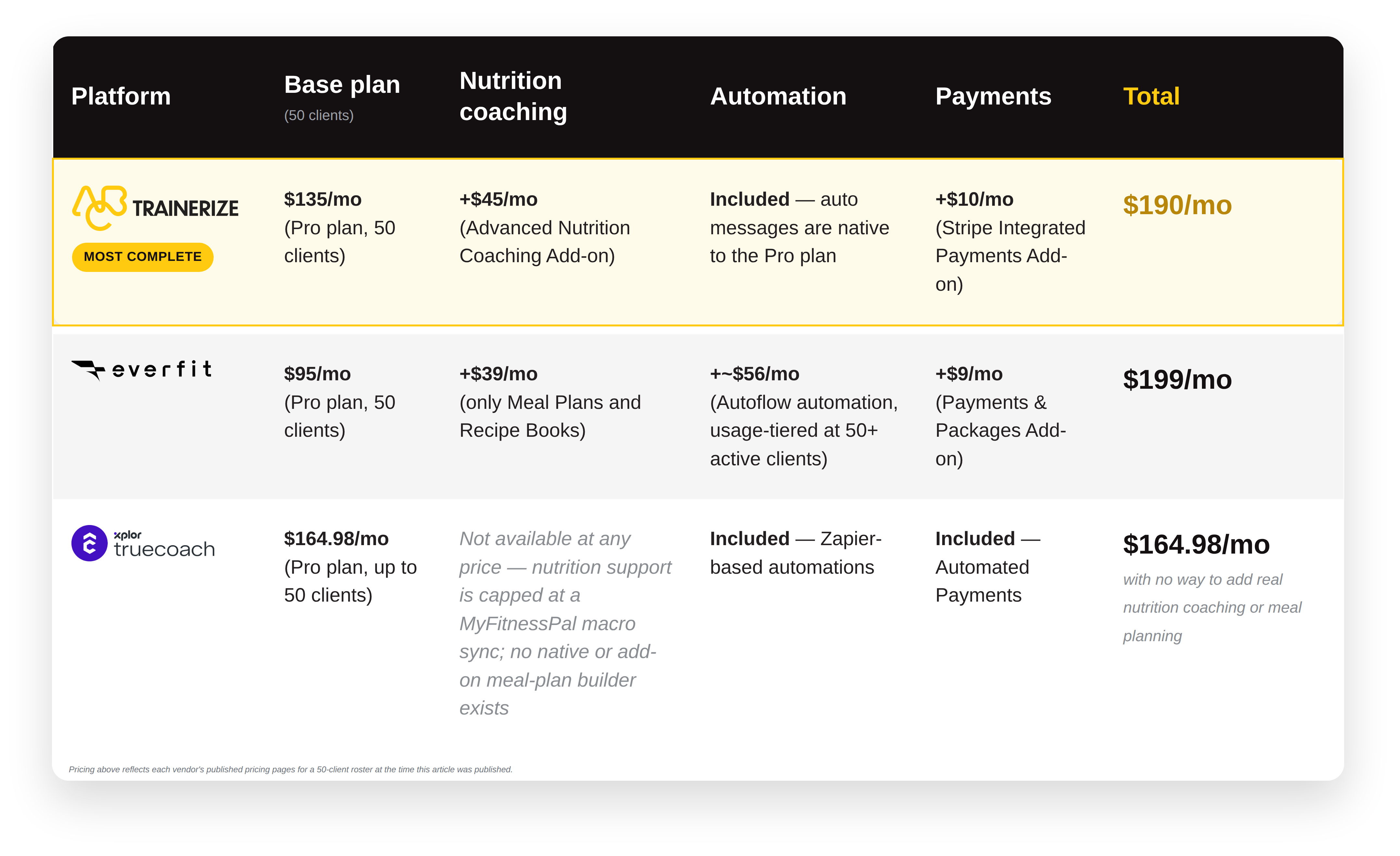
Line up the platforms you’re evaluating like this and the story flips. If you look only at just the base plan, Everfit looks like the cheaper choice – $95/mo versus Trainerize’s $135/mo, a $40 gap that would win the decision for anyone comparing sticker prices alone.
But once you add the same three capabilities a coach at 50 clients actually needs: nutrition coaching, automation, and payments, ABC Trainerize comes out ahead: $190/mo total versus Everfit’s ~$199/mo, because Everfit’s automation and meal-plan add-ons cost more than the entire head start its base price gave it.
TrueCoach still comes out cheapest at $164.98/mo month-to-month (its $136.99 headline is the annual-billing rate, not month-to-month, so that’s the number to compare fairly against the other two), but only because one of those three capabilities (an actual meal-plan builder) isn’t for sale on that platform at any price. That’s a meaningfully different situation than “TrueCoach is the budget option”: if nutrition coaching matters to your business, you’re not saving money by choosing it, you’re going without a feature entirely, regardless of what you’re willing to pay.
Run this same exercise with the specific features you need across every platform you’re considering. In many cases, the platform that looked cheapest at the entry tier ends up costing about the same, or more, once every add-on a growing coach actually needs is factored in. That’s because the low headline number was never really the comparison that mattered.
If Everfit specifically is your main alternative you’re weighing, we’ve run this comparison in more depth in Trainerize vs. Everfit Pricing: Which Platform Is Built for Growth?
Three questions to ask before you sign up
- What does this platform cost at your target client count, not today’s? Run the math at 25, 50, and 100 clients before comparing sticker prices, using the features you’ll actually need at each stage, not just the ones included in the free or entry tier.
- How many separate add-ons will you likely need within a year? Automation, nutrition, payments, and branding are common needs for a growing coaching business, not edge cases. Price them in from the start rather than discovering them one at a time.
- Does the platform bundle related features, or price each one separately? Four separate $20-30 monthly add-ons adds up differently, and creates a different renewal/cancellation experience, than one $25 bundle covering the same ground.
Weighing more than these three platforms? See our full roundup of Trainerize alternatives and competitors to run the same math against the wider field.
FAQ
Why does coaching software pricing feel like it keeps going up?
Most platforms price a low entry tier, then gate features like automation, nutrition, and payments behind separate add-ons that a growing coaching business tends to need one at a time, so the total cost climbs even though the base tier didn’t change.
What should I actually compare when shopping for coaching software?
Compare projected total cost at your target client count with the specific features you’ll need and not just the cheapest entry-tier price, which rarely reflects what a growing business ends up paying. It’s exactly why we built the Business add-on to bundle the most commonly-needed features into one line item instead of several.
Does ABC Trainerize have add-ons too?
Yes, Business, Advanced Nutrition Coaching, Video Coaching, Stripe Integrated Payments, and Custom Branded App are each separately priced. The Business add-on specifically bundles four commonly-needed capabilities (scheduling, payments, referrals, video) into one line item instead of four.
See what your real monthly cost looks like — check current Trainerize pricing and try it free for 30 days, no credit card required.