When you’re managing 15+ clients without a personal trainer CRM platform, admin starts eating your actual work hours. Follow-ups slip, onboarding varies for each new client, and billing turns into a manual chase at the end of a long day.
This isn’t the best personal training software guide. It covers the CRM layer specifically, meaning how you track, communicate with, and retain clients across their full lifecycle.
We reviewed 10 tools across fitness-native platforms, health coaching tools, and general business CRMs to help you find the right fit.
| The best CRM for personal trainers comes from a fitness-native platform, not a general business tool. General CRMs don’t have exercise libraries, client profiles, or built-in progress tracking.
ABC Trainerize covers all three and manages the full client lifecycle from onboarding to retention. Health coaches who need HIPAA compliance may prefer Practice Better, while sales-focused trainers lean toward HubSpot. |
Key Takeaways
- Fitness-native platforms cover exercise libraries, client profiles, and program delivery. General CRMs don’t, and that gap affects your coaching day.
- GetApp reviewers rank exercise library (89%), client profiles (84%), and program delivery (83%) as their top priorities. General CRMs cover none of these natively.
- The deciding variable is your coaching model, not the feature list. Fit the platform to how you actually coach.
What Personal Trainers Actually Need from a CRM
Most CRM comparisons list features without telling you which ones trainers actually open daily. GetApp data shows 84% of trainers prioritize client profiles, 83% rate workout and program delivery as a must, and 76% require built-in payment processing.
Add in-platform communication and a client progress tracking dashboard, and you’ve got the five capabilities that matter most when onboarding new fitness clients at scale. General CRMs cover communication and payments well enough, but fitness-native platforms cover all five.
Best CRM for Personal Trainers: Quick Comparison
Not every platform here is fitness-native, and that distinction shapes which one fits your business.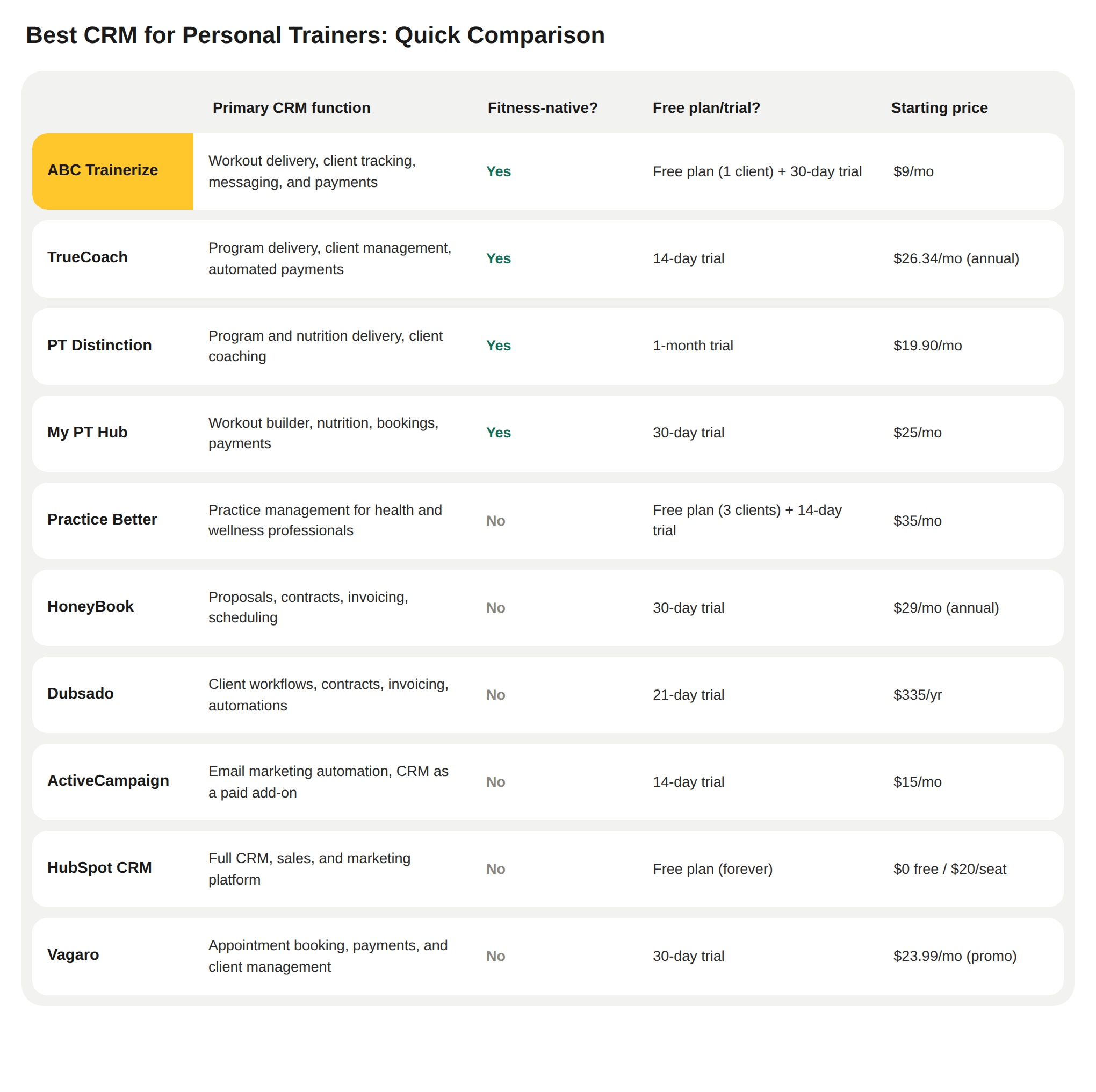
Best CRM for Personal Trainers: Full Reviews
These platforms address different parts of the trainer’s client management workflow, from coaching delivery and progress tracking to business admin and email automation. Some are fitness-native; others are general CRM trainers who adapt for the job.
1. ABC Trainerize
ABC Trainerize is a fitness-native CRM for independent trainers and online coaches. It combines client profiles, workout delivery, habit tracking, in-app messaging, and billing so you can manage 10 to 100+ clients without switching tools.
Key Features
- Client profiles and progress data
- Automated check-ins and re-engagement nudges
- Progress photo and measurement tracking
- In-app messaging with scheduled auto-messages
- Stripe billing for packages and memberships
- Wearable sync: Apple Health, Fitbit, Garmin, Withings
Pros
- Covers coaching and CRM in one platform
- Scales through automation without extra admin
- G2 reviewers highlight auto-messaging as a standout strength
Cons
- Lighter on lead pipeline than dedicated sales CRMs
- Some Capterra reviewers report extra onboarding time for older clients
Pricing: Free plan. 30-day trial at trainerize.com.
Best for: Independent trainers managing 10-100+ clients.
2. TrueCoach
TrueCoach is a fitness-native platform for delivering clean programs and communicating with clients. It centers on the coaching layer with a workout builder, real-time messaging, habit tracking, and a compliance dashboard.
Key Features
- Workout builder with 3,500+ exercise videos
- Client mobile app (iOS and Android)
- Real-time in-app messaging with media support
- Compliance dashboard with 7, 30, and 90-day rates
- Custom habit tracking per client
- MyFitnessPal integration for nutrition tracking
Pros
- Intuitive interface coaches and clients pick up quickly
- Compliance monitoring flags at-risk clients before they go inactive
- G2 reviewers consistently praise program creation speed and ease of use
Cons
- Lighter on billing, lead management, and automation
- Some Capterra reviewers note limited payment processing availability
Pricing: From $26.34/mo (annual). 14-day free trial.
Best for: Trainers focused on 1:1 coaching over full business management.
3. PT Distinction
PT Distinction is a fitness-native platform built for data-driven trainers who want deep workflow control. It combines client journey automation, habit coaching, and customizable check-ins, with every feature included on every plan.
Key Features
- Client journey builder with automation rules
- Daily habit coaching and adherence tracking
- Pre-scheduled email, SMS, and in-app messages
- Branded app included on all plans
- Program builder with group delivery support
Pros
- All features on every plan, no add-on fees
- Automation depth suits coaches running structured client lifecycles
- Capterra reviewers (4.9 stars, 443 reviews) consistently praise the habit and automation tools
Cons
- Steeper learning curve than simpler platforms
- Some users report a less polished mobile experience
Pricing: From $19.90/mo. 1-month free trial.
Best for: Data-driven trainers who want deep automation and all features without paying extra.
4. My PT Hub
My PT Hub is a fitness-native platform for coaches who want workout programming, nutrition tracking, scheduling, and client communication in one app. Unlimited clients on flat-rate plans make it practical for coaches scaling past 20 active clients.
Key Features
- 8,000+ exercise video library
- Nutrition tracking with 650,000+ food database
- Client mobile app (iOS and Android)
- Session scheduling and calendar booking
- Compliance monitoring and custom progress reports
Pros
- Unlimited clients on flat-rate plans
- Covers coaching, nutrition, scheduling, and payments in one app
- Capterra reviewers (4.6 stars, 3,164 reviews) cite value for money as a standout strength
Cons
- Lighter on automation than more feature-dense platforms
- Some Capterra reviewers note that certain features feel clunky
Pricing: From $25/mo. 30-day trial.
Best for: Coaches who want solid fitness features and unlimited clients at a flat rate.
5. Practice Better
Practice Better is a health coach CRM for nutritionists and wellness practitioners who need HIPAA-compliant records and telehealth. It suits trainers at the fitness-health crossover, but it lacks a workout builder, so pair it with a dedicated fitness platform.
Key Features
- HIPAA-compliant client records and secure messaging
- Built-in telehealth, no third-party tool needed
- Client intake forms and care plans
- Food journal with 600,000+ food items
- Session scheduling with automated reminders
Pros
- HIPAA compliance is included in every plan
- Combines telehealth, scheduling, billing, and client records
- Capterra reviewers praise the all-in-one practice management tools
Cons
- No workout builder or exercise library
- Some Capterra reviewers note slow support response times
Pricing: Free plan available. From $35/mo.
Best for: Nutrition coaches and wellness practitioners who need HIPAA-compliant records.
6. HoneyBook
HoneyBook is a client relationship platform for service businesses covering contracts, invoicing, automated workflows, and scheduling. It has no native fitness features, so it serves as a business admin layer alongside your coaching platform.
Key Features
- Contracts and invoices with e-signatures
- Automated workflows triggered by client actions
- Recurring payments with automatic reminders
- Client self-booking and scheduling
- Client portal for files and payments
Pros
- Polished client journey from inquiry to payment
- Workflow automation cuts manual follow-up
- G2 reviewers (4.4 rating) cite the contract-to-payment flow as a standout strength
Cons
- No exercise library, workout delivery, or progress tracking
- Some Capterra reviewers note pricing increases as a concern
Pricing: From $29/mo (annual). 30-day trial.
Best for: Trainers who need solid contracts and client admin, all in one place, alongside a fitness platform.
7. Dubsado
Dubsado is a service-based platform with advanced workflow automation, form-building, invoicing, and scheduling tools for trainers who want full control over their client operations. It demands significant setup time and isn’t plug-and-play, but rewards the investment with automation capabilities most service CRMs can’t match.
Key Features
- Customizable workflow automation
- Branded form and contract builder
- Invoicing with payment plans and auto-reminders
- Appointment scheduling with booking links
- Client portal with documents and payment
Pros
- Deeper automation than most service business CRMs
- All-in-one for proposals, contracts, invoicing, and scheduling
- G2 reviewers praise the workflow and contract-to-payment tools
Cons
- No fitness-native features or workout delivery
- Capterra reviewers give ease of use 3.6/5
Pricing: From $335/yr. 21-day trial.
Best for: Trainers who want deep workflow control and don’t need fitness-native features.
8. ActiveCampaign
ActiveCampaign combines marketing automation and CRM into a single platform, covering email sequencing, segmentation, lead scoring, and deal pipelines. Personal trainers get the most from it as a lead nurturing layer alongside a fitness platform, not as a standalone coaching CRM.
Key Features
- Email sequence automation with behavioral triggers
- Contact segmentation by behavior and engagement
- AI-powered lead scoring
- CRM deal pipeline management
- 1,000+ integrations, including Zapier
Pros
- Automation depth and segmentation are among the strongest available
- CRM and email work from one contact record
- G2 reviewers (4.5 stars, 14,500+ reviews) consistently praise automations and segmentation
Cons
- No workout delivery, progress tracking, or scheduling
- Some Capterra reviewers flag pricing as steep for solo coaches
Pricing: From $15/mo (annual). 14-day trial.
Best for: Trainers running active lead funnels who already use a fitness delivery platform.
9. HubSpot CRM
HubSpot CRM is a general CRM with a free tier covering contact management, deal pipelines, and email tracking. Trainers use it best as a lead-management layer alongside a fitness-delivery platform.
Key Features
- Contact management with deal pipeline tracking
- Email tracking and basic outreach tools
- Deal stages and lead activity timeline
- Basic automation (free tier limited)
- 1,000+ integrations, including Zapier
Pros
- Genuine free tier with no expiration date
- Scales from free to paid without switching platforms
- Capterra reviewers (4.5 stars, 4,400+ reviews) praise pipeline clarity and ease of use
Cons
- No fitness-native features or workout delivery
- Free plan caps at 1,000 contacts; automation requires upgrade
Pricing: Free plan available. Starter from $15/seat/mo (annual).
Best for: Trainers wanting a structured lead pipeline with a separate fitness delivery tool.
10. Vagaro
Vagaro is a booking and business management platform for fitness studios covering class scheduling, membership billing, and marketing tools. Studio trainers and gym owners get the most from it, since its CRM depth for individual coaching is lighter than fitness-native platforms.
Key Features
- Class and appointment scheduling
- Membership and package management
- Marketing automation with email and SMS
- POS and payment processing
- Staff scheduling and commission tracking
Pros
- Handles scheduling, memberships, payments, and marketing in one place
- Built for multi-staff fitness studios with class management
- Capterra reviewers (4.7 stars, 3,479 reviews) consistently praise scheduling and ease of use
Cons
- Lighter on individual coaching relationship management
- Some Capterra reviewers flag add-on costs
Pricing: From $23.99/mo (promo). 30-day trial.
Best for: Studio trainers and gym owners who need scheduling, memberships, and marketing in one place.
How We Evaluated These CRM Platforms
With dozens of platforms claiming to be the best CRM for personal trainers, the most important question isn’t which has the longest feature list but whether the platform fits how you actually coach.
We started by checking fitness-native depth. General CRMs don’t natively handle exercise libraries, client profiles, or program delivery, and that matters at scale. From there, we looked at client relationship management. A platform that stores contacts without tracking check-ins, progress, and history doesn’t manage relationships.
Strong follow-up depends on automation, so we scored each platform’s performance in onboarding, billing reminders, and re-engagement. Manual follow-up doesn’t hold past 15 clients.
Since most trainers use multiple tools, integration fit matters. We checked how each platform connects to payment, scheduling, and marketing systems. Finally, we weighted setup speed. A CRM that takes weeks to configure won’t help you right now.
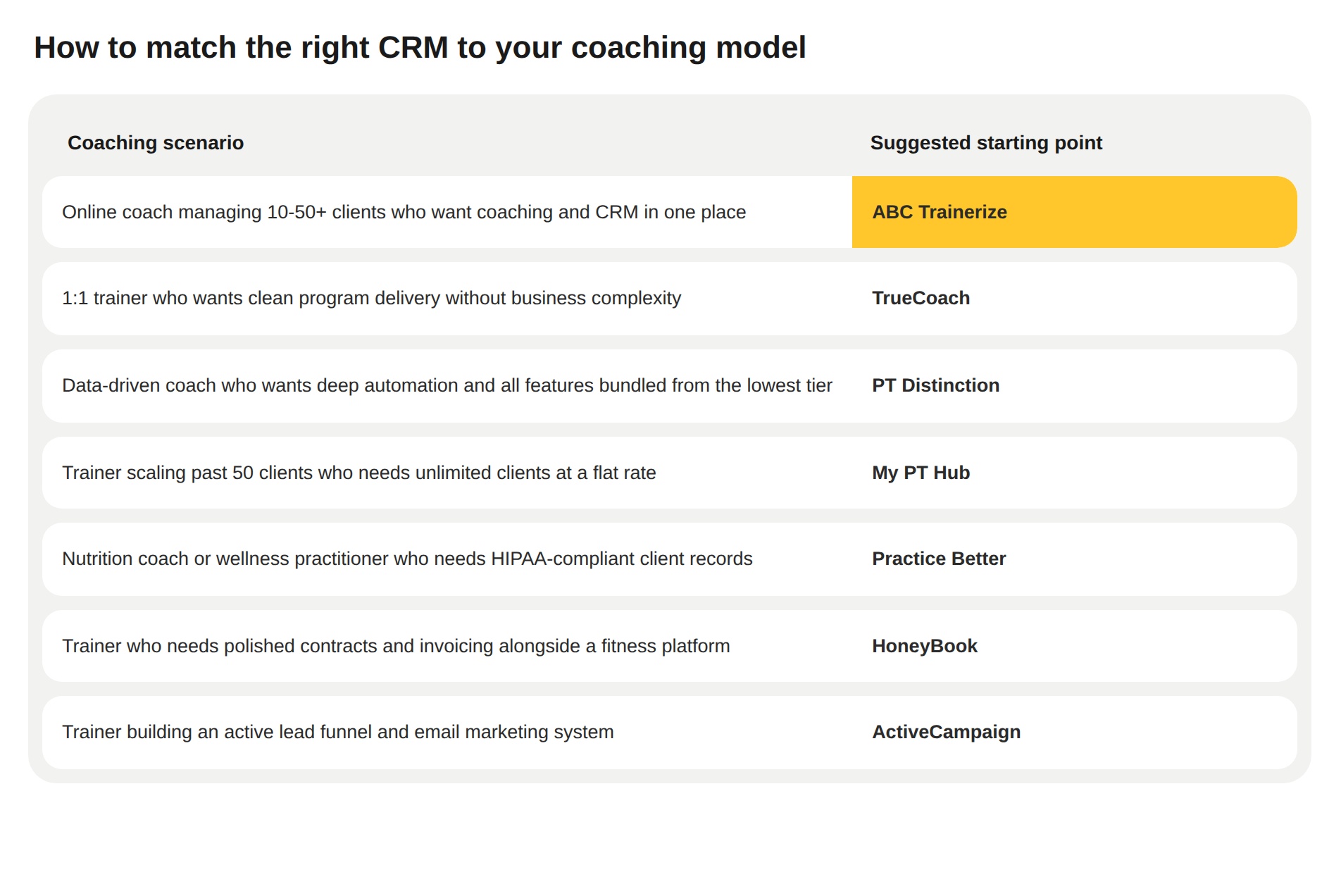
How to Match the Right CRM to Your Coaching Model
Knowing how to grow a personal training business starts with matching your tools to your coaching model.
Why Most CRM Investments Underdeliver, and How to Fix It
A CRM is only as useful as the habits built around it. Most trainers who abandon their system do so within 90 days, not because the tool failed, but because setup came without a workflow.
These are the four patterns that cause it:
- Choosing on features, not workflow fit. A platform that looks good on a spec sheet but doesn’t align with how you coach creates friction, not support.
- Skipping initial configuration. An unconfigured system becomes a $30/month to-do list that nobody opens.
- Keeping billing and communication separate. When those two functions don’t live in the same place, manual work fills the gap between every client interaction.
- Treating it as a contact database. A CRM should drive automated follow-up sequences, track client progress, and flag clients who are going inactive before they disappear.
Ready to Build a Coaching Business That Runs on Systems?
If you’re managing clients across multiple apps, you’re spending time on admin that a single system would handle automatically. ABC Trainerize combines the CRM and coaching delivery layers into a single platform, so you’re not stitching five different tools together to manage a single client relationship.
Start your free Trainerize trial and see how many hours you get back in your first week.
Frequently Asked Questions
What is a CRM for personal trainers?
A CRM for personal trainers is a platform that centralizes client information, communication, payments, and follow-up activities. As a result, trainers can manage relationships more consistently without relying on spreadsheets or disconnected tools. Many fitness-specific platforms also include workout delivery, progress tracking, and mobile client experiences alongside traditional CRM functionality.
Do personal trainers need a CRM?
Personal trainers benefit from a CRM once they manage more than 10–15 active clients. While smaller client rosters can often be handled manually, growth quickly increases the risk of missed follow-ups, inconsistent onboarding, and administrative bottlenecks. A CRM creates repeatable processes that improve both efficiency and client retention as a business scales.
What’s the difference between personal training software and a CRM?
The main difference between personal training software and a CRM is that personal training software focuses on coaching delivery, while a CRM focuses on relationship management. Coaching platforms handle workout programming, progress tracking, and client engagement tools. In contrast, a CRM centralizes client records, communication history, billing, and automated follow-up, although many modern fitness platforms now combine both functions.
Can I use a free CRM like HubSpot for personal training?
Yes, a free CRM like HubSpot can effectively manage the business administration side of a personal training practice. It helps organize contacts, track leads, and automate email follow-up, which supports client acquisition and relationship management. However, because it lacks workout programming, exercise libraries, or progress tracking, trainers typically need a separate coaching platform to deliver services.
What features should a personal trainer CRM include?
A personal trainer CRM should include client profiles, communication tools, workout delivery, progress tracking, and automated billing. These features create a complete system that supports both coaching and business operations. Additionally, trainers consistently prioritize exercise libraries, client records, program creation tools, and payment processing because they directly impact service quality and operational efficiency.
How should a personal trainer build a CRM stack?
Build a CRM stack by starting with a fitness-focused platform that handles client management, coaching delivery, communication, and payments within a single system. This approach reduces complexity while keeping daily operations centralized. If advanced lead nurturing or email marketing becomes necessary, then adding a dedicated CRM such as HubSpot or ActiveCampaign can fill those specific gaps without creating unnecessary software overlap.