

Let’s start on point: the key factor in client retention, engagement, and long-term results is offering the best client mobile experience personal training app users can rely on. That means finding the app your clients will actually open on a rainy Monday morning, when they’re not in the mood at all.
Most software reviews compare admin tools, billing integrations, and workout builders. But between coaching sessions, your client isn’t looking at your backend dashboard. They are interacting with the mobile interface on their phone.
When you are scaling past 20 or 30 active clients, you can no longer hand-hold every individual through personal text messages or manual email check-ins. At this growth stage, your mobile app becomes the primary medium for your coaching service. If the client experience feels clunky or confusing, client engagement drops, adherence slips, and churn rises quietly.
Why the Client’s Side of the App Is the Real Test
A feature-rich trainer dashboard provides little value if the client-facing side causes friction. In fact, once your client list grows beyond solo capacity, the mobile application carries your accountability structure and brand presence between face-to-face or digital coaching sessions.
Client retention depends heavily on continuous engagement. According to IHRSA health club industry research, re-engaged members who receive targeted digital outreach are 45% less likely to cancel their memberships. Additionally, a cross-sectional study published in JMIR mHealth and uHealth examining fitness app users revealed that consistent digital training logging directly correlates with higher long-term adherence and goal attainment.
Therefore, when your app simplifies workout execution, your clients build lasting habits. As fitness coach and personal trainer Sean Currey notes in his ABC Trainerize customer story, relying on Trainerize serves as “the fundamental key to the backbone of my services.” Specifically, it directly drives higher client retention rates and allows coaches to scale offer tiers without sacrificing accountability.
Workout Logging and Progress Tracking Clients Will Actually Use
To maintain high adherence, logging a workout must feel effortless. Indeed, if logging sets, reps, or weights requires navigating multiple deep menus, clients stop recording their workouts.
The best client mobile experience personal training app minimizes interaction friction by offering:
- Seamless In-Workout Logging: One-tap set completion, automatic rest timers, and simple input fields for weight and repetitions.
- Integrated Video Demos: Embedded exercise demonstrations so clients never have to leave the app to search for proper exercise form.
- Visual Progress Records: Easy access to historical personal records (PRs), workout volume trends, and body metrics.
- Side-by-Side Progress Photos: Secure photo uploads allowing clients to visually track body composition changes over time.
For a deeper look into structuring metric tracking effectively, explore our guide on Client Progress Tracker: Essential Tool for Personal Trainers.
Communication and Reminders That Keep Clients Showing Up
Scattershot communication across WhatsApp, SMS, and email causes lost messages and missed updates. A unified client app consolidates all coaching touchpoints into a single, professional hub.
Key client communication features include:
-
Centralized In-App Messaging: Direct text and voice messaging kept within the workout environment.
-
Automated Reminders & Push Notifications: Timely alerts for scheduled workouts, daily habits, and scheduled check-ins.
-
Integrated Session Booking: Enabling clients to view availability and book or reschedule training sessions directly in their calendar view.
Automating touchpoints ensures clients receive timely support without consuming all your administrative hours. To learn how to streamline outreach while retaining authenticity, read AI for Client Check-Ins: Automate Without Losing the Personal Touch.
What Makes a Great Personal Training App: The Role of Custom Branding and Community
Generic fitness apps make clients feel like they are paying for software rather than expert coaching. On the other hand, custom branding grounds the digital experience in your specific business identity.
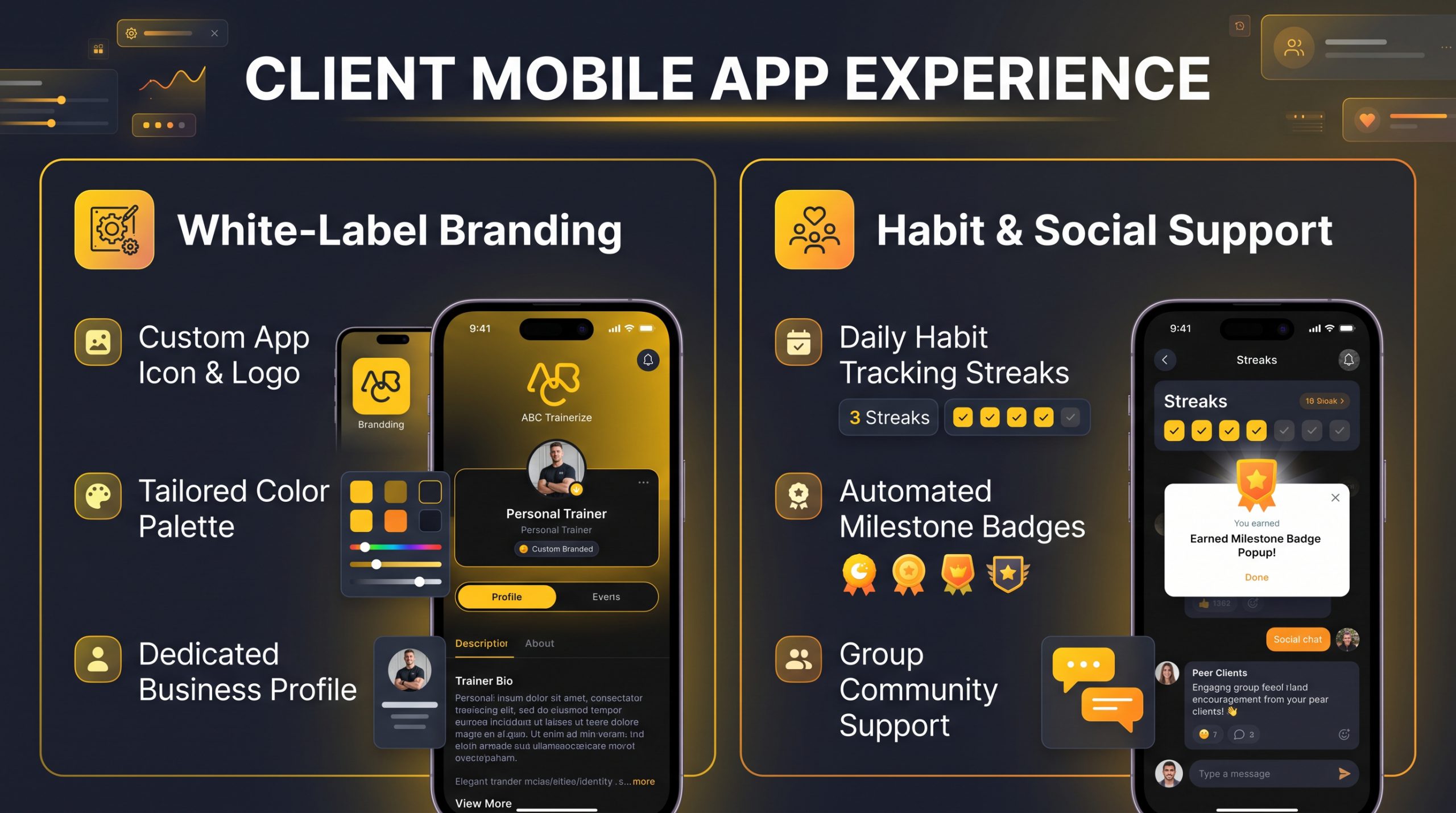
When an app features your logo, custom color scheme, and brand identity through white-label customization in ABC Trainerize, it reinforces the value of your services every time the client unlocks their phone. Combining custom branding with community features—such as habit tracking, workout streaks, and group message boards—creates a supportive environment that lowers client drop-off.
To learn more about strategies for keeping your clients engaged long-term, read our detailed analysis on Client Attrition: Retaining Clients Beyond Fitness Challenges.
Discover more real-world results on our Trainerize Customer Success Stories hub, or explore broader platform comparisons like The Best Health Coach Apps In 2026 and Best Personal Trainer Scheduling Software in 2026.
FAQs — Client Mobile Experience in Personal Training Apps
What should clients be able to do in a personal training app?
Clients should be able to view their workout schedule and log sets, reps, and weights in real-time. Additionally, they need to view exercise video demos, track habits and nutrition, upload progress photos, message their trainer, and book training sessions directly through Trainerize.
Does a better client app experience actually improve retention?
Yes. Because lowering friction in workout logging and check-ins increases app adherence, helping clients build consistent habits and achieve measurable results. Research indicates that engaged clients who receive regular digital check-ins are up to 45% less likely to cancel.
What’s the difference between a trainer-facing and a client-facing app experience?
A trainer-facing dashboard focuses on administrative tasks, programming tools, payment processing, and roster management. The client-facing mobile interface prioritizes quick workout execution, clear exercise videos, habit logging, and direct messaging with their coach.
How much should branding matter in a client’s app experience?
Custom white-label branding replaces generic platform logos with your own business branding. As a result, this reinforces your authority as a premium coach and increases client trust and brand recall every time they open the application.
Ready to elevate your client experience?
Start for free with ABC Trainerize today