
You just landed a new personal training client. Congratulations!
You’ve mapped out their goals, blocked off time in your schedule, and you’re ready to get to work.
But before the first session starts, there’s one step that often gets rushed or treated as a checkbox: putting a contract in place.
Many trainers already use tools like PandaDoc or DocuSign, or customize Terms and Conditions through in-app payment systems such as Stripe-integrated payments. That’s a great start, but what’s in that contract matters just as much as having one. For full legal protection, a formally signed agreement is always the stronger choice.
The good news? You don’t need to start from scratch. Whether you’re creating your first contract or tightening up an existing one, this guide will help you protect yourself and your business.
Key Takeaways
- A written contract protects both you and your clients by setting clear expectations from day one.
- Every trainer contract should include eight essential clauses covering services, payments, cancellations, liability, confidentiality, and termination.
- Customize templates to your specific services, location, and business model, then have a lawyer review before use.
Why Every Personal Trainer Needs a Written Contract
Here’s a scenario that plays out far too often: A client stops showing up after three sessions but disputes the charge for their prepaid package. You don’t want to get stuck in a “he said, she said” situation. This could happen to you without a contract. Always have documentation to support your case.
Contracts solve this problem and many others. They reduce dispute risks by putting everything in writing before issues arise. They establish professionalism. Just like a polished website or a well-written personal trainer bio, a contract signals that you run a real business. Not a casual side hustle. And when things go sideways, it gives you legal protection.
But contracts aren’t just about protection. They benefit clients, too. Clear agreements set professional boundaries and manage expectations so everyone knows exactly what they’re getting.
“But I train friends and family!” Even more reason to have a contract. Money and relationships get complicated fast. A simple agreement keeps business separate from personal connections and prevents awkward conversations down the road.
8 Essential Clauses Every Personal Trainer Contract Must Include
Contracts can vary, but these eight clauses form the core of a strong personal training agreement. Think of them as the framework you’ll build everything else on. Keep in mind, though, that legal requirements can also differ by country, state, or region.
It’s important to research your local laws or consult a legal professional to ensure your contract complies with the laws where you operate.
- Identification and Contact Information: This section of the contract establishes who’s bound by the contract and when it takes effect. Both parties’ full names, addresses, contact details, and effective date are all specified here.
- Scope of Services: This clause defines the scope of training services, including session length, frequency, location, and what’s included. Equally important: state what’s not included to prevent scope creep.
- Payment Terms and Fees: Clear pricing, billing schedules, and accepted payment methods help establish clear payment expectations and protect your cash flow.
- Cancellation and No-Show Policy: This outlines cancellation procedures, notice requirements, and fees for late cancellations or missed sessions.
- Liability Waiver and Assumption of Risk: This essential clause documents informed consent, acknowledging that clients understand these risks and release you from liability for injuries (within legal limits).
- Confidentiality and Privacy: This clause explains how you’ll protect their data and whether you’ll use any content for marketing purposes.
- Termination Terms: This clause establishes termination rights, explaining how either party can end the agreement and what happens to unused sessions.
- Dispute Resolution: Specify how disputes will be handled (mediation, arbitration, or legal action) and which jurisdiction’s laws apply.
Quick Start Personal Trainer Contract Template (Lite Version)
The fastest way to understand contract templates is to read the actual language used in a professional agreement. Below, you’ll see sample clauses first, followed by a complete, clean version of the contract. A Google Doc template is available so you can easily make a copy and customize it for your business.
Sample Clause 1 (Services Agreement): “Trainer agrees to provide Client with [NUMBER] personal training sessions per [WEEK/MONTH], each lasting approximately [DURATION] minutes. Sessions will take place at [LOCATION] and include exercise instruction, form correction, and workout programming.”
- Why it works: Specific details clarify the trainer-client relationship and prevent misunderstandings.
Sample Clause 2 (Payment Terms): “Client agrees to pay $[AMOUNT] per session, due [PAYMENT TIMING]. Payments may be made via [PAYMENT METHODS]. Late payments may result in suspended sessions.”
- Why it works: Clear payment language establishes expectations upfront and reduces the chance of delayed or disputed payments.
Sample Clause 3 (Cancellation Policy): “Client must provide at least [24/48] hours’ notice to cancel or reschedule a session. Sessions canceled with less than the required notice will be charged as completed.”
- Why it works: This protects your time and income while still giving clients a fair window to reschedule when needed.
Sample Clause 4 (Liability Waiver): “Client acknowledges that physical exercise involves inherent risks and voluntarily assumes all such risks. Client releases Trainer from liability for injuries that may occur during training, except in cases of gross negligence.”
- Why it works: This clause documents risk awareness and informed consent, both of which are essential for any fitness professional.
Below is a preview of how clauses will come together in a single, streamlined agreement.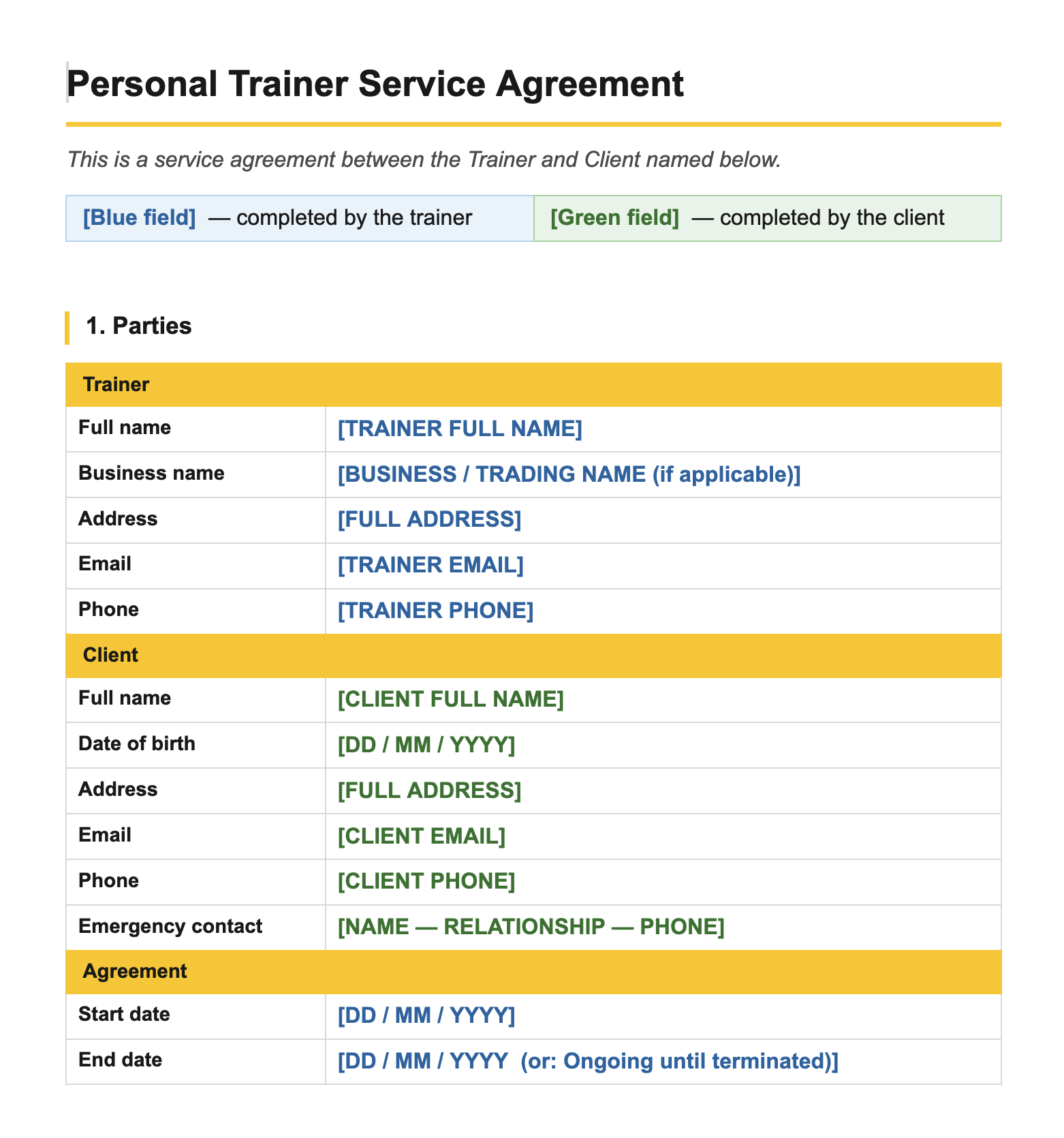
Download Now: Access Your Free Contract Template Here
Remember: Customize the bracketed sections to reflect your specific services, pricing, and policies. Then, have a legal professional in your region review it before using it with clients.
For a more comprehensive version, consider using contract management software with built-in templates designed specifically for fitness professionals.
Different Types of Personal Training Contracts
A bootcamp coach, an online trainer, and a gym-based personal trainer all need contracts. But not the same one. Which clauses matter most? How should you structure clauses? This depends on your business model and priorities.
Independent Personal Trainer Client Agreement: Best for self-employed trainers working directly with clients. This type of contract covers everything since you’re running the business on your own.
Gym-Based Personal Trainer Contract: Used when you train clients through a gym or fitness facility. These agreements usually explain how income is split and who owns the client relationship. Plus, what rules you’re expected to follow.
Online Personal Training Agreement: Designed for remote or virtual coaching. These contracts address technology use, communication methods, and liability for unsupervised training.
Group Training Contract Template: For bootcamps or small group sessions. These are often simpler than one-on-one contracts but should still clearly state class sizes, schedules, and how sessions are run.
Choosing the Right Contract Solution: Templates vs. Software vs. Lawyers
Some trainers need something fast and simple, while others require more structure as they grow or take on higher-risk clients. But the right choice depends on where you are in your business journey.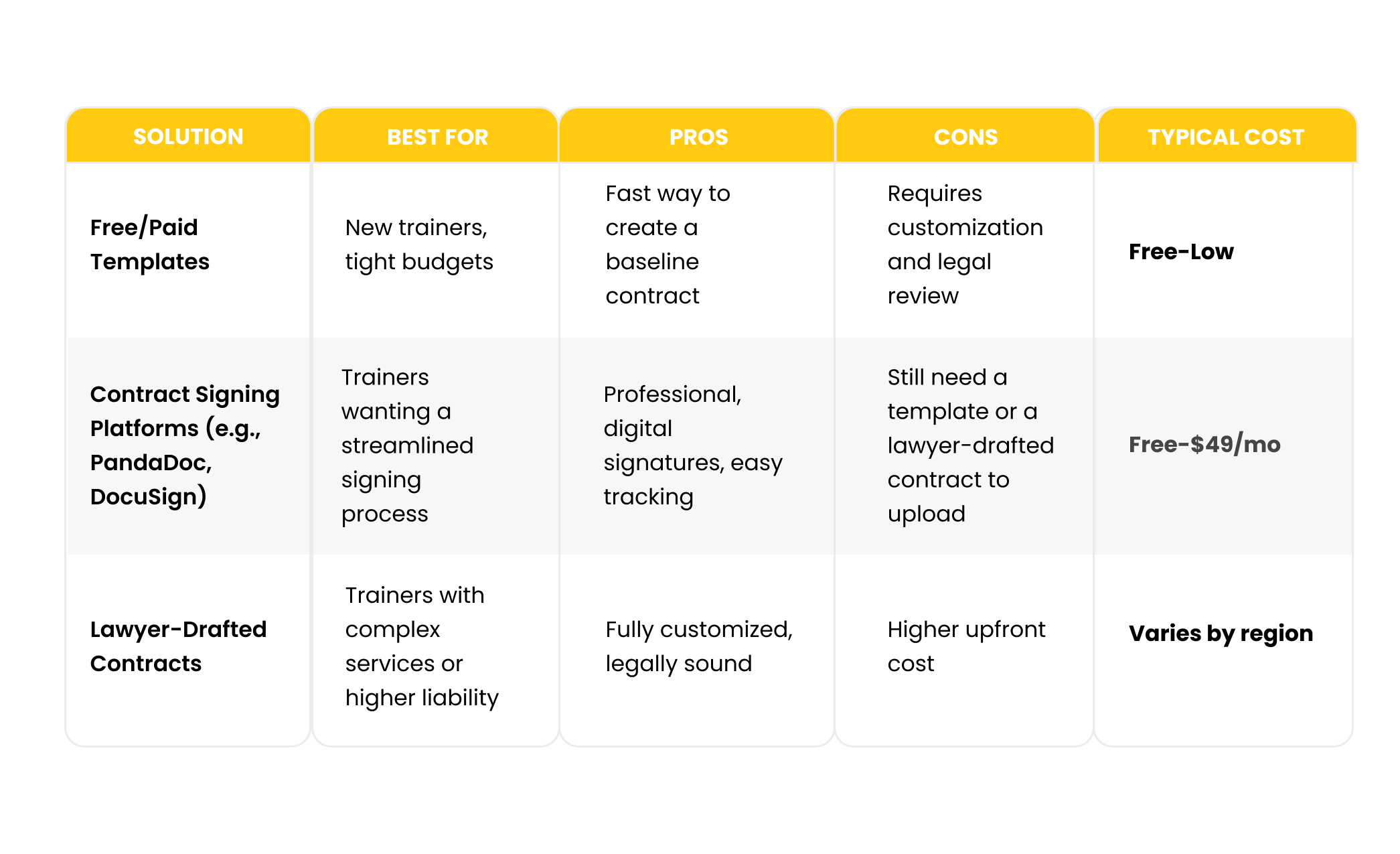
Where does ABC Trainerize fit in?
ABC Trainerize isn’t a contract tool, but the platform that powers everything after the agreement is signed. Once your client signs via PandaDoc or a printed agreement, ABC Trainerize helps you onboard them seamlessly, deliver workouts, process payments, and manage your entire coaching business.Many trainers include a link to their contract or a PDF in their Trainerize welcome email to keep the onboarding flow smooth.
How to Customize Your Personal Trainer Contract Template
Never be treat a template as a plug-and-play document. Your services, pricing model, training environment, region, and client base all shape what your agreement needs to cover.
- Add your specific services: Be clear about what you offer. Spell out whether you provide one-on-one sessions, online coaching, workout programs, or regular check-ins.
- Adjust payment structures: Make sure the contract matches how you charge (per session, in packages, or on a monthly basis), so clients know exactly when and how they’re expected to pay.
- Include state-specific requirements: Add any required disclosures or waivers relevant to your state to help ensure your contract holds up if it’s ever questioned.
- Build your policies: Clearly explain your approach to cancellations, missed sessions, refunds, and the duration of session validity.
- Enable digital signatures: Allow clients to sign electronically to complete agreements quickly during onboarding.
- Get a professional review: A lawyer can spot gaps, confirm compliance, and help tailor language to your specific training model.
Remember, any template is just a starting point. Always customize your contracts to reflect your business, services, and local legal requirements. Then, revisit them regularly. As your business evolves, so should your contracts.
Recommended Read: Personal Trainer Bio Templates
Streamline Your Personal Training Business with ABC Trainerize
Start the relationship with a signed contract. Then, what happens next that defines your business. ABC Trainerize helps you handle everything that comes after the agreement—all from a single app.
With Trainerize, you can:
- Onboard new clients with custom intake forms
- Deliver personalized workout programs, nutrition plans, and habit coaching
- Keep clients accountable with progress tracking, body stats, and compliance insights
- Stay connected through in-app messaging, video check-ins, and community groups
- Sell services, schedule clients, and automate payments via seamless integrations
You can even create your own Custom Branded App to deliver a training experience that’s uniquely yours.
PandaDoc or DocuSign might handle your contracts, but Trainerize runs your entire coaching business. Less admin. More training.
Ready to professionalize your fitness business? Start your free 30-day trial and see how ABC Trainerize simplifies everything from coaching to client management.
Frequently Asked Questions
Do I really need a contract for personal training?
Yes. A written contract clarifies trainer-client relationship expectations, protects both parties legally, and prevents the payment disputes and misunderstandings that derail so many training relationships.
Can I use a free personal trainer contract template?
Yes, but proceed carefully. Free templates work as starting points, but they require customization to your services and local laws. Never use a template verbatim without review.
What’s the difference between a contract and a liability waiver?
A contract covers the entire business relationship: services, payments, and terms. A liability waiver specifically addresses risk acknowledgment and releases you from injury claims. Most trainers need both, often combined into one document.
How often should I update my personal training contract?
Review annually at a minimum, and update whenever you change services, pricing, business structure, or become aware of new legal requirements in your area.