

What you charge as a personal trainer comes down to three things: your delivery model, your experience level, and your location. Get those three aligned, and you have a pricing structure that reflects what you actually deliver.
Pricing is one of those things that can feel uncomfortable to think about, so a lot of trainers just… don’t. They copy someone else’s rates, hope it works out, and end up undercharging without realizing it.
You deserve to charge what you’re worth. It’s one of the fastest ways to get off the hamster wheel and grow the business of your dreams. 💯
In this guide, we’ll walk through how much to charge for personal training across in-person, online, and hybrid coaching. We’ll also cover what should actually be driving your personal trainer pricing (not just ~vibes~) and how to build a structure that doesn’t cap your income. There’s also a pricing calculator you can use right away.
Use our free Pricing Calculator to price your personal training packages [Google Sheets]
Ready? Let’s go!
Personal Training Rates 2026: How Much Do Personal Trainers Charge?
According to the U.S. Bureau of Labor Statistics, the national median annual earnings for fitness trainers sit at $46,180, but that number moves significantly based on format, specialization, and market.
Our 2026 State of the Personal Training Industry Report found that 48% of trainers now run a hybrid model as their primary way of working, with 60% of clients seeking more flexible pricing options.
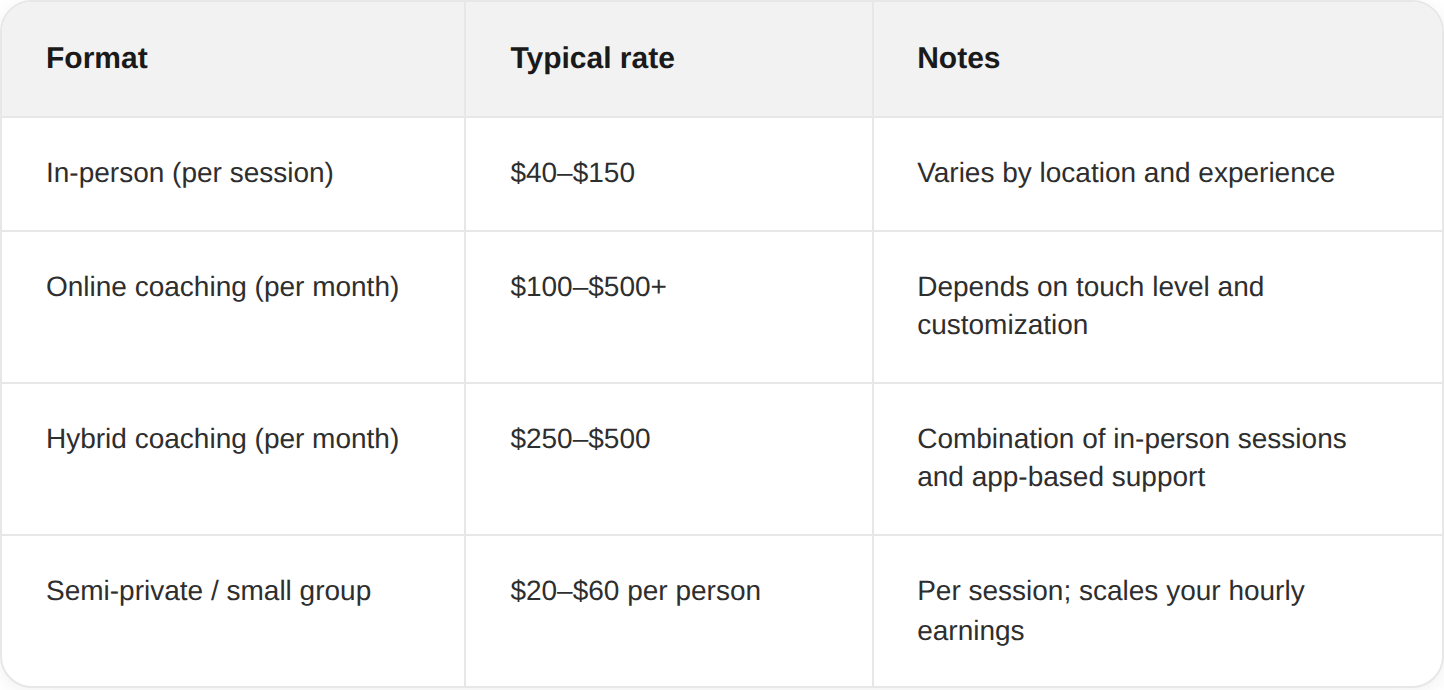
The sections below break down each format in detail, along with the factors that should actually be driving where you land within these ranges.
What Personal Trainers Actually Charge in 2026
Before you can set smart prices, you need a realistic baseline. But an important caveat before we get into numbers: we mentioned that the most-cited benchmark — the U.S. Bureau of Labor Statistics median annual wage being $46,180. But that includes part-timers, floor staff, and group instructors.
Since 72% of fitness trainers work part-time, that figure gets pulled down considerably. For independent trainers setting their own session rates, the real numbers run higher.
#1 In-person personal training rates
For in-person sessions, the national average in the US runs roughly $40–$100 per session. However, this range varies depending on where you’re located. Location shapes what clients expect to pay, but also what you need to earn to cover your cost of living.
NASM reports that certified personal trainers average $61 per hour for one-on-one sessions, with experienced specialists regularly exceeding that.
Geography moves that number significantly. The highest-paying states for personal trainers, per BLS May 2024 data, are:
- New Jersey: $66,970 mean annual wage
- New York: ~$65,000
- Connecticut: ~$62,000–$64,000
- California: ~$61,000
Top-paying metro: San Francisco at $82,820 annually.
This is why personal trainer session cost by state varies so significantly. Trainers in major metro areas earn 10–20% more on average than peers in smaller markets.
In major metro areas like New York, Los Angeles, or San Francisco, $100–$150+ per session isn’t unusual for an experienced certified personal trainer. In suburban or rural markets, on the other hand, $40–$60 is more typical.
Session length is another factor. A 30-minute training session usually runs 60–70% of a 60-minute rate (not exactly half), because you still need to account for travel, setup, and the session itself.
So if you typically charge $80 for an hour, pricing a 30-minute session at $55–$60 makes sense.
Rates in Canada
Independent trainers in Canada typically charge $50–$150 CAD per session for one-on-one training, per First Class PT, with rates running higher in major urban centres like Toronto and Vancouver. Specialized or high-end trainers can charge more.
Rates in the UK and Europe
In the UK, the national average runs around £40/hour, with a range of £25–£100+. Location drives significant variation: London averages £50–£150 per session, the South East runs £40–£80, and the Midlands and North of England typically sit between £20–£50, per Future Fit.
On the European mainland, Amsterdam averages €50–€120/hour for one-on-one sessions, per Physicum. Rates across other European markets vary considerably by country and cost of living. If you’re based in Europe, checking local fitness industry associations or job boards in your country is the most reliable way to benchmark your market.
How to find your local benchmark
The fastest way to ground your pricing in real market data:
- USA: Use the BLS OES Explorer and search SOC code 39-9031 filtered by your state or metro area for median wage data. Cross-reference with NASM’s salary tool for session rate context.
- Canada: The Government of Canada’s Job Bank wage tool gives provincial breakdowns by NOC 54100.
- UK: Future Fit’s regional pricing guide covers all major regions with session rate ranges.
- Everywhere: Search what trainers with your certification level and specialty are charging in your city on platforms like Bark, Thumbtack, or local Facebook fitness groups. That’s your real competitive floor.
Remember: these figures reflect what the market pays. Where you land within that range comes down to what you bring to it, which is what the rest of this guide covers.
Read More: 8 of the Highest Paid Personal Trainers in 2026
#2 Online personal training rates
One mistake a lot of trainers make with online personal training pricing is treating it like discounted in-person coaching. It’s a different animal, and needs to be treated that way.
Monthly rates for online personal training typically land between $100–$500+/month, depending on how much direct access and customization the client gets.
Example: A lower-touch template program with weekly check-ins sits at the low end. Whereas custom programming with nutrition coaching and regular 1:1 calls can easily push past $300+/month.
Check Out: Personal Trainer Workout Plan Template: 7 Components That Drive Real Results
Sure, you’re not paying rent at a gym when you offer online training. But figuring out how much to charge for online personal training still means accounting for things like:
- Personal training software
- The time you spend building and maintaining programs
- Continuing education and PD
- Marketing
- Etc.
You have different overhead, not zero overhead.
What clients expect at each price point has shifted, too. According to our 2026 State of the Personal Training Industry Report, 60% of clients are more budget-conscious and want flexible options.
That said, there’s still a bunch of clients who want the full experience (nutrition coaching, habit support, accountability between sessions, etc.) and are willing to pay good money for it.
If you’re delivering the whole shebang, knowing how much to charge for online personal training at that level matters. You gotta price it like it.
#3 Hybrid training rates
Our survey shows that 48% of trainers run a hybrid model as their primary way of working in 2026.
This makes sense. Clients get the connection of in-person training plus the ongoing support of a digital coaching experience. Hybrid coaching rates reflect this, the combination is worth more, and you can price it that way.
For instance: A hybrid membership with a handful of in-person sessions plus full app-based programming, check-ins, and nutrition support could run $250–$500/month.
Download our PT pricing guide: The Ultimate Pricing Guide for Personal Trainers and Online Coaches

3 Factors That Should Actually Drive Your Personal Trainer Pricing
The above benchmarks are just a starting point for personal trainer pricing. Where you actually land within those ranges comes down to a few things specific to you.
Factor #1 – Your training experience and certifications
Certs aren’t everything, but they do something important: they lower the perceived risk for a new client.
When a prospect sees NASM, ACE, ISSA, or CSCS next to your name, it signals that a trusted authority has already vetted your skills. That’s worth something!
Specializations can push your personal training pricing even higher. Working with athletes, pre/postnatal clients, active aging populations, or the growing wave of GLP-1 users? You’re solving a more specific problem, and specific problems can command specific pricing.
➡️ Our latest PT industry report found that 52% of scale-stage trainers are seeing clients actively seek out specialized expertise.
Certs get you in the room. The results you deliver keep you there, and justify your pricing once you’re inside.
Factor #2 – Your delivery model, location, and overhead costs
In-person, online, hybrid… Each model has a different cost structure and a different income ceiling.
- In-person training requires physical space and equipment, plus your time bound to a specific location.
- Online coaching opens you up to clients anywhere in the world, but doing it well takes time and money upfront.
- Hybrid blends both. 🤝
Here’s a question worth sitting with: which model actually lets you serve more clients without running yourself into the ground?
Our data makes it clear: time, systems, and delivery models are the real limits on growth, NOT demand. That’s why you need to build a pricing structure that works for your business model, not just one that matches what your buddy is charging.
Check Out: The Ultimate Guide to Personal Training Business Models for Sustainable Success
Factor #3 – What your clients actually value (not just what competitors charge)
Copying what your competitors charge is the lazy version of pricing. You’re also more likely to undercharge without realizing it.
The smarter move is understanding what your specific clients are willing to pay, and what actually drives that willingness.
It comes down to how you’re positioning your offer.
Budget-conscious clients may want flexibility and a low-barrier way to get started. For example: a lower-cost on-demand program they can follow at home on their own schedule. This is a great offer! It just needs to be priced and marketed like the self-directed product it is.
Clients who expect 360° support are a different story. They’re not buying a program. They’re buying a transformation and a lifestyle, which is reflected in what they’re willing to pay.
The disconnect happens when trainers deliver the full coaching experience but price it like the DIY version. That’s value-based pricing for personal trainers working against you instead of for you. Instead, charge based on what you’re actually delivering: the outcomes, accountability, and experience.
📝 Read More: How to Sell Personal Training: Online and In-Person Strategies for Success
4 Personal Training Pricing Models
Knowing how much to charge for personal training is one thing. How you structure that pricing is another. Some models let you grow, where others cap your income over time. Let’s get into it. 👇
#1 Per-session and hourly rates
Per-session pricing is how most of us start out, and that’s completely fine. It’s easy for clients to understand and easy for you to manage.
The catch comes when you’re fully booked. There’s literally nowhere to grow from there. This is called the time-for-money trap. Your calendar maxes out, but your personal trainer income doesn’t follow.
Per-session rates still make sense for intro packages, specialty sessions, or short-term clients. Just don’t build your entire business model around them.
#2 Training packages (and how to structure tiers)
Learning how to price personal training packages well is one of the fastest ways to stabilize your income. You get predictable revenue, your clients get more consistent results, and your personal training packages pricing structure finally works for you instead of against you. It’s a win-win. 💪
The structure that tends to work best is a simple good/better/best framework:
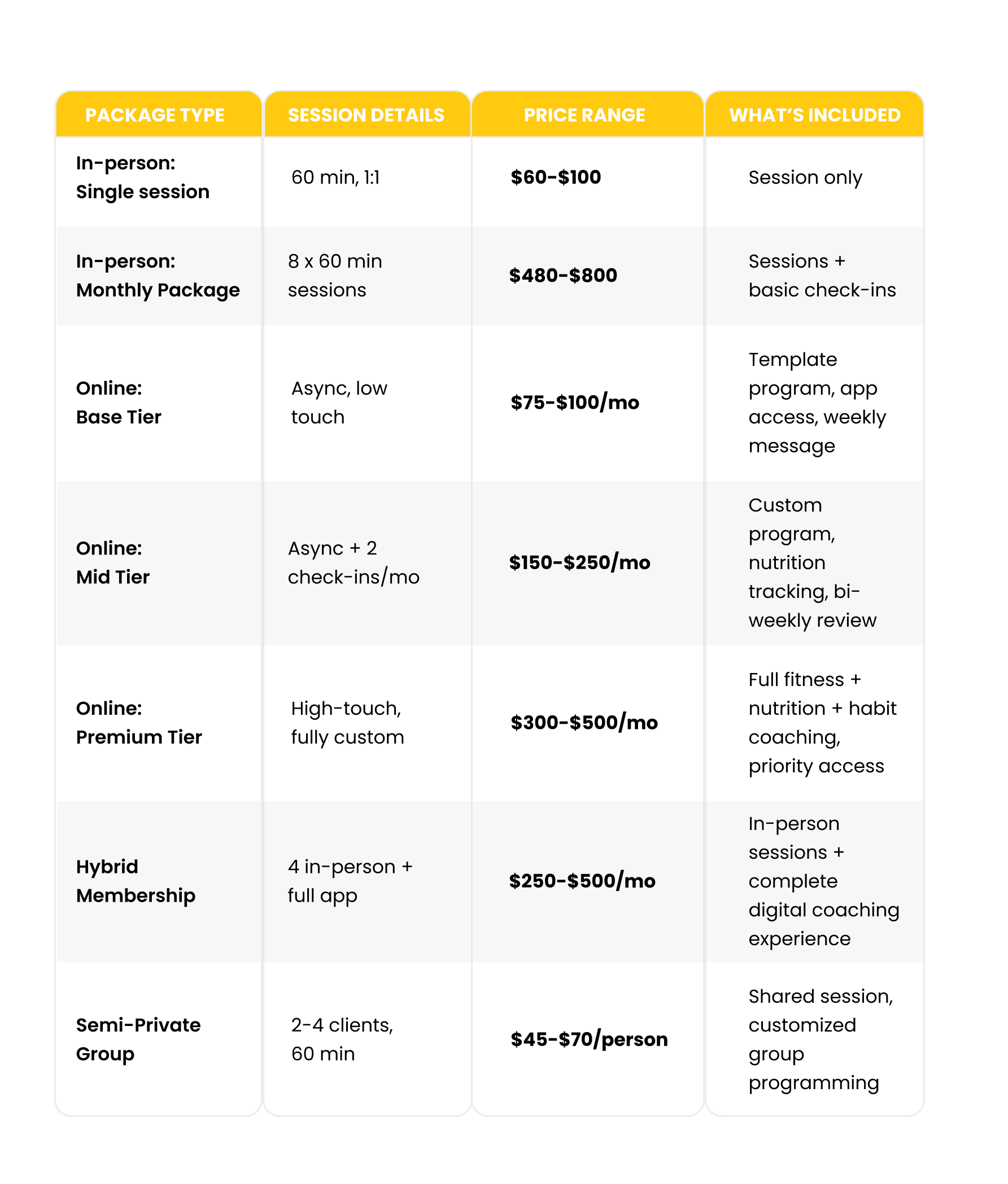
- Base tier: Template or semi-customized workout plan, basic app access, weekly check-ins
- Mid tier: Customized programs + nutrition coaching or meal tracking + bi-weekly progress reviews
- Premium tier: Fully personalized training, nutrition, and habit coaching + daily accountability, video calls, and priority access
Be specific about what’s included at each level. Bundling services increases perceived value. Vague tiers confuse people (and hurt conversions).
Check Out: How to Build Your Online Personal Training Packages
#3 Monthly recurring memberships
If packages are a step up from per-session pricing, recurring memberships are the step after that.
Instead of selling sessions or session blocks, you’re selling a coaching relationship. Ongoing and subscription-based, with recurring monthly billing.
Two things happen when you make this shift:
- Your cash flow stabilizes
- The value framing changes completely
Case in point: digital support isn’t a free add-on to your sessions anymore. It becomes a core part of what clients pay for every month.
Read More: 2026 Revenue Strategy: Maximize Your Personal Training Profit Centre
#4 Group training sessions and semi-private models
Want to earn more per hour without working more hours? Group training is how you do it.
Example: train 4 clients in a semi-private session instead of one, and you can charge each of them less than your 1:1 rate. This model makes training more accessible for clients, while bringing in significantly more per session overall.
Semi-private training typically runs $40-$60 per person per session. Group classes go a bit lower, usually $20-$40 per person.
📝 Check Out: 5 Reasons to Add Group Personal Training to Your Fitness Business in 2026
How to Price Personal Training Packages for Online Clients
When you’re pricing online personal training packages, think about it in terms of how much you’re focusing on them day-to-day:
- Low-touch packages (template programs, community access, weekly check-ins) typically run $50-$100/month
- Mid-touch, with customized programming and bi-weekly check-ins, usually lands $150-$250/month
- High-touch, fully custom training with nutrition and habit coaching, can comfortably sit at $300-$500+/month
Remember to be crystal clear about what each tier includes. Ambiguity makes people hesitate (and close the tab).
Using software to deliver premium value
Clients paying hundreds a month for online coaching expect a pro-level experience, not a Google Docs workout plan with the odd text message here and there.
The platform you use is part of what justifies the price.
ABC Trainerize delivers custom workout programs, nutrition and habit coaching, automated check-ins, self-booking, and in-app messaging — all through a branded app that makes your coaching feel premium. 🙌
Read More: The Simplest Way to Upsell Nutrition Coaching to Personal Training Clients

Your Personal Training Pricing Calculator
Think of this as your personal trainer package pricing template — something you build once and refine over time, not rebuilt from scratch every time you onboard a new client or launch a new offer.
Here’s a calculator you can use to figure out what to charge.
How to use this calculator [Google Sheets]
- Start by estimating your hard costs on a monthly basis (software, liability insurance, marketing, rent, etc.)
- Add your target hourly income based on the number of clients you want to serve. This gives you your break-even number.
- Then build your tiers upward from there, pricing each package to reflect the value delivered, not just the hours spent.
- Revisit this at least once a year as your business grows, your skills sharpen, and your client base evolves.
When (and How) to Raise Your Personal Training Rates
Knowing how to raise personal training prices — and when — starts with recognizing the signs. Here when it’s time to revisit:
- Your calendar is consistently full with no room for new clients
- You suddenly have a waitlist
- You’ve added certs or specializations since you last updated your rates
- You have expanded your offer (nutrition coaching, habit coaching, group sessions)
- Your results are strong and you can point to them
Worth noting: our 2026 report found that 82% of trainers say getting new clients is harder or has plateaued. If demand for your services is holding strong, that’s a sign to increase your rates!
Read more: How to Scale a Personal Training Business: From 1:1 to Online Coaching
How to communicate a price increase for personal trainer packages?
Lead with the value, not the number. Tell clients what’s changed before you tell them the price is changing. “I’ve added nutrition coaching and a full app experience” lands very differently than “rates are going up in January.”
Take care of your long-term clients. Grandfathering loyal clients, even temporarily, goes a long way.
Give proper notice (30 days minimum). And own it! Your rates reflect what you now deliver.
Read More: The Ultimate Guide to Personal Training Business Models for Sustainable Success
FAQs
1. How much should I charge for a personal training session?
It depends on your market, experience, and delivery model. In the US, independent trainers typically charge $40–$100 per session for in-person training, with experienced trainers in major metro areas charging $100–$150+. NASM puts the average for certified trainers at $61/hour for one-on-one sessions. Start by researching what trainers with your certification level are charging in your city, then factor in your overhead, target income, and the value you deliver.
2. How do I price my personal training packages?
Build your packages from the bottom up, not by copying competitors. Start with your monthly costs (software, insurance, marketing, continuing education), add your target hourly income based on how many clients you want to carry, and work upward from there. A good/better/best tier structure tends to convert well: a lower-touch base tier, a mid-tier with customized programming and check-ins, and a premium tier with full nutrition and habit coaching. Use our free pricing calculator to run the numbers for your specific situation.
3. What is the average personal trainer cost in the US?
For employed trainers, the Bureau of Labor Statistics puts the national median at $46,180/year, but that figure includes part-timers and group instructors. For independent trainers setting their own rates, Thumbtack puts the national average session rate at around $40–$100/hour, with a national average closer to $55. High-cost metros run significantly higher.
4. When should I raise my personal training rates?
The clearest signals to raise your personal training rates: your calendar is consistently full, you have a waitlist, you’ve added certifications or specializations, or you’ve expanded your offer since you last updated your pricing.
5. How much should a beginner personal trainer charge?
New trainers typically start in the $40–$60/session range for in-person training while building their client base and results portfolio. That’s not a permanent floor; it’s a starting point. As you accumulate client results, add specializations, and fill your schedule, your rates should move up accordingly. Use the pricing calculator to make sure your starting rate at least covers your costs.
6. Is it worth charging more for hybrid coaching?
Yes. Hybrid coaching delivers more touchpoints, more accountability, and more ongoing support than in-person sessions alone, and that combination is worth more to clients. A well-structured hybrid membership with in-person sessions plus app-based programming, check-ins, and nutrition support can comfortably run $250–$500/month.
8. How do I calculate what to charge for personal training packages?
Three inputs drive the calculation: your fixed monthly costs, your target income, and your client capacity. Add up everything you spend to run your business monthly, set a realistic income target, divide by the number of clients you can serve well, and that gives you your minimum per-client rate. Then build your tiers upward from there based on the value delivered at each level. The free pricing calculator walks you through this step by step.
9. How much more can I charge for hybrid vs. in-person training?
Typically 2–3x a comparable in-person package when the hybrid offer is structured well. A client paying $80/session for weekly in-person training is paying around $320/month. A hybrid membership delivering those same sessions plus daily app access, nutrition tracking, and between-session check-ins can reasonably sit at $400–$500/month.
Build a Personal Training Business That Pays What You’re Worth
How much to charge for personal training isn’t about what the trainer down the road charges or what feels safe to ask. It’s about understanding what you actually deliver, who you deliver it for, and what that’s genuinely worth to them.
ABC Trainerize gives you the tools to deliver a top-tier training experience: workout programming, nutrition and habit coaching, automated billing, self-booking, and a client app your clients will actually want to use, all in one simple platform. Try it free today!