
So you want to become a personal trainer? Great choice. Helping clients achieve their health and fitness goals can be a rewarding career. It’s also a great opportunity for anyone who wants the flexibility to either work for a company or chart their own entrepreneurial path. But there’s no becoming a personal trainer without the right online personal training certifications!
Before you can start changing lives and working with clients, there are a few things you’ll need to do to get trained up. Keep reading to learn how to become a personal trainer and discover if this is the right career path for you! And if you’re already certified and considering a second credential or a renewal, the same breakdown applies just as directly to you.
Table of Contents
- What does a personal trainer do?
- How much does a personal trainer make?
- How to get certified for online personal training?
- Step 1: Earn a high school diploma or GED
- Step 2: Consider a college or university degree
- Step 3: Get your First Aid, CPR, and AED certification
- Step 4: Choose a personal trainer certification course
- 1. The International Personal Trainer Academy (IPTA):
- 2. American College of Sports Medicine (ACSM)
- 3. National Academy of Sports Medicine (NASM)
- 4. American Council on Exercise (ACE)
- 5. Canfitpro
- Step 5: Pass your online personal trainer certification examination
- Step 6: Apply for jobs or start your own business
- Step 7: Level up your skillset
- Meet our education partners
What does a personal trainer do?
Personal trainers work with individuals to help them achieve their fitness goals, improve their health and wellbeing, or achieve their full athletic potential. They do this by building training programs or regiments tailored to their clients’ goals.
These programs are most often made up of workouts and exercise routines, but can also include guidance around healthy habits and nutrition guidance.
Personal trainers work with all different levels of clients, from beginners to experienced athletes and adapt their approach based on client needs, any injuries or health concerns, age, ability, and other important factors.
And while a large part of their role is to be a source of expert knowledge and advice, an equally large part of their work is to build strong relationships with their clients so that they can keep their clients motivated and hold them accountable to the goals they’ve set for themselves.
Learn more about the role of a personal trainer and what it takes to succeed as a PT.
Check Out: A Guide to Continuing Education for Personal Trainers
How much does a personal trainer make?
The average salary of a personal trainer in Canada is $52,650. In the United States, the reported median is $64,100.
Of course, your compensation as a personal trainer, just like in any other role, will vary depending on their level of expertise, skills, and geographic region. It may also vary based on where you work (e.g., if you work in a fitness club or if you run your own independent business).
Check Out: What Salary Can I Expect as a Personal Trainer?
How to get certified for online personal training?
- Earn a high school diploma or GED
- Consider a college or university degree
- Get your First Aid, CPR, and AED certification
- Choose an accredited personal trainer certification course
- Pass your personal trainer certification examination
- Apply for jobs or starting your own business
- Level up your skillset
Step 1: Earn a high school diploma or GED
For most online personal trainer certification programs, the minimum requirement is a high school diploma or a GED, so you’ll want to make sure you’ve completed one of these two options.
Step 2: Consider a college or university degree
Although you don’t need to have a college or university degree to become a personal trainer, many individuals choose to earn a degree in a related field such as:
- Kinesiology
- Exercise science or physiology
- Physical health education
- Life sciences
- Sports medicine
- Fitness and health management
- Biomechanics
Having a degree in a related field will deepen your expertise and allow you to support specific client niches or needs. Similarly, it can also be a way to distinguish yourself from other personal trainers or to elevate the cost of your personal training services.
Step 3: Get your First Aid, CPR, and AED certification
On rare occasions, physical activity can come with risks, which is why, before you can start working with clients, you’ll need to get your complete first aid, cardiopulmonary resuscitation (CPR) and automated external defibrillator (AED) certifications.
These certifications (which need to be renewed on a regular basis) can be completed through a variety of certifying organizations. Often, the same groups that run personal trainer certification courses will also offer AED and CPR certification courses. The courses cost on average $125-$250.
🔗 Go Beyond Social Media to Strategic Marketing:
The FitPro’s Guide to Getting Your First Sale
Step 4: Choose a personal trainer certification course
Before you can call yourself a personal trainer, you’ll need to be certified by an accredited organization or educational institution.
Why is NCCA accreditation important when picking personal training certifications?
NCCA accreditation is third-party validation that a certification program’s exam and governance meet recognized credentialing standards so employers can trust what ‘certified’ means. Any reputable employer in the US will want an NCCA-accredited personal training certification.
The NCCA upholds certain standards from each organization including the following:
- Clear exam specifications based on nationwide job task surveys
- The test must be developed by experts in the given field
- The program must require periodic recertification that is time-limited
- The certification program must be governed in a way that protects the integrity of certification decisions
As a result, all NCCA-accredited personal trainer certifications assess the same core competency domains and foundational body of knowledge to determine whether a candidate can train clients safely and effectively.
There are many different certifying bodies that you can choose from.
Best Online Personal Trainer Certifications
All seven certifications below are legitimate. The best online personal trainer certification for you comes down to cost, format, and program length, not which name sounds most familiar. Here’s the at-a-glance comparison, followed by what makes each one worth considering.
1. The International Personal Trainer Academy (IPTA):
In a crowded field of NCCA-accredited personal training certifications, IPTA has emerged as a cost-efficient contender that aims to reduce financial barriers and speed to certification without lowering credential standards.
As one of the newer NCCA-accredited organizations, IPTA has streamlined the certification process, but not at the cost of overall quality. IPTA holds NCCA accreditation and like other accredited programs, it tests the same core competencies under the same development protocols.
Where IPTA further differentiates itself is in bundled value and financial risk reduction. In addition to having one of the lowest upfront costs in the industry, IPTA also saves candidates money by including:
- Unlimited exam retakes under its pass guarantee (avoiding $200+ retest fees common elsewhere)
- A free online CPR/AED certification (often $125–$250 separately)
- A free digital textbook
- First recertification included
- A job assurance guarantee that reduces post-certification risk
Collectively, these features materially reduce the total cost of certification even further.
IPTA is also known for being one of the fastest ways to get certified, not because the exam is easier, but because the learning tools are so good.
The curriculum comes with structured study plans, spaced-repetition flashcards, memory tricks, and an AI study tool called SurePass AI that spots your weak areas and tells you when you’re ready for the exam. The whole point is to help you study smarter, not longer, without cutting corners on what you actually need to know.
Everything’s available on one platform, so you can study from your laptop, tablet, or phone. When you’re ready, take the proctored exam online or at one of thousands of Prometric test centers worldwide.
Between the pricing, guarantees, study tools, and NCCA accreditation, IPTA is hard to beat on value. If you want an affordable, lower-risk path to certification that doesn’t skimp on quality, it’s worth a serious look.
Pricing is three flat tiers, not subscription-based: Rookie $399, All-Star $599, MVP $799, each all-inclusive of exam and materials.
2. American College of Sports Medicine (ACSM)
As one of the most established and research-driven organizations in the exercise science field, ACSM has built its reputation on academic rigor and clinical credibility. Its Certified Personal Trainer (CPT) credential is NCCA-accredited, and like all NCCA-accredited exams, it measures standardized core competencies developed under strict psychometric and item-validation protocols.
Where ACSM differentiates itself is in its strong scientific foundation and alignment with medical and allied health standards.. ACSM is widely known for publishing peer-reviewed position stands and industry guidelines that influence global exercise prescription standards. This research-first orientation makes the ACSM CPT particularly attractive to candidates interested in clinical populations, corporate wellness, or medically integrated fitness settings.
Key features of the ACSM CPT pathway typically include:
- A science-focused digital or print textbook grounded in exercise physiology
- Exam development aligned with evidence-based guidelines and competency domains
- Computer-based testing administered through Pearson VUE testing centers or approved remote proctoring
- Continuing education pathways connected to ACSM conferences, workshops, and publications
- Recognition within hospital systems, university programs, and clinical wellness environments
ACSM’s curriculum leans heavily into risk assessment, health screening, behavior change, and exercise prescription for special populations. Expect a lot of coverage on cardiovascular, metabolic, and musculoskeletal issues, makes sense given ACSM’s long ties to medical and academic institutions.
Study materials are available online and through official prep products, but retakes, CPR/AED certification, and recertification fees usually cost extra rather than being bundled in.
Given its history, scientific credibility, and ties to healthcare standards, ACSM carries a lot of weight. If you want clinical depth, evidence-based exercise prescription, and a credential respected in medical or university settings, it’s one of the top options out there.
Pricing is exam-only by default: $310 for ACSM members, $410 for non-members (retest $205), and their study materials are optional and priced separately.
3. National Academy of Sports Medicine (NASM)
As one of the most widely recognized personal training certification bodies in the industry, NASM is often chosen for its standardized approach to program design and its strong brand recognition across commercial gyms.
The NASM Certified Personal Trainer (CPT) credential is NCCA-accredited, and like all NCCA-accredited CPT exams, it evaluates the same core competency domains under formal exam-development and validation standards.
NASM’s curriculum is built around the OPT Model (Optimum Performance Training), which organizes training into a phased progression (Stabilization Endurance → Strength Endurance → Hypertrophy → Maximal Strength → Power). For many candidates, this creates a clear, repeatable roadmap for building client programs, especially for general population clients in gym settings.
Key NASM CPT features and value drivers commonly include:
- A structured curriculum centered on the OPT Model for program progression and periodization
- Flexible exam delivery: proctored testing can be taken in-person or via live remote proctoring (through PSI scheduling)
- Different package tiers offer other features like free renewal and a job guarantee
In practice, NASM is frequently regarded as a “high-structure” certification path: it tends to appeal to those wanting a clear programming model and a predictable study-to-application bridge rather than a purely academic exercise science emphasis.
Considering its NCCA-accredited exam, widely adopted OPT-based programming framework, and flexible testing options, NASM remains one of the most mainstream, gym-recognized certification choices.
Pricing is a monthly subscription, starting from $79/mo, $99/mo, $109/mo, $114/mo across four tiers, not a flat package price.
4. American Council on Exercise (ACE)
As one of the most established “mainstream” certification bodies in fitness, ACE is frequently chosen for its broad employer recognition and its strong emphasis on coaching fundamentals for general-population clients.
Like NASM, ACE offers two versions of its Certified Personal Trainer (CPT) credential: one that is NCCA-accredited, and an open-book version which is not NCCA-approved.
Where ACE most clearly differentiates itself is in its client-centered coaching orientation, particularly behavior change, communication, and practical programming for real-world training environments.
In other words, ACE tends to appeal to candidates who don’t just want exercise science concepts, but also want a framework for helping clients actually follow through.
Key ACE CPT features and value drivers commonly include:
- NCCA-accredited CPT exam
- Flexible exam delivery: in-person proctoring or Live Remote Proctoring (remote exams are proctored through ProctorU / Meazure Learning per ACE’s exam location guidance)
- Excellent online study portal with practice questions and a Q&A webinars
Materials and prep are delivered through ACE’s online ecosystem (with optional add-ons depending on the package chosen). The overall pathway is designed to be accessible for first-time trainers while still maintaining recognized credential standards.
For candidates prioritizing a widely accepted credential with a strong “how to coach people” emphasis, ACE is consistently a solid contender on most CPT shortlists.
Pricing is two separate costs: study program tiers run $989 (Basic) to $1,749 (Advantage). The NCCA-accredited exam itself is a separate add-on.
5. Canfitpro
As one of the most recognized Canada-first fitness education brands, Canfitpro is often chosen for its employer familiarity across Canadian gyms and its practical, job-ready orientation.
Since 1998, it has been certifying fitness professionals and is accredited by EuropeActive. While rooted in Canada, Canfitpro has expanded internationally, operating in more than 25 countries and maintaining a visible presence at major global fitness trade shows.
Key Canfitpro’s Personal Training Specialist (PTS) features and value drivers commonly include:
- A defined PTS scope that explicitly covers evaluating, designing, and monitoring programs for 1:1 and small-group clients (including virtual settings).
- A Theory Exam format that includes multiple-choice questions plus a written client case study, emphasizing applied decision-making (not just recall).
- Course delivery options that can be completed virtually or in-person, with guidance to test after a dedicated study window.
Considering its strong Canadian brand recognition and practical exam structure (including case-study application), Canfitpro can be a compelling choice for candidates who plan to work primarily in Canada and want an employer-familiar pathway.
Pricing runs CA$848 (Basic) to CA$1,599 (Premium) across three tiers, all currently 25% off except Basic.
6. International Sports Sciences Association (ISSA)
Founded in 1988, ISSA is one of the largest personal trainer certification providers by volume, with more than a million students trained across 176 countries.
Its curriculum spans nutrition, exercise science, and coaching psychology alongside standard training fundamentals, making it broader in scope than most single-focus certifications.
Where ISSA differentiates itself is in its accreditation structure: the standard ISSA course exam is not itself NCCA-accredited. NCCA accreditation runs through the National Council for Certified Personal Trainers (NCCPT), a subsidiary ISSA has owned and operated for close to two decades, which offers a separate proctored exam that does meet NCCA standards.
Candidates who need an NCCA-accredited credential should confirm they’ve registered for the NCCPT exam specifically, not just the base ISSA course.
Key ISSA features and value drivers commonly include:
- A broad curriculum covering exercise science, nutrition fundamentals, and client psychology/behavior change
- A dedicated business and marketing chapter, uncommon among competing certifications
- Fully online, self-paced delivery with no fixed course schedule
- An NCCA-accredited exam pathway available through NCCPT, proctored via Prometric (in-person or online)
ISSA’s self-paced format and business-oriented content tend to appeal most to candidates planning to work independently or build an online coaching practice, rather than those targeting a single gym employer straight out of certification.
Considering its scale, curriculum breadth, and flexible delivery, ISSA presents a strong option for candidates who want business training built into their certification from day one.
For candidates prioritizing independence, online coaching, or a broader curriculum beyond core exercise science, ISSA remains a widely recognized choice among top-tier certification pathways.
Pricing runs around $868, frequently discounted from $1,068 list, with payment plans available, plus a separate $79 Prometric proctoring fee specifically for the NCCA-accredited NCCPT exam.
7. National Council on Strength & Fitness (NCSF)
Now in its fourth decade, NCSF has built a reputation as a science-driven, budget-conscious alternative to the larger commercial certification brands, without sacrificing the accreditation gyms actually check for.
Its Certified Personal Trainer (CPT) credential is NCCA-accredited, and the organization has certified professionals across more than 160 countries.
Where NCSF differentiates itself is in the combination of price and third-party recognition: several independent comparison guides rank it among the top overall picks for new trainers, largely on the strength of its curriculum depth relative to cost.
NCSF-CPT holders are recognized at major chains including Gold’s Gym, Planet Fitness, 24 Hour Fitness, and Orangetheory.
Key NCSF features and value drivers commonly include:
- An NCCA-accredited exam, alongside EuropeActive accreditation for candidates working internationally
- Flexible, self-paced online study with no fixed course schedule
- Exam delivery online or at a local testing center
- Additional credential pathways in strength coaching and sport nutrition for trainers who want to specialize later
Program length is one of NCSF’s more flexible features: motivated candidates can complete the certification in as little as a few weeks, while most trainers finish within two to six months depending on study pace.
Considering its accreditation, cost relative to curriculum depth, and consistent third-party rankings, NCSF presents a strong value-focused option among NCCA-accredited certifications.
For candidates prioritizing affordability without giving up recognized accreditation or gym-chain recognition, NCSF remains a competitive choice among top-tier certification pathways.
Pricing starts at $299 for the exam alone, with full study bundles commonly running around $999 after standard promotional discounts off a much higher list price — worth confirming directly, since I saw the active discount banner on NCSF’s site but not an itemized price list.
Comparison Table: Online Personal Trainer Certification Comparison at a Glance
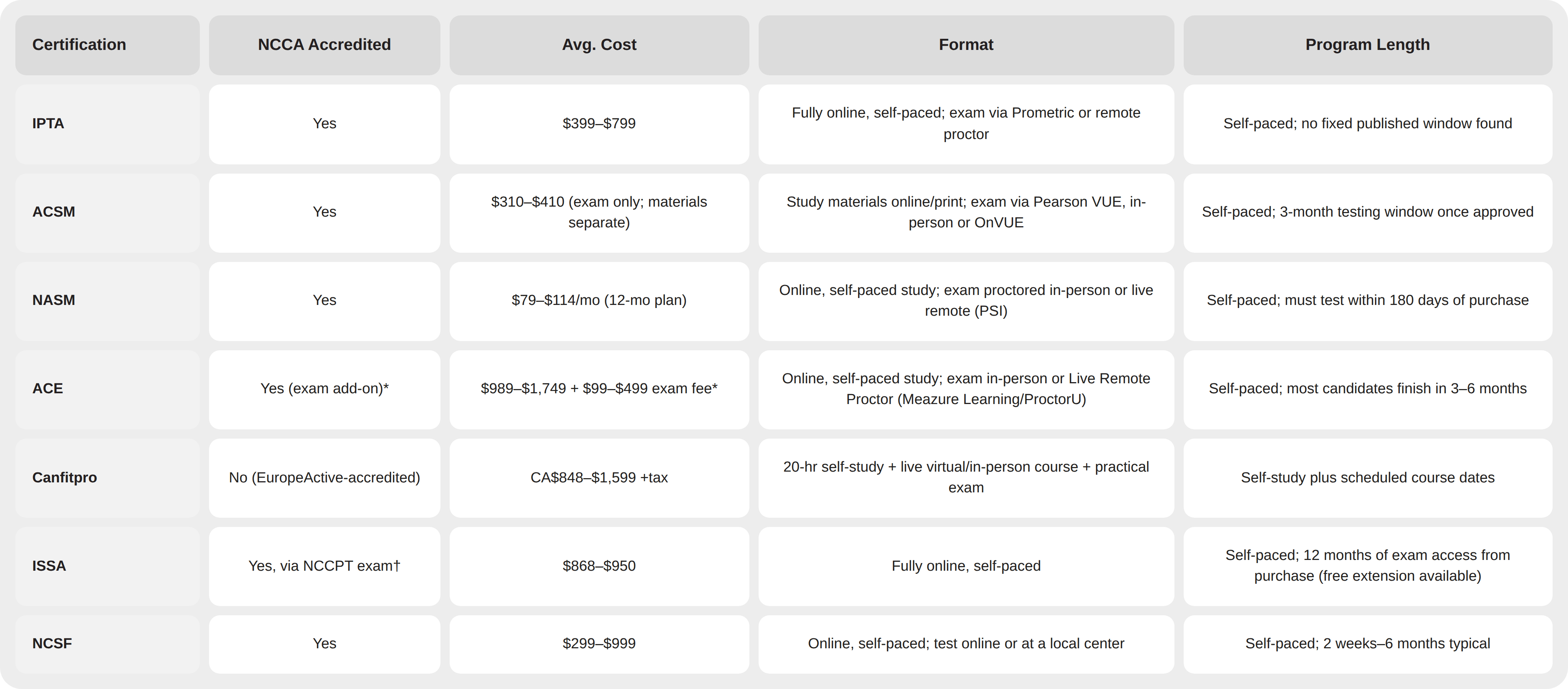
*ACE: study program tiers don’t include the NCCA-accredited exam, billed separately, with two unreconciled figures on ACE’s own site ($99 add-on vs. $499 standalone)
†ISSA: NCCA accreditation runs through NCCPT, an ISSA-owned subsidiary exam pathway, ISSA’s standard course exam is not itself NCCA-accredited.
Step 5: Pass your online personal trainer certification examination
At the end of your chosen course, you’ll need to register for and complete your online personal trainer certification examination. This is where all the knowledge you learned in your course will come in handy!
There is often a small fee to register and the exam itself will likely be completed electronically. You’ll be tested on topics including:
- Client programming
- Client consultation and fitness assessments
- Proper exercise form and techniques
- Safety or emergency responses
Once you’ve successfully completed your exam and received a passing grade, congratulations! You’re officially a certified personal trainer.
Step 6: Apply for jobs or start your own business
You’re certified, you’re excited, you’re ready to start helping clients lead their healthiest lives! Now it’s time to start applying for jobs or building your own independent business.
As a personal trainer you have a few options on how and where you work. You can work:
- As a personal trainer in a commercial fitness club or gym
- As an independent trainer (as an owner of your own business
- In a private studio
- In recreation centers, spas, or resorts
- For a corporate wellness provider (a company that provides training services to employees as part of an employer benefit)
Working for a fitness club or gym
If you enjoy being part of a larger team where you’ll be able to collaborate with other trainers or other health, fitness, or nutrition professionals, working for a fitness club or gym can be a great option.
As a personal trainer in a club or gym, you’ll work with members that have purchased training services. You’ll also likely engage in some sales yourself, helping members learn more about the benefits of personal training and why they may want to consider signing up.
Most clubs or gyms offer guidance on the type of training or programming they should offer, and sometimes have templates or best practices that you can follow to quickly build and deliver training to members. You may also have the chance to shadow more senior trainers and as a result, learn from their experience. Meanwhile, you’ll be charting your own career path within a company that shares your passion for fitness.
Working for yourself
Rather be your own boss? Crave a more flexible work environment? Starting your own personal training business or working as a solopreneur is also an option.
⚡️ TZ Tip: Subscribe to the Trainerize Fitness Business Blog for tips on building your personal training business from the ground up!
As an independent personal trainer, you’ll need to build up your roster of clients using various sales and marketing strategies. However, you’ll have total control over your schedule and the type of programming or services you deliver to your clients.
If you do decide to go the independent route and start your own business, you may want to find a software to help streamline your training and build your client roster. Having the right tools and strategies in place can help unlock your full potential and turn your passion into a profitable career.
Pro tip: As an independent trainer, you are liable for your clients’ safety. At a minimum, you need Professional and General Liability insurance. In 2026, basic coverage for solo trainers starts as low as $11/month. This protects you from claims of negligence or accidental injury, and most gyms won’t even let you through the door without a Certificate of Insurance (COI).
Free Resource: New Business Checklist for Personal Trainers | FREE RESOURCE
Step 7: Level up your skillset
The world of health and fitness is constantly evolving! Therefore, it’s important to keep up to date with the science and what your clients are looking for.
Completing additional training is a great way to do this. Further, additional training can help you become an expert in a specific field or niche, and can allow you to better attract and support specific types of clients.
There are a variety of excellent continuing education and advanced qualifications available through the same organizations that offer personal training certifications. Here are some of the possible courses you could take to take your skillset to the next level:
- Nutrition Coach certification
- Group Fitness Instructor certification
- Health Coach certification
- Medican Exercise Specialist
- Youth Fitness Specialist
- Senior or Functional Aging Fitness Specialist
- Weightloss Specialist
Check Out: The 2026 Fitness Professional Resource List: Learn, Grow, and Level Up
FAQs
1. Are online personal trainer certifications legitimate?
Yes. In the US, legitimacy comes down to NCCA accreditation. NASM, ACE, ISSA (via its NCCPT exam), NCSF, ACSM, and IPTA all clear that bar, so an accredited online personal trainer certification from any of them carries full weight. Before you commit to a personal trainer certification, confirm which body accredits it; it doesn’t have to be NCCA. If the provider can’t name one, don’t take it.
2. How much does it cost to become a certified personal trainer online?
Budget $300–$1,300+ for your first certification, depending on provider and package tier. Across online personal training certifications, NCSF and IPTA sit at the affordable end (exam-only from $299–$399); NASM, ACE, and ACSM run $600–$1,300 once you add study materials; ISSA lands around $868–$950 once you add the separate NCCPT proctoring fee. If budget is the deciding factor, the best online personal trainer certification for you is usually just the cheapest NCCA-accredited option that fits how you study.
Budget beyond the sticker price too: CPR/AED if it’s not bundled ($30–$250), a retake fee if you don’t pass the first time ($150–$200), and continuing education credits every two years to stay certified. The lowest listed price isn’t always the cheapest total cost.
3. How long does it take to get an online personal trainer certification?
Most personal trainers finish in 6–12 weeks studying part-time, as fast as 2–4 weeks going all-in, or 3–6 months around a full-time job. Program structure sets the outer bounds: NCSF windows its program at 2 weeks to 6 months; ISSA gives 12 months of access from purchase; Canfitpro ties you to scheduled course dates plus a live practical exam, so your timeline follows the course calendar rather than your own pace.
Meet our education partners
Looking to level up your skills or expand your knowledge?
As an ABC Trainerize paid subscriber, you’ll gain special access and exclusive discounts on a collection of carefully curated courses, certifications, and education resources from leaders and experts across the industry.
You coach your clients to be their best selves. Now it’s time to be yours!
🔗 Check out the Trainerize Education Partner Program
Personal trainers wear many different hats and juggle a variety of responsibilities. Above all, being a personal trainer is all about helping people achieve their health and fitness goals, and live happier and healthier lives.
And now that you know how to become a personal trainer (in just seven easy steps) you can take your first steps toward an exciting and rewarding career.