

You did everything right. The program worked. The client hit their goal. And then they ghosted.
If that sounds familiar, you’re not alone; losing clients right after their biggest wins is one of the most common, most avoidable leaks in a personal training business. It’s rarely the workouts. It’s what happens (or doesn’t) between sessions: the check-in that never comes, the progress they can’t see, the next goal nobody set.
Personal training client retention isn’t about charisma. It’s a system: onboarding, personalization, visible progress, communication, habit coaching, accountability, a clear next step. Get it right, and clients stay because the coaching keeps proving its worth.
How Personal Trainers Drive Client Retention
Personal training client retention strategies work because they hand trainers control over the one variable clients cannot manage alone: whether effort turns into visible progress. A trainer who tracks that progress, explains it, and adjusts the plan around it becomes difficult to replace.
That translation work is what separates coaching from programming. Anyone can hand a client a plan. What keeps a client paying for a coach is consistent proof that the plan is working, and someone accountable for adjusting it when it is not.
Client accountability runs in both directions. Clients stay accountable to their trainer, and trainers who build a real coaching experience stay accountable to the client’s actual results, not just attendance. That two-way accountability is what drives client renewal, quarter after quarter.
Read more: 10 Ways to Improve Client Retention in Your Fitness Business
Why Personal Training Clients Disengage
Personal training clients disengage for six predictable reasons:
- Unclear expectations
- Generic programming
- Invisible progress
- Weak communication
- Scheduling friction
- No clear next goal after they hit one
None of these happen overnight. Clients pull back gradually, long before they actually cancel.
Unclear expectations set the pattern early. If a client does not know what progress looks like for them, every plateau feels like proof the programme is not working.
Generic programming and invisible progress compound it. A plan that ignores a client’s schedule or goals reads as low effort, and without visible tracking, clients fall back on the scale as the only signal they have.
Weak communication is often the real trigger. No check-ins, no client engagement between sessions, and the client starts to wonder if anyone is paying attention. Add scheduling friction and a missing next goal, and there is no reason left to renew.
Overall, client churn rarely comes from one single moment. It shows up as a pattern of engagement signals: fewer questions, shorter replies, missed sessions that used to be non-negotiable.
Read more: Fitness Business Retention in 2026: Why Fitness Clients Quit and How to Keep Them
10 Personal Training Client Retention Strategies to Run in 2026
Here is how to retain personal training clients, broken into ten specific, repeatable moves. Together, they are what personal trainer client retention actually looks like week to week.
1. Tighten client onboarding
Onboarding starts with a real form intake, not a form buried in an email. Book a short consultation before training begins, and use it to run through a health and lifestyle questionnaire and a quick medical history check, so you know about injuries, schedule, and goals before you program a single workout.
- Day 1: Automated welcome message plus the intake questionnaire
- Day 2-3: A personal follow-up referencing their actual answers, not a template, plus their first workout
- Week 1: A short check-in on how the first sessions felt
- Week 2-3: The first milestone check-in, tied to whatever they said mattered most at intake
Read more: The Ultimate Guide to Onboarding New Fitness Clients in 2026
2. Personalize the programme, not just the exercises
Personalization starts with the details most trainers skip: a client’s actual injury history, their real schedule, and the specific goal they stated in their own words, not the generic version of it.
A desk worker with a bad shoulder and a new parent training around naptime need different programmes, even with the same stated goal.
This is where an AI workout tool earns its keep. ABC Trainerize’s AI Workout Builder pulls from the client’s profile, goals, past workouts, and preferences to generate a starting programme in minutes, which you then adjust for whatever the intake surfaced. The time saved goes back into reading how a client is actually doing, not building sets and reps from scratch every time.
Read more: How to Do a Personal Trainer Assessment: Form, Template, Step-by-step
3. Make progress visible early
Progress tracking needs a rhythm, not just a metric:
- 2 weeks: An early, easy win to build confidence
- 6 weeks: A real, visible change
- 12 weeks: A full reassessment against the original goal
Track more than the scale, strength numbers, measurements, energy, sleep, whatever actually maps to what the client said they wanted at intake. Visibility has to run both ways: you need the trend in front of you before every session so you can adjust the plan, and the client needs a simple version too, a one-line summary after a check-in rather than raw numbers they have to interpret themselves.
Read more: How to Retain Clients and Keep Their Motivation High
4. Communicate consistently between sessions
In-app communication works best on a fixed cadence, not whenever you remember:
- A weekly check-in on the same day each week, so it becomes an expected touchpoint, not a surprise
- A one-line message after each session referencing something specific from it, not a generic “good job”
- An automatic nudge if a client goes quiet for more than a few days, rather than waiting for them to reach out first
The cadence matters more than the content. Clients notice the pattern before they notice the words.
5. Coach habits, not just workouts
Habit coaching works best as micro-habits stacked onto something the client already does (drink a glass of water after brushing their teeth, take a short walk after lunch) rather than a full lifestyle overhaul on day one.
Pick the one habit that unlocks the most for that specific client, sleep for someone who trains exhausted, protein for someone who cannot recover, and build from there once it sticks.
Read more: How Habit Coaching Improves Client Retention and Long-Term Success
6. Build accountability into the app, not just the relationship
Client accountability that depends on the trainer remembering to follow up does not survive a busy week. Build it into the structure instead:
- Logged workouts the client can see building up over weeks, not just you
- A habit streak counter for whatever single habit you picked in step 5
- An automated nudge after a missed session, sent before the client has a chance to skip a second one
None of this replaces the relationship. It just means the accountability does not disappear the one week you are slammed.
Read more: 10 Workout Accountability Ideas
7. Offer online and hybrid support
Hybrid personal training works best with tiers, not one flat package: app-based programming and weekly check-ins at the base, live virtual sessions in the middle, regular in-person sessions at the top.
Coaching continuity survives a missed in-person week because the client never actually loses access to you.
Read more: Hybrid Personal Training: The Best of Both Worlds for Clients and Trainers
8. Use groups and challenges
Fitness challenges and group coaching do not need to be elaborate: a two-week step challenge, a shared group chat for celebrating wins, or a Friday shoutout for whoever hit a milestone that week. A client anchored to a group is harder to lose to a slow month.
Read more: Building a Community as a Personal Trainer
9. Act on early disengagement
By the time a client cancels, the real decision happened weeks earlier. Watch for the early signals:
- One missed session with no reschedule request
- Replies that get shorter or slower over 2 to 3 exchanges
- A skipped check-in, especially if it is the first one they have missed
Reach out at the first signal, not the third, with a direct question instead of a generic one. ‘I noticed you missed Tuesday, is the schedule still working for you?’ gets a real answer. ‘Everything okay?’ usually does not.
Read more: Spot the Warning Signs: How to Tell When a Client is About to Quit (and How to Save Them)
10. Plan the renewal before you need it
Never let a programme end without the next one already discussed. Build the renewal conversation into the plan itself:
- Flag the renewal point on the calendar when the current block starts, not when it ends
- Bring it up two weeks out, framed around the next goal, not the next payment
- Come with an actual next step already sketched out, not just “want to continue?”
Client lifetime value is built goal cycle by goal cycle, and the trainers who show up with a plan already in hand are the ones who keep getting a yes.
None of these work well in isolation. Combined, they are the client retention strategies for personal trainers who want fewer cancellations and steadier referrals.
Read More: 2026 Revenue Strategy: Maximize Your Personal Training Profit Centre
How ABC Trainerize Supports Coaching-Led Retention
ABC Trainerize connects the pieces of coaching-led retention into one system, so none of it depends on you remembering everything at once:
- Programming and progress tracking: Build a programme, adjust it with the AI Workout Builder using the client’s profile, goals, past workouts, and preferences, and track strength, measurements, and trends in the same place you programme from.
- Messaging and Check-Ins: In-app messaging keeps every reply in one thread, and scheduled Check-In forms capture wellness, lifestyle, and progress updates on a set cadence without adding admin time to your week.
- Habit coaching: Assign daily habit tasks tied to whatever actually moves the needle for that client, and clients log them in the same app they train in, so streaks stay visible to both of you.
- Wearables: Sync data from Apple Watch and other devices directly into the client’s profile, so you are coaching on real activity and recovery data, not what a client remembers to report.
- Groups and challenges: Run a group challenge or community feed inside the same app clients already train in, instead of a separate group chat you have to check manually.
- Hybrid delivery: Build tiered packages, app-based programming at the base, live virtual sessions in the middle, in-person sessions at the top, all delivered through one custom-branded app.
Explore all the features: ABC Trainerize product features
How Trainerize and Glofox Support Different Retention Layers
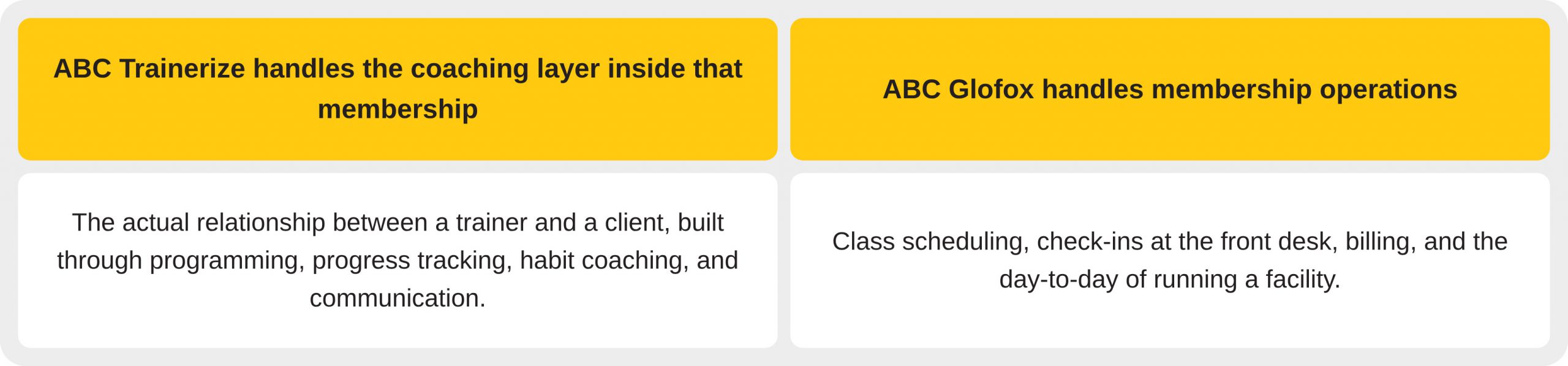
ABC Trainerize and ABC Glofox solve different layers of the same retention problem, and gyms running both PT and general membership often need both.
ABC Glofox handles membership operations: class scheduling, check-ins at the front desk, billing, and the day-to-day of running a facility. That is gym member retention, the layer covered in the guide below.
Check Out: Gym Member Retention Strategies That Actually Work in 2026
A member can renew their membership through ABC Glofox and still fire their trainer. A client can love their trainer through ABC Trainerize and still cancel their membership over parking or hours.
In practice, this often looks like one gym running both side by side. A member joins through ABC Glofox for group classes and facility access, and when they want more personalized coaching, they add a PT package delivered through ABC Trainerize, with its own programme, progress tracking, and habit coaching.
The two do not need to be sold as separate businesses. A front desk running on ABC Glofox can hand off to a coaching team running on ABC Trainerize, and the client experiences one relationship with the gym, not two different tools.
Read More: What is the Glofox x Trainerize Integration?
FAQs
1. What are the best client retention strategies for personal trainers?
The strategies that make the biggest difference are: tighter onboarding, real personalization, visible progress tracking, consistent communication, habit coaching, built-in accountability, hybrid delivery options, groups and challenges, acting on early disengagement, and planning renewals before clients ask. None of them work well alone. Together, they turn retention into a system instead of a personality trait.
2. How can personal trainers improve client retention?
Start with the two that move fastest: make progress visible early, and communicate on a fixed cadence instead of whenever you remember. Both cost little to implement and address the two most common reasons clients disengage, invisible progress and silence between sessions.
3. What’s the difference between gym member retention and personal-training client retention?
Gym member retention is about keeping someone paying for facility access: classes, equipment, front-desk service. Personal training client retention is about keeping someone paying for a specific coach. A member can renew their membership and still fire their trainer, which is why the two need different strategies.
4. How does progress tracking improve personal-training client retention?
Clients quit fastest when they cannot see a difference. Progress tracking across more than one metric, shown as a trend rather than a single number, answers that doubt before the client has to ask, and gives the trainer an early signal when a plan needs to change.
5. How can hybrid coaching help retain personal-training clients?
Hybrid coaching keeps the relationship intact through travel, illness, or a busy month, so a missed in-person week does not turn into a missed month. Tiered packages, from app-based programming to in-person sessions, let clients stay engaged at whatever level fits their life right now.
6. How often should personal trainers check in with clients?
A weekly check-in on a fixed day, plus a short message after each session, is enough for most clients. The exact cadence matters less than the consistency. Clients notice the pattern before they notice the content.
Keep Clients Connected With ABC Trainerize
Personal training client retention comes down to whether the coaching keeps proving its worth between sessions, not just during them. Onboarding, personalization, visible progress, habit coaching, accountability, hybrid delivery, community, and a next step always on the calendar- that is the system, and none of it depends on being the most charismatic trainer in the room.
ABC Trainerize brings the pieces of that system into one place: programming, progress tracking, habit coaching, messaging, wearables, groups, and hybrid delivery, so retention stops being something you scramble to fix after a client goes quiet.
Start your free trial of ABC Trainerize, and build the retention system into how you coach from day one. Start your free trial