

Coaching management software usually ranges from free to $500 or more a month, depending on your client count, feature needs, and the pricing model a platform uses.
To help you with that matter, this guide covers business and practice management software for life, health and wellness, business, and fitness coaches. It does not cover class or institute management software used by tutoring centers, test-prep academies, or educational coaching institutes.
The sticker price on a pricing page rarely matches what you actually pay once add-ons, payment processing, and client growth enter the picture.
This guide breaks down 2026 pricing across the category, explains how the major pricing models differ, and walks through how to calculate your real total cost of ownership before you commit to a platform.
Start with the key numbers, then dig into the model that fits how your practice is built.
Key Takeaways
- Most independent coaches land between $20 and $150 a month once they choose a platform and client volume that fits their practice.
- Feature add-ons, especially nutrition, video coaching, and branded apps, are the single biggest reason your final bill runs higher than the advertised entry price.
- The Wellness Watch Mid-Year 2026: The Reinforcement Shift found that even as new studio memberships declined 5% year over year, check-ins rose 27% and cancellations fell 6%, a sign that existing members are engaging more, not less.
- ABC Trainerize offers a free 30-day trial with no credit card required, so you can test a full-featured platform before committing to a paid plan.
Why Coaching Software Pricing Matters More Than Ever
The 2025 ICF Global Coaching Study reports $5.34 billion USD in annual coaching revenue, a 17% increase since 2023, marking the strongest period of global growth measured in the study’s history.
A growing coach population means more people competing for the same clients. The tools you use to deliver, track, and bill for your coaching are no longer just admin overhead. They are part of what makes your practice look professional and worth paying for.
ABC Fitness’s Mid-Year 2026 Wellness Watch Report, based on proprietary platform data from more than 30,000 fitness businesses and 40 million members, found that even as new studio memberships declined 5% year over year, check-ins rose 27% and cancellations fell 6%, a sign that existing members are engaging more, not less.
That data points to the same shift happening in coaching: growth is coming less from signing new clients and more from keeping existing ones engaged and consistent. A platform that helps you deliver that consistency is doing real business work, not just admin work.
On the return side, the ICF/PwC 2024 Global Coaching Client Study found that 87% of coaching clients reported a positive return on their investment in coaching itself, a figure about client outcomes rather than software ROI specifically, but one that underscores how much value clients place on a well-run coaching relationship.
Before comparing dollar figures across platforms, it helps to understand the pricing model behind the number, since the model shapes how your bill changes as your client base grows.
For the full picture of where the coaching industry is headed in 2026, check out our State of the PT Industry Report.
The Four Coaching Software Pricing Models Explained
Coaching software pricing generally falls into four models: freemium, per-client tiered, flat-rate, and enterprise custom.
The model a platform uses determines not just what you pay today, but how your bill changes as you add clients, which matters more than the entry price for most growing practices.
Freemium and Free Trials
Freemium means a permanently free plan with real limits, usually on client count or features, that you can use indefinitely. A free trial is different: full access to paid features for a fixed window, after which you need to subscribe or lose access.
ABC Trainerize offers both. Its Free plan covers 1 client at no cost, forever, with no credit card required. Its paid-plan trial runs 30 days with unlimited clients and no credit card required.
Free tiers are useful for testing a platform’s workflow and interface. They are rarely enough to run a real practice, since client caps of 1 to 3 mean you will outgrow them quickly.
Per-Client Tiered Pricing
Per-client tiered pricing charges a base fee that covers a set number of clients, then steps up to a higher fee once you cross each threshold. Your cost is predictable at any given roster size, but it rises in steps rather than smoothly as you grow.
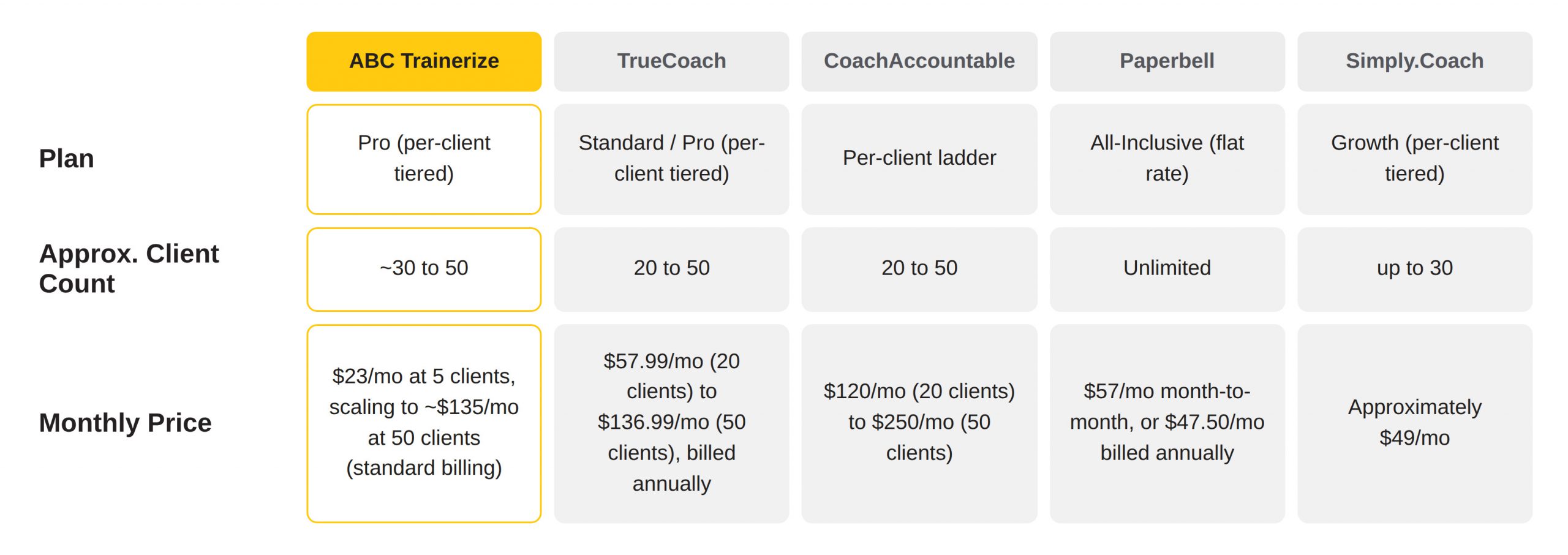
ABC Trainerize, TrueCoach, and CoachAccountable all use this model, though each structures its tiers differently: Trainerize and TrueCoach group clients into named plan tiers (Grow, Pro 5, Standard, Pro), while CoachAccountable uses a longer ladder of smaller steps.
Because the jump between tiers can be steep, calculate your cost at the client count you expect to have in 12 months, not just where you are today. A platform that looks cheap now can get expensive fast if your growth crosses a tier boundary.
Flat-Rate Pricing
Flat-rate pricing charges one price regardless of how many clients you have. Your margin improves with every new client you sign, since your software cost never changes.
Paperbell is a clear example: one paid plan, called All-Inclusive, covers unlimited clients for a single flat monthly fee.
This model works well for coaches who are confident in their growth trajectory and want predictable costs. It can mean fewer specialized features than a per-client platform built specifically for your niche, so weigh the tradeoff against what your practice actually needs.
Neither model is objectively better. Per-client tiered pricing rewards coaches who are still building their roster; flat-rate pricing rewards coaches who already have, or expect to quickly reach, a larger one.
Enterprise and Custom Pricing
Enterprise plans are typically quote-based rather than listed on a public pricing page. They usually include dedicated account management, single sign-on, advanced analytics, and white-label or multi-location options.
ABC Trainerize positions its Enterprise plan for club chains, franchises, and large multi-location fitness businesses that need custom integrations and centralized reporting across locations.
If you are evaluating an enterprise plan, request a demo and come prepared to negotiate. Enterprise pricing is built around seat count and feature needs, and vendors expect back-and-forth before landing on a final number.
What Does Coaching Management Software Actually Cost? A 2026 Breakdown
With the models covered, here are the actual numbers. All prices below are in USD, reflect standard monthly billing unless noted otherwise, and were verified against each platform’s public pricing page in July 2026.
Entry-Level Plans ($0 – $30/month)
At this tier, expect basic session or program delivery, client messaging, and a client cap somewhere between 1 and 5.
ABC Trainerize’s Free plan covers 1 client at no cost. Its Grow plan runs $9/month for 2 clients, and its Pro 5 plan is $23/month for up to 5 clients.
Other entry-level options include CoachVantage, an all-in-one coaching CRM starting around $29/month, and Nudge Coach, whose pricing is not publicly listed and requires contacting the vendor directly.
Mid-Tier Plans ($30 – $150/month)
This is where most coaches managing 15 to 50 clients land, and it is general industry context rather than a claim from any single vendor’s site.
On ABC Trainerize, this range covers the Pro plan family: $23/month at 5 clients, scaling to roughly $135/month at 50 clients under standard monthly billing (about $122/month, if billed annually).
Table shell:
Studio and Enterprise Plans ($150+/month)
At this tier, expect white-label or fully branded apps, team and multi-coach management, advanced reporting, deeper integrations, and dedicated support.
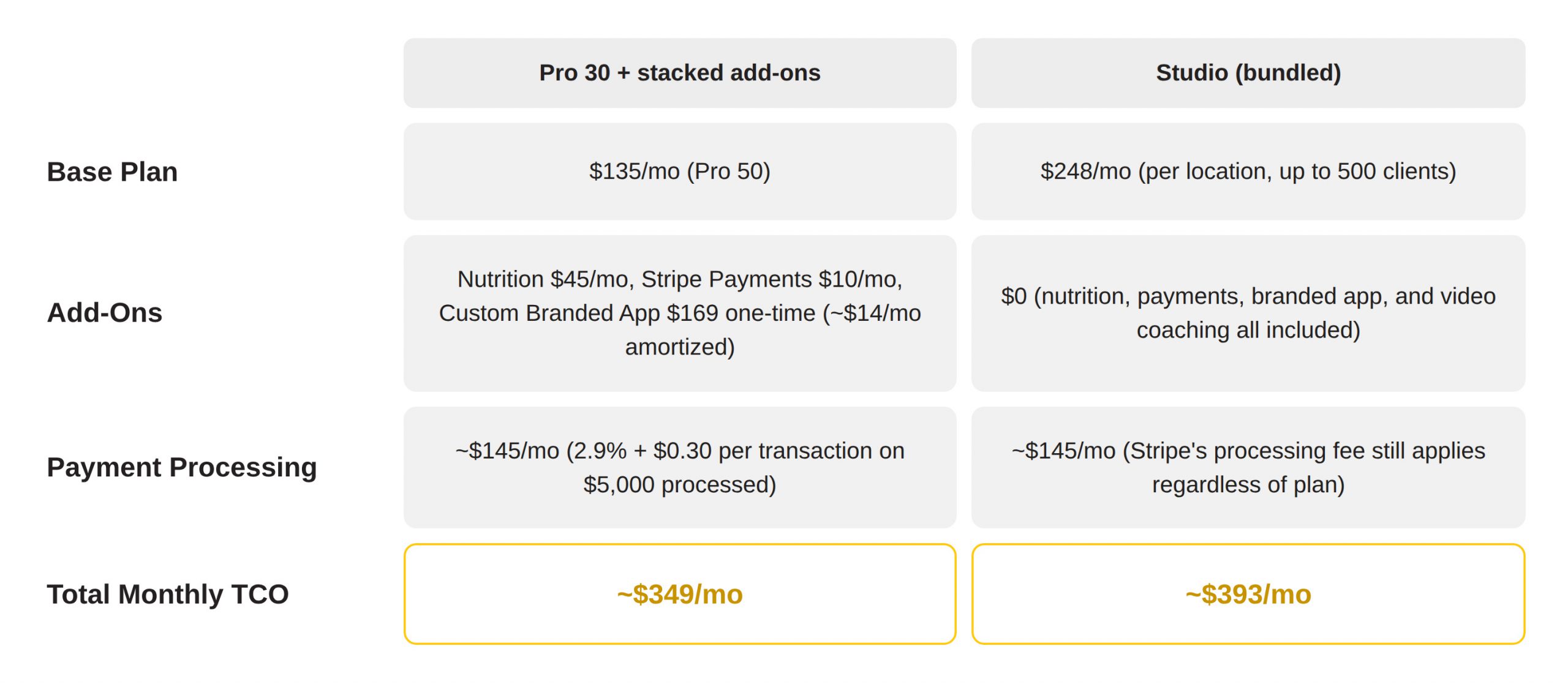
ABC Trainerize’s Studio Plus plan runs $248/month per location, covering up to 500 clients per location, with most add-ons, including the branded app, nutrition tools, and Stripe payments, included at no extra cost.
Enterprise pricing for larger platforms in this category is typically custom and quote-based rather than published, so treat any number you see for enterprise-tier competitors as a starting point for a sales conversation, not a fixed rate.
Studios and agencies evaluating this tier should look at total cost of ownership rather than the subscription line item alone. A bundled plan can cost more or less than stacking add-ons, depending on how many features you actually use.
Hidden Costs That Inflate Your Coaching Software Bill
The gap between a platform’s advertised entry price and what coaches actually pay is one of the most common frustrations in this category.
Three categories drive that gap: feature add-ons, per-client overage fees, and payment processing surcharges.
Feature Add-Ons (Nutrition, Video, Branded Apps)
The three most common paid add-ons across coaching platforms are nutrition or meal planning, video coaching, and custom branded apps.
On ABC Trainerize, the Advanced Nutrition Coaching add-on costs $20/month on Grow, Pro 5, and Pro 15 plans, and $45/month on Pro 30 and above. It is not a single flat $45 price across every plan.
Trainerize bundles most add-ons into its Studio plan at no extra cost. If your practice needs the full feature stack, nutrition, payments, video, and branding, compare the Studio price against Pro plus all its add-ons stacked together before deciding which is actually cheaper.
Per-Client Overage Fees
Many per-client tiered platforms automatically move you to the next plan tier once you exceed your current client cap, rather than charging a small per-client overage fee.
This creates what’s sometimes called a pricing cliff: a jump in monthly cost that happens the moment you sign one client past your tier’s limit, rather than a gradual increase.
Before committing to a platform, map your projected client count 12 months out against its tier structure. A plan that looks affordable at your current roster size can jump substantially once you cross the next threshold.
Payment Processing Surcharges
Most coaching platforms route payments through Stripe at its standard rate of 2.9% plus $0.30 per transaction. That fee is set by Stripe, not the coaching platform, and it applies no matter which platform you use.
TrueCoach is an exception: as of January 7, 2026, TrueCoach Payments charges a flat 5% fee on every transaction, on top of what Stripe alone would charge.
On $5000 a month in client payments, the difference is real money: 2.9% works out to about $145/month, while 5% works out to $250/month, a gap of roughly $105 a month, or about $1260 a year.
ABC Trainerize uses standard Stripe integration through its Stripe Payments add-on, with no additional platform-level surcharge on top of Stripe’s own processing rate.
How to Calculate Total Cost of Ownership
Use this formula as a starting template for any coaching platform you’re evaluating:
Monthly TCO = Base subscription + add-on fees + (monthly client revenue × payment processing %) + (one-time fees ÷ 12)
Here’s how that plays out for a coach managing 50 clients on ABC Trainerize who processes about $5000 a month in client payments, comparing a stacked Pro setup against the bundled Studio Plus plan.
Does Coaching Software Pay for Itself? The ROI Case
The real question isn’t how much a platform costs. It’s whether it pays for itself.
Smart billing, payment protection, and structured engagement interventions combined are associated with a 6 to 12% reduction in churn across the ABC Fitness network. Consistent mobile app engagement alone is associated with a 2 to 4% retention improvement.
That is the most direct, software-specific ROI data available in this category: it ties a defined percentage range to the actual mechanism, engagement technology and billing automation, rather than to coaching in general. A 6 to 12% cut in churn compounds fast, since keeping an existing client is consistently cheaper than replacing one.
Software supports that retention math in three concrete ways: automated scheduling cuts down the back-and-forth of booking sessions, integrated payments reduce the failed-payment cancellations that operators often mistake for a member wanting to leave, and built-in progress tracking gives clients visible proof that coaching is working, which supports renewals.
ABC Trainerize centralizes scheduling, progress tracking, messaging, and payments in one place, which reduces the admin overhead that otherwise eats into billable coaching time.
With the ROI case in mind, the next question is which specific plan and pricing model actually fits your practice today.
Want to dig deeper into the retention math behind this ROI case? Our guide to client retention covers the benchmarks and tactics that keep churn down long after the software is set up.
How to Choose the Right Pricing Plan for Your Coaching Business
The right plan depends on three factors: your current client count, your projected growth over the next 12 months, and which features are essential versus nice-to-have.
Solo Coaches (1-10 Clients)
Start with a free trial or an entry-level plan. ABC Trainerize’s Free plan (1 client) and Grow plan ($9/month for 2 clients) both fit this stage, and the 30-day free trial gives you unlimited clients to test the platform properly before paying anything.
At this stage, core features like workout or session delivery, messaging, and progress tracking matter more than advanced automation or branding tools.
Don’t overbuy. Scale to a higher tier only when client volume actually demands it, not because a bigger plan looks more professional.
Growing Practices (10-50 Clients)
This is the critical decision point. The pricing model you choose now locks in your cost trajectory as you keep growing.
Evaluate your total cost at both 25 and 50 clients before choosing a platform, not just at your current roster size. On ABC Trainerize, that means comparing the Pro plan range ($23/month at 5 clients up to roughly $135/month at 50) plus any add-ons you need against whether a Studio upgrade makes more sense once you’re stacking three or more add-ons.
Annual billing saves 10% on ABC Trainerize’s paid plans, which is worth factoring in if you’re confident you’ll stay on the platform for the full year.
Studios and Teams (50+ Clients)
At this size, evaluate all-in-one plans where add-ons are bundled rather than purchased separately. ABC Trainerize’s Studio Plus plan, at $248/month per location for up to 500 clients, is built for exactly this stage.
White-label apps, team management tools, and advanced analytics become genuinely worth their cost once you’re coordinating multiple team members or locations, rather than a nice-to-have for a solo practice.
For multi-location operations, ABC Trainerize’s Enterprise plan adds custom integrations and centralized reporting. Request a demo and negotiate: enterprise pricing in this category is built to flex around seat count and feature needs.
Once you’ve picked your software, the next step is pricing your own services. Our complete pricing guide for personal trainers breaks down how to set rates that reflect your value (not just cover your costs).
Start Your Free Trial with ABC Trainerize
See what a platform actually delivers before you pay for it
Every core feature, unlimited clients, no credit card required.
Frequently Asked Questions
How much does coaching management software cost per month?
Most coaching platforms range from free to around $250 a month for a typical solo or small-team practice, with enterprise plans running higher on a custom quote. Entry-level plans run $0 to $30/month, mid-tier plans for 15 to 50 clients run roughly $30 to $150/month, and studio or enterprise tiers start around $150/month and scale from there.
Is there free coaching management software?
Yes, in two different forms. ABC Trainerize and Paperbell both offer permanently free plans limited to 1 client. Others, like TrueCoach and CoachAccountable, offer full-featured but time-limited free trials (14 to 30 days) instead of a permanent free tier. Trainerize’s free trial specifically runs 30 days with unlimited clients and no credit card required.
What hidden costs should I watch for in coaching software?
Watch for three things: paid feature add-ons like nutrition coaching or branded apps, tier upgrades triggered the moment you exceed a client cap, and payment processing surcharges beyond Stripe’s standard 2.9% plus $0.30 per transaction. TrueCoach, for example, adds a 5% platform fee on top of processing as of January 2026.
What is the difference between per-client and flat-rate pricing?
Per-client tiered pricing charges more as your client count crosses set thresholds, so cost rises in steps as you grow, used by platforms like ABC Trainerize, TrueCoach, and CoachAccountable. Flat-rate pricing, used by Paperbell, charges one price regardless of client count. Neither model is inherently better; it depends on your growth stage and feature needs.
Does coaching software provide a return on investment?
Yes, according to industry research on coaching outcomes. The ICF/PwC 2024 Global Coaching Client Study found that 87% of coaching clients reported a positive return on their investment in coaching. Software supports that return indirectly, by automating scheduling and payments and centralizing progress tracking, which frees up time for billable coaching work.
Can I switch coaching software plans without losing data?
Within ABC Trainerize, yes: you can upgrade or downgrade your plan at any time from your account, though downgrades that remove features or add-ons take effect at your next billing cycle rather than immediately. Switching between different platforms entirely is a bigger undertaking and typically requires manually rebuilding client programs, so budget real planning time for a full migration.