

Most trainers can build a great program. Fewer know what to charge or how to get paid for it. To sell fitness programs online, pick one niche, package the outcome, choose how clients pay, set up tech that charges and delivers for you, then promote one offer. Easier said than done, right?
About 15% of the 388,400 fitness trainers and instructors in the US were self-employed in 2025. Self-employed means you run the whole business, from your LinkedIn bio to your Stripe fees.
Below, we compare one-off programs, packages and memberships. Then we show how to collect personal trainer payments and deliver the program without chasing clients in DMs, emailing PDFs, or ticking names off a spreadsheet.
Jump to:
- #1 Start With One Clear Offer
- #2 Programs, Packages and Memberships: How Each One Gets Paid
- #3 How to Collect Payment Without Chasing It
- #4 Deliver the Program Automatically After They Pay
- #5 Get Buyers to the Checkout
- FAQs
#1 Start With One Clear Offer
We won’t repeat the basics here. If you’re still working out how to sell workout plans online, start with finding your niche and choosing one specific person to serve. Then package the outcome, not the exercises, into digital programs.
⭐ Our online business guide covers the rest.
#2 Programs, Packages and Memberships: How Each One Gets Paid
A one-off program is paid once, a package is paid in advance, and a membership bills monthly to a card on file. Each model below collects payment differently, so each one needs a different setup from you.
| One-off program | Package | Monthly membership | |
|---|---|---|---|
| Price Scale | $ | $$ | $$$ |
| How the client pays | One-time purchase, a single payment | Paid upfront for a set number of sessions or weeks | Card on file, charged each month |
| What they get | Instant access to a fixed program | Sessions or a fixed-length program | Ongoing programming and support |
| Best for | Self-paced clients, a first online offer | In-person and hybrid coaching | Clients who want accountability |
| Watch for | Income stops when sales stop | Expiry dates and unused sessions | Failed payments and cancellations |
Read more: Fitness Pricing 101: How To Establish Training Plan Pricing
A one-off program is the simplest. The client pays once and gets access. That keeps it low-touch for you, but you need a steady flow of new buyers. Think: online personal trainer who sells digital products via Instagram or other marketplaces.
If you sell training packages online, you get the payment (or at least part of it) before the work starts. But each package should come with simple rules or a “contract.” So, for example, set expiry rules before launch, so a pack bought in January doesn’t become a debate in July.
A monthly membership gives you the most predictable income, because the client’s card is charged on a schedule. It also asks more of you: ongoing programming and support.
The good news is you can build all three over time, adding each one as you grow. Many coaches already do exactly this.
This year, we found out that nearly half of trainers name hybrid as their primary delivery model. Put simply, this might suggest the trainers are more commonly swapping 10-packs for a recurring monthly membership.
This is what scaling is. Your income becomes more predictable, and you do more with less effort.
Start with one model. Add a second once the first runs without you thinking about it. That is how to sell workout plans online without chasing every payment.
Check Out: 2026 Revenue Strategy: Maximize Your Personal Training Profit Centre
#3 How to Collect Payment Without Chasing It
To get paid as a personal trainer, ask each client for a card on file before their first session. Then recurring billing charges them every month.
Many PT tools support a couple of processors:
- Stripe: cards, payment links, and recurring charges in one account.
- US fee: 2.9% + $0.30 per successful card payment.
- PayPal: global; many clients already trust it, higher fees. Top pick in many trainer blogs.
- US fee: 3.49% + $0.49 at checkout, or 2.99% + $0.49 for card payments.
- GoCardless: direct debit for recurring memberships. Strong in UK/EU.
- UK fee: 1% + 20p per payment, capped at £4.
Fees change and vary by country, so check each provider’s pricing page (Stripe, PayPal, and GoCardless).
Stripe might be the most common tool, mainly because it covers everything in one account: a payment link, a card on file, and recurring charges. It also costs less per card payment than PayPal.
With Stripe, you can even avoid invoices by just sending a single payment link once you have a saved card on file. The client pays at checkout, and for memberships, the card is charged each period again.
That’s ✨ recurring billing ✨: automatic charges on a schedule.
Read More: Compare Online Payment Solutions for Personal Trainers in 2026
When to set it up, and what it costs
Set up your payment processor once you have a clear offer, but before your first sale. Stripe has to verify you first, which can take 3-5 business days. Your first payout is typically sent 7 days after your first payment, and up to 14 days for some businesses.
Check that your country is supported before you start. Our Stripe Integrated Payments add-on is available in 40+ countries.
What happens when a payment fails
Cards expire, get replaced, or get declined. When that happens, it doesn’t mean your client is leaving. Your revenue should recover automatically, not through manual chasing.
Personal trainer payments have become easier to recover, since most platforms now retry a failed charge without your help. Stripe, for example, can choose the retry times for you. Some declines, though, need the client to act. A lost or stolen card, for instance, won’t go through until they add a new one, so plan for that step.
We’d suggest these:
- Allow a short grace period before you pause access.
- Send a friendly payment reminder: “Hey, your payment didn’t go through. Can you update your card here? Your plan is still active.”
- Keep the tone light. Most clients want to fix it.
Stop doing these 4 things:
- Sending manual invoices
- Asking for payment by DM
- Emailing PDFs
- Tracking who has paid in a spreadsheet
Each one adds a task you repeat for every client, every month, which is not necessary anymore.
How ABC Trainerize fits
Already taking payments through Stripe on its own? That works. ABC Trainerize makes your payments more powerful by adding automation on top of them.
The Stripe Integrated Payments add-on connects Stripe payments to ABC Trainerize, so each purchase can trigger the right delivery automatically.
That matters most when your offer has tiers, such as a one-off program, a session pack, and a monthly membership. Each one needs different delivery.
- Sell and deliver: One product link can assign a program to one client or hundreds. Think: memberships, session credits and packs, recurring services, digital products and PDF meal plans.
- Price: $10 a month on Grow and Pro plans, included in Studio plans, not available on the free plan. See our pricing comparison for plan costs.
- Still applies: Stripe’s per-transaction fee, plus 3 to 5 business days for Stripe to verify you. Set it up before launch day.
#4 Deliver the Program Automatically After They Pay
Getting paid and delivering the program should be one step. If you still have to assign a program by hand after each sale, you’ve only moved the chasing.
Stripe takes the payment, and ABC Trainerize delivers the program. That’s how you grow your tech stack!
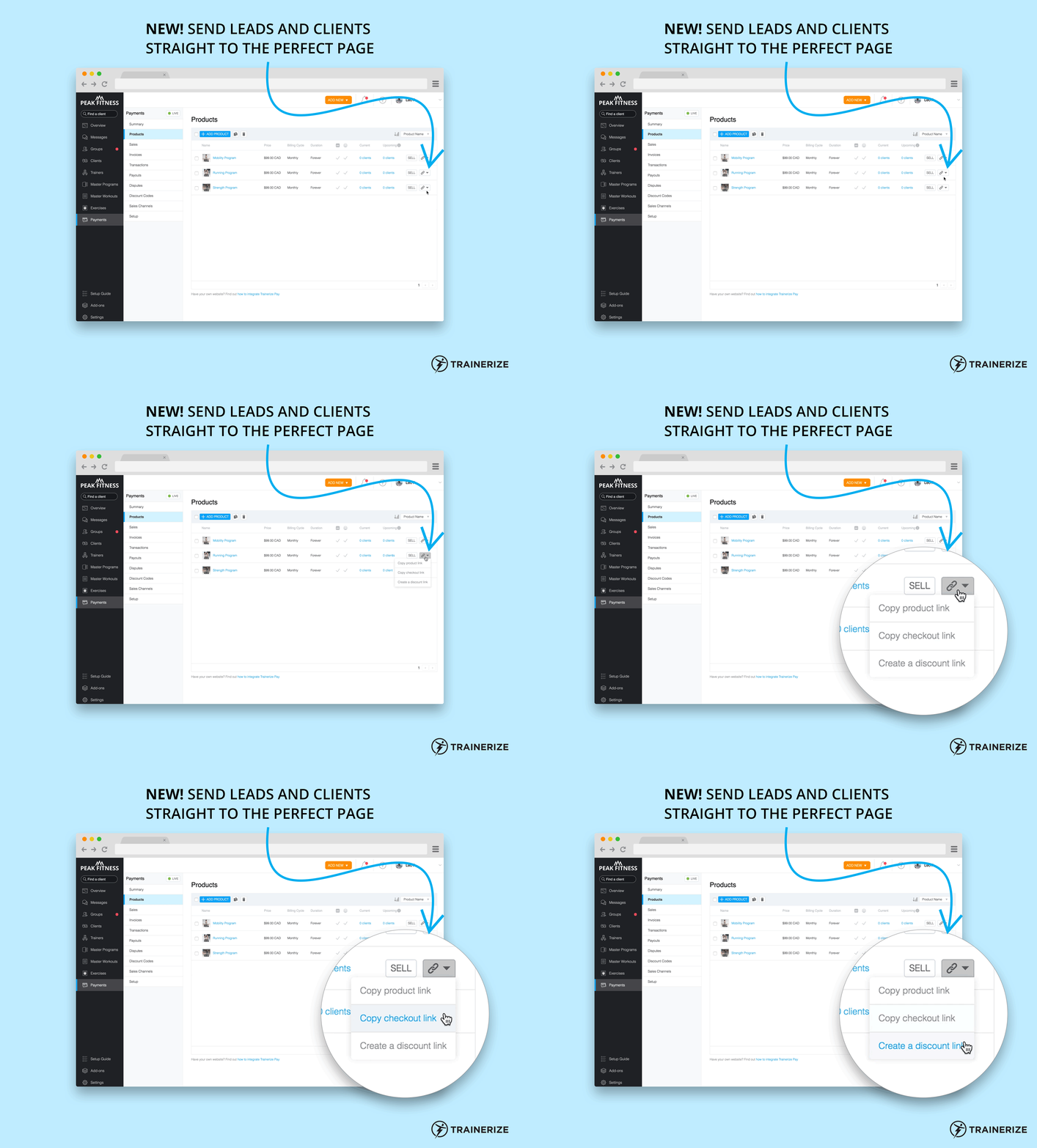
With our Stripe Integrated Payments add-on, automatic delivery starts from one product link. One link can assign a program to one client or hundreds. Memberships, add-on content, and session credits are delivered automatically after purchase too.
Make the first week easy with a simple client onboarding flow:
- Send a short welcome message the moment they buy.
- Share a first-week plan with one clear goal.
- Ask for one small win, like a first workout logged.
Don’t forget to set terms before the sale. Decide your policy on cancellations, pauses, and refunds, and show it at checkout in plain words. This protects your time, revenue, and avoids awkward conversations down the line.
If you coach in person too, session packs can sit next to digital programs so clients can buy both in one place.
Mike Monti tripled client numbers with ABC Trainerize
[customer quote] “By adding ABC Trainerize and taking my business online, I’ve been able to reach people across the globe and am no longer limiting myself to potential clients only living in surrounding neighborhoods.” – Mike Monti, Mike Monti Fitness
#5 Get Buyers to the Checkout
The last step in how to sell fitness programs online is to send people to your offer page.
Start with people you already reach: current clients, your email list, and the link in your bio. They already trust you, so your first sales usually need the least convincing.
Pick one lead magnet and one offer. Pitching every model at once confuses people. A short free guide that leads into your program is plenty.
👀Free Resource: Get 30 Clients in 30 Days: Free Guide
FAQs: How to Sell Fitness Programs Online and Get Paid
1. How do personal trainers sell workout programs?
They pick a niche, package the outcome, choose a model (one-off program, package, or membership), connect a payment processor, deliver access automatically after purchase, and promote one offer to people they already reach, such as current clients and their email list.
2. How do personal trainers get paid online?
To get paid as a personal trainer online, most use Stripe. Creating and verifying an account may take 3-5 business days. Then set up your offer and share a payment link, or take a card on file at checkout. Stripe payouts take up to 7-14 business days. With our Stripe Integrated Payments add-on, the same sale also delivers the program.
3. Should I sell programs, packages, or memberships?
You can start with the model that matches how you coach. Sell training packages online for in-person and hybrid clients. Offer one-off programs for self-paced clients, and memberships for clients who want ongoing support. Pick one, then add a second once the first grows in capacity.
4. What happens when a client’s card fails?
Depending on your setup, the payment platform may retry it, and some declines need a new card. Send a short, friendly message with a way to update the card. Payment processors like Stripe handle the charge on its own, but you manage client access manually.
5. Do I need a website to sell workout programs?
Typically, a personal trainer might need at least a simple landing page. It depends on what you sell. A one-off program can start with a payment link alone, while packages and memberships usually need a page that explains what’s included and who it’s for.
How to Sell Fitness Programs Online With ABC Trainerize
To recap how to sell fitness programs online: pick one clear offer, let a card on file or a payment link take the money, and deliver the program the moment they pay. Stripe handles the payment, but it can’t deliver your program.
For that, you need a platform that ties payment to delivery, and more. With ABC Trainerize, you build programs, take payments, and deliver access automatically, all in one place.
Bring your first client for free. Start today!