
TL;DR: Most personal trainers need personal trainer insurance that includes general liability insurance and professional liability insurance. A gym may require proof before you train on-site, while online, studio-owning, and employing trainers may need different protection. This guide explains four main coverage types, current cost examples, and nine providers to compare.
While most working personal trainers need personal trainer insurance, the exact answer depends on how and where you coach.
- If you are self-employed and train in a gym or studio, the facility may ask for a Certificate of Insurance (COI) before you can work on the floor.
- If you are employed, ask what the gym’s policy covers and whether it protects you individually.
- If you coach online, your advice can still create professional risk, so online training insurance may matter even without a physical location.
Think of insurance as one part of starting a personal training business. Your training model determines the gaps: a solo coach usually starts with liability coverage; a studio owner may add property protection; and a trainer with employees may need workers’ compensation. Trainers serving online clients should also confirm that remote instruction is included rather than assuming an in-person policy follows them online.
Below, we break down the types of insurance, what they cover, current provider pricing, and some of the best insurance for personal trainers to compare.
Why Personal Trainers Need Insurance
Accidents happen, even in the safest training environments. The National Safety Council estimates exercise and exercise equipment accounted for 564,845 injuries treated in U.S. emergency departments in 2024. That’s the most of any sports or recreation category. 😬
Insurance for independent trainers can protect both you and your client when something goes wrong. It may help with covered medical expenses, property damage, legal defense, or allegations that your programming or instruction caused harm.
It also protects your ability to work. Many commercial gyms require independent trainers to show a Certificate of Insurance (COI) before coaching clients on the floor. A Certificate of Insurance guide from Travelers explains that a COI summarizes active coverage, limits, and effective dates. Some facilities may also require you to list them as an additional insured. This is usually a contractual requirement, not proof that every trainer is legally required to carry the same policy.
One more potential upside: the IRS small-business tax guide says premiums for liability, malpractice, workers’ compensation, and certain other business-related insurance may generally be deductible when they meet the ordinary-and-necessary rules. Tax treatment depends on your circumstances, so confirm it with a qualified tax professional.
📝 Read More: How to Navigate Tax Season for Personal Trainers
4 Types of Insurance for Personal Trainers
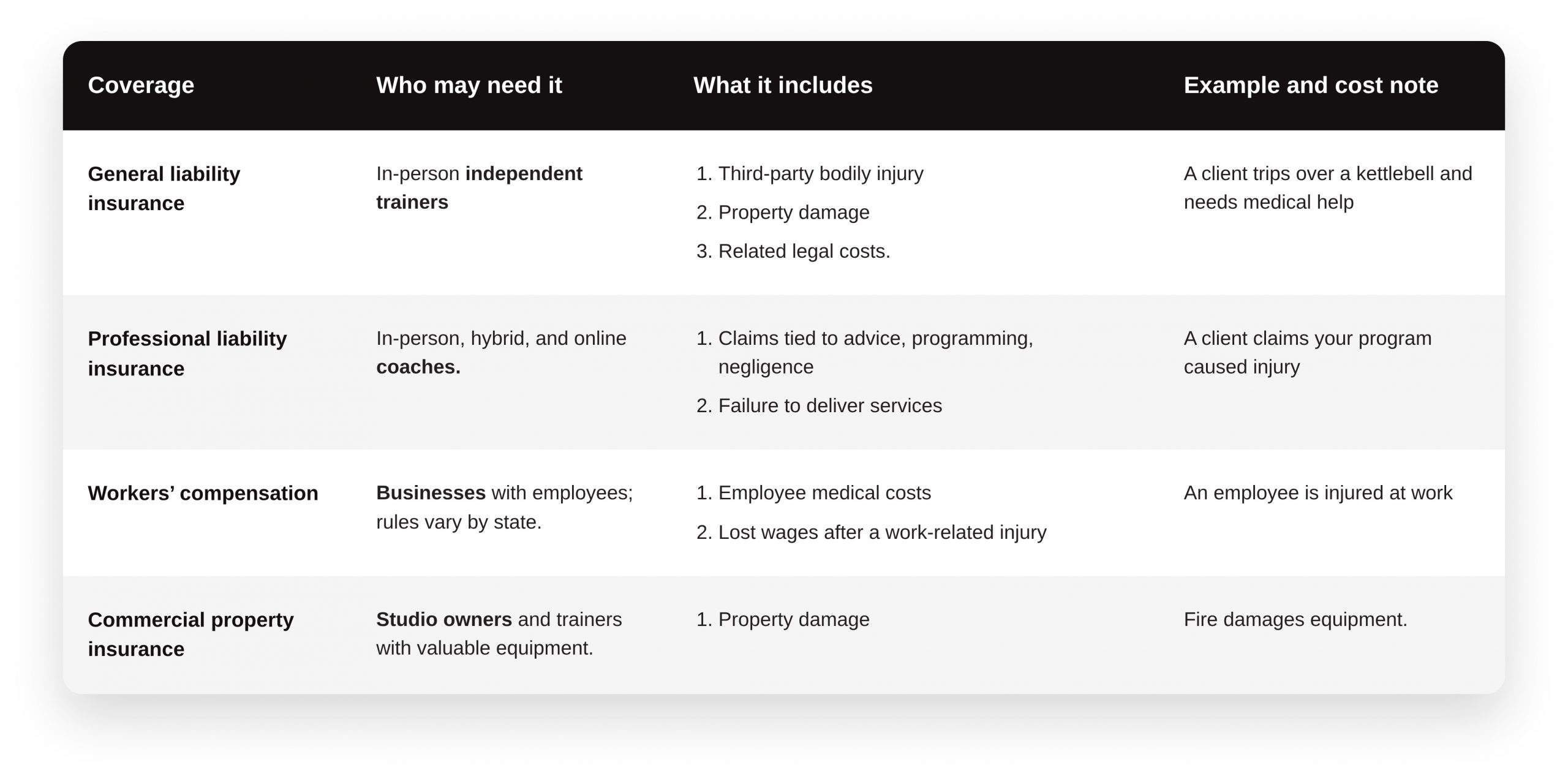
The best personal training insurance covers a few different risks. The U.S. Small Business Administration‘s insurance overview distinguishes general liability from professional liability and other business coverage. Here is the at-a-glance version for fitness professionals:
General liability insurance
General liability is your baseline. It covers the cost associated with third-party bodily injury (AKA the “slip and fall” insurance) during a session. This is probably the first policy gyms are looking for when they request a COI. 🤝
A COI is a one-page document from your insurer confirming you have active coverage. Gyms use it as proof before letting you train on their floor, and some require you to list them as an “additional insured.”
Coverage typically follows you across locations (the gym, a park, a client’s home), but specifics vary by policy.
Professional liability insurance
Professional liability (sometimes called “Errors and Omissions”) protects you from claims tied to your advice or expertise. If a client claims your programming caused an injury or your nutrition guidance led to harm, this is the coverage that has your back.
This one matters for online trainers, too. Even without a physical training space, you’re still giving advice clients act on, so you’re still vulnerable to negligence claims.
Workers’ compensation insurance
Workers’ comp only comes into play if you employ other trainers or staff. It covers medical costs and lost wages if an employee gets hurt on the job. If you’re a solo trainer, you generally don’t need it. State requirements vary, though, so check local rules as your business grows.
Commercial property insurance
If you own equipment, rent training space, or run a small PT studio, commercial property coverage protects your physical assets. This type of insurance is a lifesaver in the event of theft, fire, vandalism, or weather damage. ⛈️
Some providers bundle commercial property with general liability in a Business Owner’s Policy (BOP) for a discount. This is often the most cost-effective route if you have your own equipment or location (e.g., run a personal training studio).
Additional coverage to consider
There are a few extras worth flagging.
- Personal accident coverage helps if you get hurt and can’t work.
- Loss of earnings coverage gets you income protection while you recover.
- Equipment coverage may protect portable gear.
You may also want to check out equipment coverage if you own pricey gear. 💰
Which personal trainer insurance coverage might you need?Solo, in-person trainer: Start by comparing general and professional liability, then confirm COI and additional-insured requirements with every facility. Online-only trainer: Prioritize professional liability and verify that live sessions, asynchronous programs, client locations, and your full scope of practice are covered. Studio owner: Consider general and professional liability plus commercial property and business-interruption options. Trainer with employees: Check state workers’ comp requirements and whether your policy covers employees, contractors, or both. Insurance does not replace good business practices. Use appropriate screening, a written scope of services, informed consent, and a personal trainer contract reviewed for your location and business model. |
How Much Does Personal Trainer Insurance Cost?
Personal trainer insurance can be relatively affordable for a solo coach, but the old blanket range of $10 to $35 per month hides important differences. At the time of review, several individual liability programs advertised starting prices between $11 and about $16 per month when paid annually. Insure Fitness Group listed $189 per year for combined general and professional liability, while other providers used different limits, memberships, eligibility rules, or quote-based pricing.
The National Association of Insurance Commissioners small-business guide notes that liability premiums can reflect factors such as business type, sales or payroll, claims, operations, and state law. Compare limits, deductibles, exclusions, coverage form, additional-insured fees, and online-training terms – not just the headline price.
Prices and coverage last checked: Sep 6, 2026. Advertised prices are examples, not guaranteed quotes. Availability and final premiums vary by location, certification, training activities, limits, payroll, claims history, and add-ons.
Read more: How Much Should Personal Trainers Charge in 2026?
4 Factors that affect your premium
A few things move the needle on what you’ll actually pay:
- Training location: Gym, in-home, outdoors, or fully online. More physical risk usually means a higher premium.
- Solo vs. team: Adding employees triggers workers’ comp requirements and pushes costs up.
- Coverage limits and deductibles: Higher limits cost more. So do lower deductibles.
- Annual revenue and claims history: A growing business with past claims may have to pay more than a brand-new solo trainer with a clean record.
- Services and add-ons: Nutrition guidance, group training, specialty modalities, equipment, cyber coverage, and identity protection can change eligibility or price.
No matter what coverage you choose in the end, you’ve gotta know what’s out there so you can protect yourself and your clients. DO. YOUR. RESEARCH.
Speaking of which… 👇
9 Best Insurance Companies for Personal Trainers
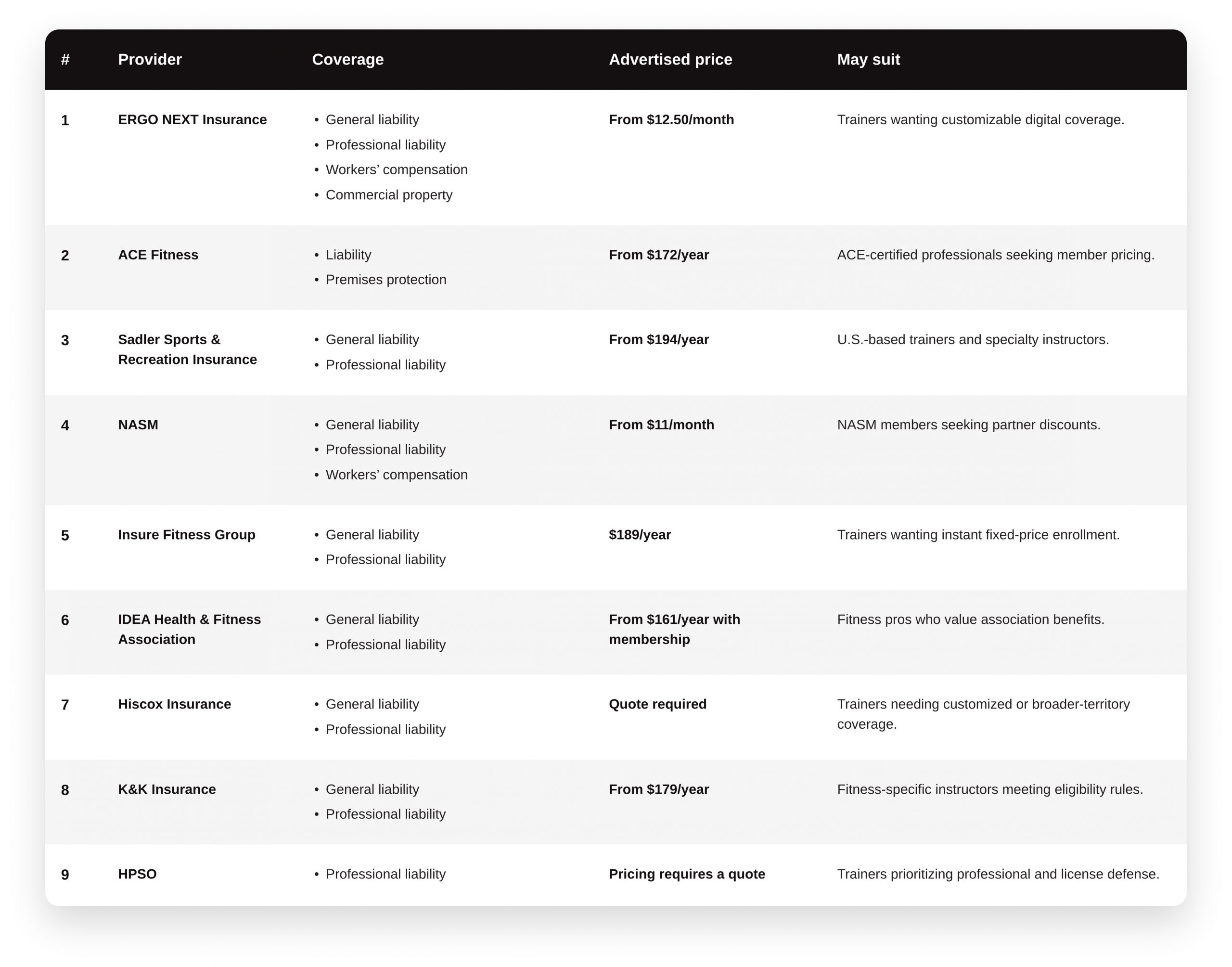
Here are some of the best personal trainer insurance providers to look into. Each one is solid, but the best one for you depends on where you work and what you offer.
ERGO NEXT Insurance
What they cover: General liability, professional liability, workers’ comp, and commercial property, a pretty comprehensive stack, if you ask us. You can also get an Instant Quote in about 10 minutes to get the price tailored to your business.
Pricing: Personal trainer policies start as low as $12.50/month, with general liability averaging $16/month for most customers.
Best for: Trainers who want fast coverage with flexible bundles they can tailor to their business.
ACE Fitness
What they cover: Liability coverage for ACE-certified and non-certified trainers (discount if you hold the cert), in 1-year or 2-year terms. Explicitly includes outdoor training.
Pricing: Varies, but around $12-18/month for a 1-year term (billed annually). Depends on the term, coverage you choose, and whether you’re ACE-certified.
Best for: ACE-certified trainers wanting cert-aligned coverage and outdoor protection.
Sadler Sports & Recreation Insurance
What they cover: General and professional liability for U.S.-based personal trainers, with an option for extended coverage for multiple locations and online training. Also covers specializations in yoga, Pilates, HIIT bootcamps, etc.
Pricing: 1-year premium for certified instructors starts around $16/month ($194/year, billed annually).
Best for: U.S.-based trainers who want to do specialized small-group training in multiple locations or online.
📝 Read More: How to Become an Online Personal Trainer
NASM
What they cover: General and professional liability underwritten by NEXT Insurance, tailored to NASM-certified trainers. Includes additional insureds (gym, client’s home, park).
Pricing: Starts as low as $11/month (6% discount if you’re NASM-certified).
Best for: NASM-certified trainers who want fitness-specific coverage at a low monthly rate.
📝 Read More: Best Personal Trainer Certification
Insure Fitness Group
What they cover: Professional and General Liability coverage at multiple locations, including online. 500+ modalities, including TRX, CrossFit, Strength training, etc.
Pricing: Around $15-16/month ($189 for a 1-year term, billed annually).
Best for: Trainers who want to skip the waiting period and get instant coverage for different training modalities.
IDEA Health & Fitness Association
What they cover: Professional liability insurance coverage organized by profession, including options for group fitness, older adults, gyms, triathlons, etc. Plans include IDEA membership.
Pricing: Basic Plan starts as low as $9-10/month ($111/year, billed annually).
Best for: Personal trainers who want professional liability insurance AND an IDEA membership.
Hiscox Insurance
What they cover: Professional and General Liability coverage with a footprint outside the U.S., a good option when you have international clients. They also have options for BOPs and Cyber Security coverage.
Pricing: Varies depending on plan. May range from around $33-45/month.
Best for: Trainers with international clients and a higher budget.
K&K Insurance
What they cover: General and Professional Liability insurance with no charge for COIs. Coverage can be tailored to fit virtual training, dance instructors, sports instructors, health clubs, etc.
Pricing: Premium starts around $15/month ($179/year, billed annually).
Best for: Trainers who want fitness-specific providers with a long-standing history (K&K has been operating for 70 years).
HPSO (Healthcare Providers Service Organization)
What they cover: Professional Liability coverage for fitness professionals, with policies built around malpractice and license protection.
Pricing: Varies depending on plan. May range from $8-33/month ($100-400/year, billed annually)
Best for: Trainers who want malpractice and license protection alongside standard liability.
📝 Read More: How Business Courses Can Take Your Personal Training Career to the Next Level
FAQs about personal trainer insurance
1. Do personal trainers need insurance?
Usually, yes. Independent trainers commonly need general liability insurance and professional liability insurance, and a gym may require proof before allowing them to train clients. The legal position varies by location and business structure, so check local rules and your contracts.
2. What insurance should a personal trainer have?
A solo trainer usually starts with general and professional liability. Add commercial property if you own substantial equipment or a studio, and check workers’ compensation requirements if you employ staff. Your services, location, and client population may create additional needs.
3. What is the difference between general and professional liability insurance?
General liability covers third-party bodily injury and property damage, such as a client tripping over equipment. Professional liability covers allegations about your advice or services, such as a claim that your program caused injury. Many personal-trainer policies bundle both.
4. How much does personal trainer insurance cost?
Personal trainer insurance cost varies, but several providers in this guide advertise entry prices around $11 to $16 per month or approximately $161 to $194 annually for certain individual plans. Limits, deductibles, location, certification, activities, employees, and add-ons can change the quote.
5. Do gyms require personal trainers to carry insurance?
Many do, particularly when a trainer is an independent contractor. The facility may request a COI and may ask to be listed as an additional insured. Ask for its required limits and wording before buying a policy.
6. Do I need insurance if I only train clients online?
Yes. Professional liability still applies to online trainers because the risk follows your advice, not your physical location. If a client claims your program caused an injury, you can be named in a claim whether you trained them in person or through an app. Check out our list of some of the best insurance for personal trainers above. 👆
7. What is a certificate of insurance and why do gyms require it?
A certificate of insurance (COI) is a short document from your insurer confirming active coverage and listing your policy limits. Gyms require it to verify you’re insured before you train on their floor, and many ask to be listed as an additional insured. The best personal trainer insurance providers issue COIs at no extra cost.
Build Your Personal Training Business with ABC Trainerize
Personal training insurance removes one source of uncertainty so you can focus on coaching, programming, and growing your client roster. Once your coverage is sorted, the next step is putting the rest of your business on solid ground.
ABC Trainerize helps independent trainers deliver programs, manage clients, take payments, and scale without burning out, all from one platform.
Start your free trial and see what a streamlined coaching business looks like!