
How do you start an online fitness business?
To start an online fitness business, choose a niche, create a coaching or program offer, and use a platform to deliver your services. You’ll also need to build an audience through content and marketing. Consistency and clear positioning are key to growing sustainably.
Basic steps to start:
- Choose your niche (e.g., weight loss, strength training)
- Create your offer (1:1 coaching, group programs)
- Select a platform (like ABC Trainerize)
- Build an audience through content
- Launch and refine your services
Personal training has become one of the biggest revenue drivers in the fitness industry. The segment now makes up nearly half of all global health club revenue, and it’s on track to keep growing by more than 10% a year through 2032. For coaches building a business right now, that’s real, sustained demand to tap into.
And more of that demand is shifting online. The online fitness market is projected to grow from the mid-$30 billion in 2026 to roughly $120 billion by 2031, as clients increasingly look for coaching they can access from anywhere.
Starting an online fitness business puts you right in the middle of that shift, letting you scale by tapping into new niches and expanding well beyond your geographic location. Not sure where to begin? Here’s the list of 10 steps to get you started!
📝 FREE RESOURCE: New Business Checklist for Personal Trainer
Table of Contents
- Why Start an Online Fitness Business?
- A 10-Step Guide to Starting an Online Fitness Business
- #1: Establish an audience and a niche
- #2: Get certified
- #3: Register your business
- #4: Determine a business model
- #5: Make a business plan
- #6: Build a website
- #7: Set up your equipment and tech
- #8: Create content
- #9: Brush up on your business skills
- #10:
- How ABC Trainerize Can Help Online Trainers
Why Start an Online Fitness Business?
Not every online fitness business looks the same, and the split is bigger than you might think. According to the 2026 State of the Personal Training Industry Report:
- 48% of trainers are hybrid coaches: In-person sessions plus app-based programming and check-ins
- ~32% of trainers do online-only coaching: Fully digital, no physical location
- ~14% of trainers only do in-person coaching: Traditional face-to-face training, sometimes with light digital add-ons
Whichever model you land on, going online opens up a genuinely global client base as you’re no longer limited to who can drive to your gym or studio.
And this isn’t a short-term bump. The growth behind it is expected to keep compounding well into the next decade, which makes this more than a good career move. It’s a real business opportunity that doesn’t look like it’s slowing down anytime soon.
That opportunity shows up in practical ways, too. You can add a package that allows clients to purchase customized nutrition plans as an add-on to your on-demand workouts or monthly membership fees. Or you can run specialized workshops or weekly classes on topics of interest to your clients, the possibilities are endless!
Check Out: Learn the A-Z of Starting Your Online Training Business with ABC Trainerize Academy
A 10-Step Guide to Starting an Online Fitness Business
Starting an online fitness business requires a bit of upfront planning, but we promise it’s well worth the effort it takes to build the business of your dreams. These 10 easy steps will get you started in no time.
Free Resource: How to Start Your Side Hustle Fitness Coaching Business
#1: Establish an audience and a niche
We won’t spend too much time on this point because we’ve nailed it home so often, but like any good business plan, it all starts with knowing your audience and establishing your niche.
Because when you take the time to understand who you’re talking to, then you learn what problem you’re helping your clients solve. And when you know what people want to solve, you can match your services to meet their needs.
When choosing a niche, we recommend starting with a broad one and then niching down. Some popular broader fitness niches include:
- Yoga: (The most widely practiced activity in US clubs, with participation up to 21.8% of fitness facility members)
- Strength training (The fastest-growing equipment category since 2021(
- Pilates (Steadily climbing, now at 8.1% participation)
- Pickleball (Up 21.3% year over year to 7.6 million members)
- Tai chi (Continued steady growth alongside Pilates)
- Spin
- Barre
- CrossFit
- Zuma
Once you know your broader niche, you can narrow it down even further by identifying the target audience you’d like to serve. For example, do you want to teach yoga to prenatal moms? Or would you love to help athletes build muscle and recover from sports injuries?
We recommend thinking about what excites you in the industry and the type of people you’d like to serve because it’s much easier to build a business when it’s doing something you love.
Check Out: How to Find Your Niche as a Personal Trainer
#2: Get certified
According to ISSA’s 2025 Human Advantage report, 64% of certified fitness professionals believe AI will make certification more valuable over the next five years, not less, compared to just 13% who expect the opposite.
As AI makes it easier than ever for anyone to look legit online, a real credential is what actually sets you apart. Once you know who you want to coach and what outcome you help them achieve, choose a certification that supports that direction.
Start with a nationally recognized personal training certification for your region, then consider one specialization that fits your niche. For example, pre- and post-natal training, strength and conditioning, corrective exercise, nutrition coaching, or behavior change.
The top three most recognized global certifications are from NASM (National Academy of Sports Medicine), ISSA (International Sports Sciences Association), and ACE (American Council on Exercise).
Level Up Your Coaching: Explore the All-New ABC Trainerize Academy
Certification is not just a box to check. It can shape your positioning, your programming approach, and the level of confidence clients have in choosing to work with you.
If you’re unsure, pick the credential most widely accepted in your area, and add an add-on certification once you start getting real client feedback.
Check Out: Best Online Personal Training Certifications
#3: Register your business
Before you start accepting payments or coaching clients online, get your business set up properly in your region. Start by registering your business name and applying for any required licenses. You’ll also need to choose a legal structure.
In many countries, trainers can operate as sole proprietors (individuals) or form limited liability companies. A sole proprietor setup is usually faster and simpler, while a limited company can provide stronger separation between personal and business liability as you scale.
For a deeper breakdown of the options and how to choose the right one for your business, see our guide to business structures for coaches.
Next, set up your tax basics. Register for any required local tax IDs, confirm how to report income, and check whether you need to charge sales tax or VAT on digital services.
Finally, protect yourself with insurance and paperwork. Look into professional and general liability coverage, make sure it includes online coaching, and use clear client waivers and agreements.
#4: Determine a business model
When it comes to building your online business, it’s important to take the time to think about what business model you’ll use.
The great news is that it’s completely up to you as an entrepreneur! Some of the most popular models include one-on-one classes, group live-stream classes, and pre-recorded classes.
- One-on-one classes: These are essentially online personal training sessions. It’s a lot like having your personal training clients in the gym. But you can be more flexible with your schedule and reach a wider audience beyond your current location.
- Group live stream classes: This is one of the best-selling business models available to you. You earn more revenue per hour, train more clients per session, and clients who train in groups tend to stick around longer thanks to the built-in accountability and community. Keep in mind that these classes require you to show up live to teach, and the number of clients who can attend depends entirely on the platform you choose to stream from.
For the numbers behind this, see 5 Reasons to Add Group Personal Training to Your Fitness Business in 2026.
- Pre-recorded or on-demand classes: Pre-recorded or on-demand classes are pre-recorded workouts you upload for clients to purchase. In this model, clients pay either a flat rate or a monthly rate to access your videos. You can also include add-ons such as meal plans or 1-1 coaching sessions.
When choosing your business model, take the time to consider what model best helps you reach your financial and flexibility goals. And don’t be afraid to combine several models to maximize your profit and reach!
The easiest way to run any of these models is through a custom-branded app built for it.
Read More: Personal Trainer Business Apps: Top Picks to Grow, Coach, and Scale
#5: Make a business plan
Once you know your niche and the types of classes you’d like to host, it’s time to create a business plan. Writing a business plan doesn’t need to be complicated, and many free downloadable templates are available online.
When creating your business plan, the most important things to consider are how much it will cost to run your business compared to the revenue you’ll bring in.
Additionally, when writing your business plan, consider your unique selling point or what it is that sets you and your services apart. Doing so will help you build out other areas of your plan, such as your marketing strategies.
FREE RESOURCE: New Business Checklist for Personal Trainer
See What’s Possible: Explore ABC Trainerize Features to see the tools built to help you plan, launch, and deliver your online coaching business from day one.
#6: Build a website
Once you have a solid business plan and a strong knowledge of who you serve, it’s time to build your online presence. This doesn’t have to mean a big, complicated website. Depending on your goals and budget, your online presence could be a landing page, a full website, a branded app, or some combination of the three.
- Landing page: One page that explains who you are and what you offer, with a single clear way to book or get in touch. The fastest way to look legitimate online.
- Website: A more built-out option with a homepage, about page, and contact page, useful if you want a home base for content and SEO over time.
- Branded app: Your own coaching experience under your own name, where clients train, track habits, and message you.
If you go the website route, you can build it on a platform like Wix, Squarespace, or GoDaddy, or have someone build it for you.
The most important pages to include, if you build a full site, are your homepage, about page, and contact page.
- Homepage: On your homepage, you’ll put all the information you have about your services and what you do. Be sure to explain why people should train with you and purchase your services.
- About page: When a business is new, people visit the about page to confirm that your company is reputable. So, it’s here where you’ll want to tell them everything about you and your experience. Don’t be afraid to bring your personal fitness journey into the mix. It’s a great way to help people relate to you.
- Contact page: Be sure to include a way for people to contact you, whether it’s through a fillable form that goes right to your inbox or a page with your email and contact info.
Finally, be sure to include a sign-up form for your fitness newsletter. It’s a great way to build an email list of new leads.
Check Out: Best Fitness Website Builders: Tools to Launch Your Fitness Business Online
#7: Set up your equipment and tech
Depending on the type of fitness classes you’ll be running, you may need some equipment—whether it’s a yoga mat, pilates reformer, weights, or exercise ball. Take the time to think about all the equipment you’ll need, including a way to play music.
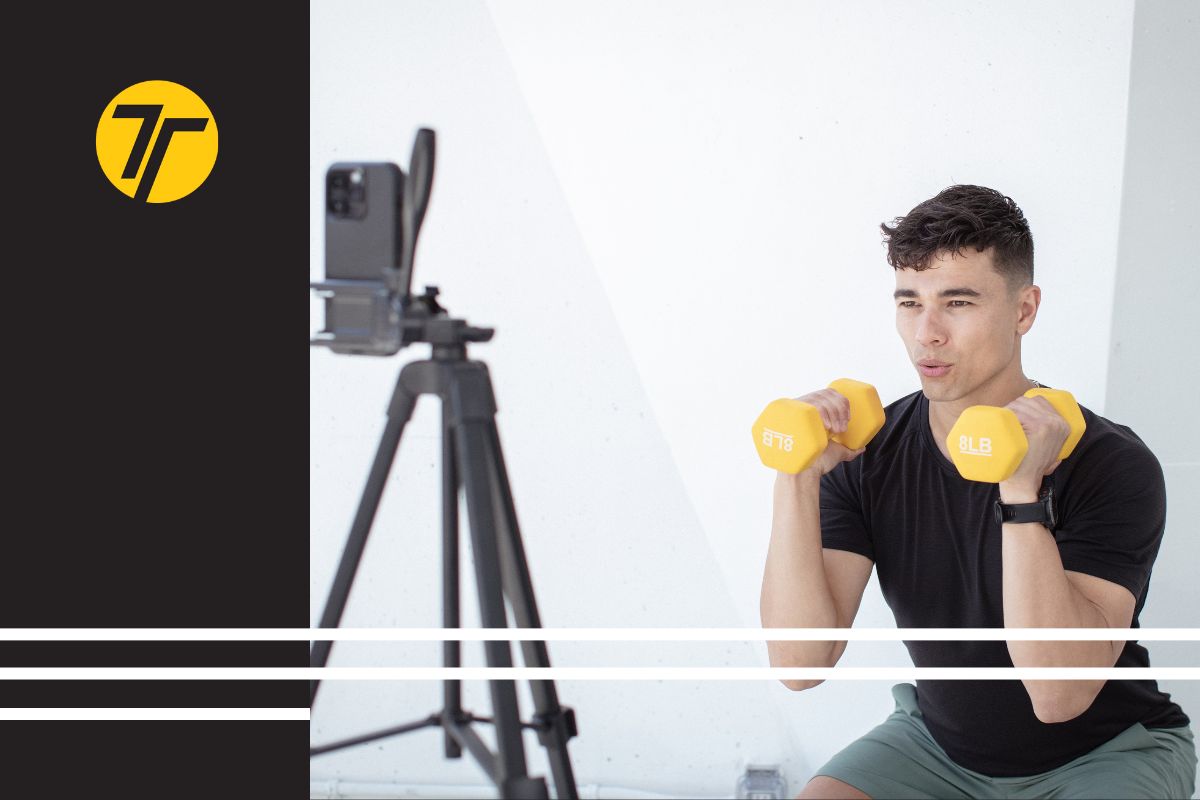
In addition to exercise equipment, consider what you’ll need to record your videos, including a high-quality camera and additional lighting. Doing so will give your videos that added professional feel.
#8: Create content
Creating content is a big part of your online fitness business. From social media posts to blog posts and videos, high-quality content is one of the best ways to position yourself as an industry leader.
If Instagram is your main channel, check out our Ultimate Guide to Instagram Marketing for Fitness Professionals.
Leaning into TikTok instead? Our Ultimate Guide to TikTok for Fitness Professionals breaks down how to use the platform to grow your business.
When creating content, don’t be afraid to keep your fitness journey at the forefront. Your audience will resonate with the wins and struggles you’ve had along the way.
Finally, the great thing about taking the time to create high-quality content is that you can repurpose it. For example, you can take a blog post and easily shorten it to a social post or even convert it into a video. For some great content ideas, start here.
Free Resource: The Social Media Cheat Sheet for Personal Trainers
#9: Brush up on your business skills
Don’t worry; when it comes to brushing up your business skills, we’re not talking about running out and grabbing a new degree. However, understanding a few business basics, such as bookkeeping, write-offs, and tax preparation, can go a long way toward setting your business up for success from the start.
One of the fastest ways to close these gaps is through ABC Trainerize Academy, which offers courses built specifically for coaches on pricing and packaging, client retention, sales, and the fundamentals of running a personal training business.
For a broader roundup of options, check out our guide to business courses for personal trainers.
Some great people to talk to before you launch are an accountant. An accountant can help you prep, and a lawyer can make sure you have the right liability and release forms for your clients.
#10: Market your business
Once you’ve completed all the other steps in this article, it’s time to get out there and market your brand-new fitness brand!
Without marketing, there will be very few clients, so take the time to write a solid 12-month marketing plan, then get out there and promote, promote, promote!
For a deeper breakdown of channels, messaging, and how to actually convert interest into paying clients, check out our full guide to personal trainer marketing.
And if client acquisition is where you’re stuck right now, How to Get More Personal Training Clients: 9 Proven Ways has tactical next steps.
Finally, starting an online fitness business is a fantastic way to scale your business and achieve financial freedom in 2025!
How ABC Trainerize Can Help Online Trainers: Let Fitness Tech Carry the Workload
Every step in this guide gets easier with the right technology behind it. ABC Trainerize brings a lot of it under one roof:
- Program delivery: Build and assign 1:1, group, or on-demand programs with the AI Workout Builder, matching whichever business model you chose in Step 4.
- Client engagement: In-app messaging, habit coaching, and progress tracking keep clients connected between sessions, the same retention lever behind group training.
- Nutrition: The Smart Meal Planner adds a nutrition offer without you building meal plans from scratch.
- Business tools: The Business add-on handles booking, payments, and lead capture, so the admin side of this guide runs itself.
- Your own brand: A custom branded app puts your name on the experience clients open every day, the same branded presence covered in Step 6.
Conlcsions
Starting an online fitness business in 2026 comes down to a handful of decisions: your niche, your business model, your online presence, and the systems you use to deliver all of it. Get those right, and you have everything you need to become an online fitness coach clients trust, not just for a launch, but for a business that keeps growing.
See for yourself by starting a free trial today! Start today!