
If you’ve started comparing online coaching platforms, you already know the problem. Every option promises the same things and every pricing page hides something.
The decision carries more weight in 2026 than it did two years ago. Roughly half of all coaches now run hybrid as their primary delivery model, according to the 2026 State of the Personal Training Industry Report from ABC Trainerize.
This guide cuts the category down to size. You’ll learn which platform types exist, what sets them apart, and where most fall short. You’ll have a clearer framework for finding a platform that fits the way you coach.
Key Takeaways
- Choose a platform based on how you coach, not just the brand name.
- Look beyond the advertised price and factor in add-ons, payment fees, and other costs.
- Switching platforms takes time, so prioritize a solution that can support your business as it grows.
What Makes an Online Coaching Platform Worth Using?
The strongest tools centralize client management, workout delivery, nutrition planning, and progress tracking in a single platform. So before you compare brands, focus on the features that matter most to your coaching business. Here is what to measure every option against.
The 5 Core Functions Every Platform Must Cover
While every platform offers a different mix of features, a few essentials should be non-negotiable.
- Program Delivery: Create workouts, assign them to clients, and include exercise videos and instructions.
- Client Communication: In-app messaging and check-ins keep coaching conversations out of WhatsApp threads and email chains.
- Progress Tracking: Measurements, photos, assessments, and performance data belong in one progress tracking dashboard.
- Payment Processing: Recurring billing, package management, and automated invoicing should run inside the platform
- Scheduling and Onboarding: Collect client information, set goals, and book sessions through the platform.
Where Do Most Platforms Fall Short?
Most platforms run into one of three common issues.
- Some offer lots of features but take time to learn. Others are easy to use at first, but become limiting as your client base expands.
- Pricing can also be misleading, with extra fees for features like nutrition coaching, automation, branded apps, or advanced forms.
- Finally, don’t overlook the client experience. A platform that’s easy for you but frustrating for clients can hurt engagement and retention over time.
Platform Categories: Matching the Tool to Your Coaching Model
Once you understand what an online coaching platform needs to do, the next step is figuring out where each type of tool actually fits. Identify the category that best matches how you coach to significantly narrow your options.
Fitness-First Platforms (Built for Personal Trainers)
Online fitness coaching platforms treat workout builders, exercise video libraries, body composition tracking, nutrition plans, and habit modules as native features.
Popular examples include ABC Trainerize, TrueCoach, PT Distinction, Everfit, and My PT Hub. These platforms are typically the best fit for trainers, gym owners, and sports performance coaches who deliver personalized training programs.
Recommended Read: ABC Trainerize vs. Everfit vs. TrueCoach vs. MyPTHub: Which Fitness Coaching Platform Is Best?
General Coaching Platforms (Built for All Coaches)
This category supports multiple coaching niches, including fitness, nutrition, life, business, and wellness program delivery. General coaching platforms offer strong client management, scheduling, communication, and payment tools.
CoachAccountable, Paperbell, Satori, Practice, HoneyBook, and Dubsado all fit here, though their fitness-specific features, like workout delivery and exercise libraries, are limited.
Course and Content Platforms (Built for Scale)
Course platforms are designed to sell digital courses, memberships, and group programs to larger audiences. Popular options include Kajabi, Teachable, and Thinkific.
These tools work well if you’ve turned your coaching process into a course or digital product. Some trainers use them alongside a fitness coaching platform. That setup allows them to sell courses and digital products alongside live coaching, creating diversified revenue streams.
The Top Online Coaching Platforms for Personal Trainers in 2026
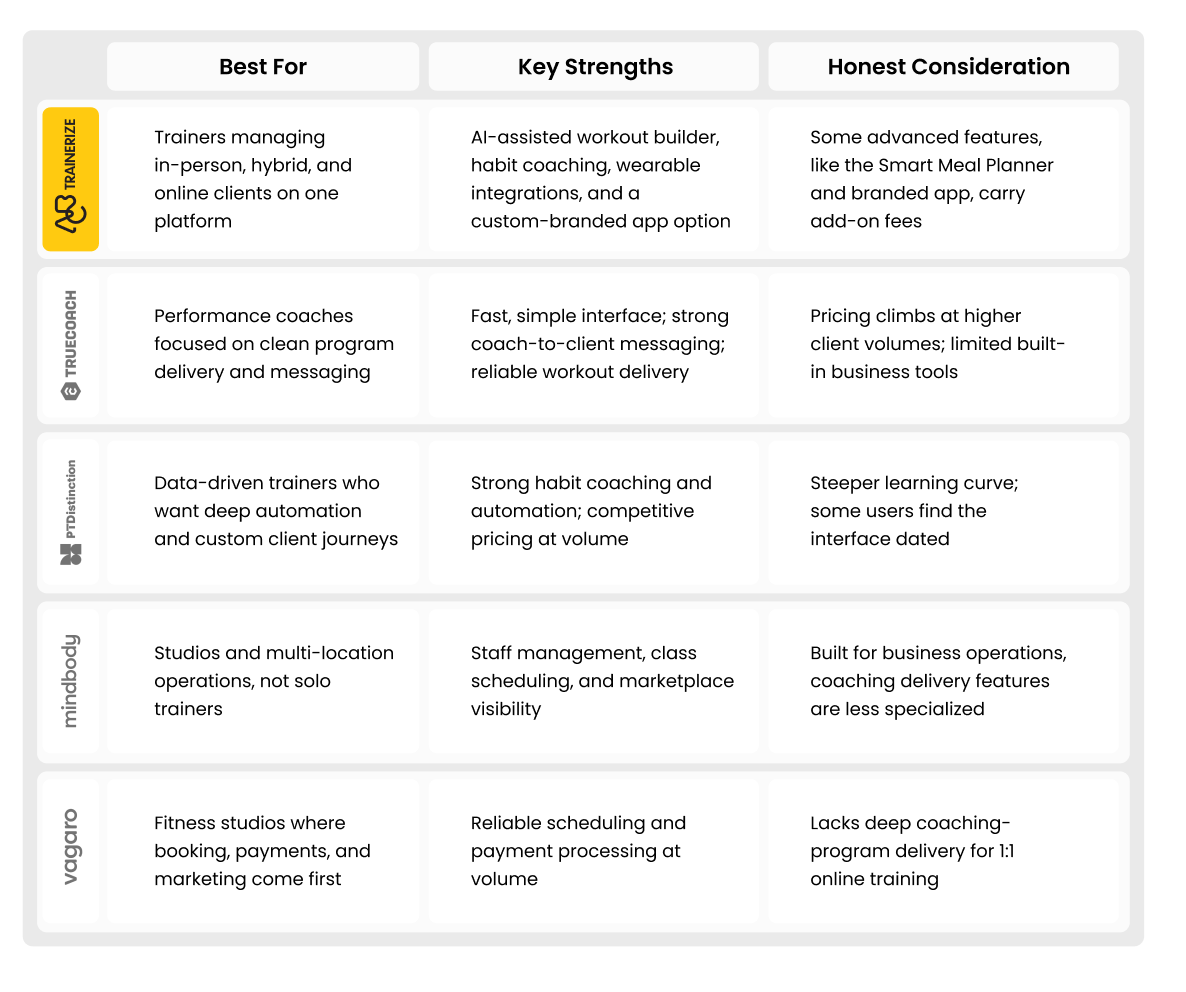
Read the table with your own coaching model in mind, and pay as much attention to the honest considerations as the strengths.
ABC Trainerize
ABC Trainerize is a fitness coaching platform that combines workout programming, nutrition tracking, habit coaching, client check-ins, payments, and a branded mobile app. It also includes an AI-assisted workout builder that creates draft programs based on client history, which coaches can edit before assigning.
The platform also integrates with wearable devices and health apps, including Apple Health, Garmin, and Fitbit, giving coaches real-time client biometric data between sessions.
Best For: Personal trainers and gym owners managing in-person, hybrid, or fully online clients, especially those scaling beyond 10 clients.
Pros:
- AI workout builder that speeds up program creation while keeping full coach control
- Stripe payments and Zapier integrations for connecting other tools
- Built-in habit tracking with streaks, badges, and engagement features
- Provides a branded mobile app experience, letting you put a professional, client-facing product on app stores at scale
Pricing: Paid plans start at $10/month, with a free plan for one client. Rates change, so verify the current pricing here.
Honest Consideration: Some key features, like the Smart Meal Planner and branded app, require add-on fees. Your real cost would depend on which features that you actually need.
What coaches report: Trainers who stay with Trainerize long-term most often cite the breadth of integrations and the habit-tracking module as the features that keep them from switching, particularly once clients are embedded in the app.
The most common friction point reported by coaches who left is feature overwhelm early on: the platform has more capability than most new users need at launch, which can make the first few weeks feel heavier than expected.
Coaches who stick through the setup curve consistently report that the time investment pays off at 15+ clients.
TrueCoach
TrueCoach is a streamlined coaching platform focused on workout programming, client messaging, and basic nutrition tracking through MyFitnessPal integration. It supports an asynchronous coaching style, where clients follow programs and submit check-ins on their own time while coaches review and respond between sessions.
Recommended Read: Trainerize vs TrueCoach vs Everfit: Best Software for Online Coaches (2026)
Best For: Performance coaches who mainly need simple program delivery and client communication without extra business management tools.
Pros:
- Clean, fast interface that clients pick up quickly
- Strong coach-to-client messaging with photo and video support
- Reliable workout delivery with a large exercise video library
Pricing: Starts at $26.34/month billed annually for up to 5 clients, with a 14-day free trial and no permanent free plan. Check current pricing before signing up.
Honest Consideration: Costs increase as your client base grows, and the platform has limited built-in business tools, so many coaches eventually rely on additional software.
What coaches report: TrueCoach earns consistent praise for one thing above all others: ease of use. Coaches who switched from more complex platforms specifically cite how quickly they got new clients onboarded and how rarely they needed support.
The most frequently reported reason for switching away from TrueCoach is hitting the business-management ceiling. Trainers who grow beyond 30–40 clients and want automated check-ins, built-in payments, and habit tracking often bolt on separate tools that TrueCoach doesn’t natively replace.
PT Distinction
PT Distinction is a highly customizable coaching platform built for automation and structured client journeys. It allows coaches to set up onboarding flows, intake forms, and program delivery systems that run automatically once configured, reducing manual work over time.
Best For: Data-driven trainers who want full control over client workflows and don’t mind a steeper learning curve.
Pros:
- Strong habit coaching and automation tools for hands-off client journeys
- Deep customization across programs, forms, and branding
- Competitive pricing at higher client volumes
Pricing: Starts at $19.90/month for up to 3 clients, rising to $89.90/month for up to 50 clients, with a 1-month free trial. Confirm current rates before signing up.
Honest Consideration: The platform can feel less modern than newer tools, and the client mobile experience is not as polished as that of fitness-first competitors. Its depth of features also means the setup takes longer before you see the full benefit.
What coaches report: The trainers who love PT Distinction tend to be the ones who invested time up front in building their automation sequences. Coaches who did the setup work report that the platform essentially runs their client journey without manual intervention.
The most common complaint from coaches who tried it and left is that the onboarding and interface felt overwhelming: “There are so many features that it takes time to figure out where to start.”
Coaches coming from TrueCoach or My PT Hub who want more automation depth are the most common switchers in.
Mindbody
Mindbody is a business management platform designed for studios, gyms, and wellness businesses, not solo personal trainers. It combines scheduling, payment processing, and client communication into a single system. Mindbody also includes a consumer marketplace that helps studios get discovered by people looking for classes and services nearby.
Best For: Gym owners and studio operators managing staff, class schedules, multiple locations, and client bookings at scale.
Pros:
- Reliable class and appointment scheduling built for studio environments
- Marketplace listing that can support client acquisition
- Staff management and multi-location reporting in one platform
Pricing: Starts at $99/month per location, with higher tiers depending on features. Payment processing fees apply separately. Always confirm current pricing directly with Mindbody.
Honest Consideration: Mindbody is a business operations tool that includes some coaching features, not a coaching delivery platform. For independent trainers, it usually costs more and delivers less programming depth than fitness-first software.
What coaches report: Mindbody users are almost exclusively studio owners or multi-staff operations. Independent trainers who try it consistently report that the pricing and feature set are designed for businesses larger than theirs.
The most common pattern: solo trainers sign up attracted by the marketplace visibility, then switch out within 6 months when they realize the coaching delivery features don’t match what fitness-first platforms offer at a fraction of the cost.
Vagaro
Vagaro is a booking and business management platform built for salons, spas, fitness studios, and wellness businesses. It handles scheduling, payments, and basic marketing in a single system and supports recurring memberships with automated billing and renewals. A consumer marketplace helps businesses get discovered by local clients searching for services.
Best For: Fitness studios and wellness businesses that prioritize bookings, staff scheduling, and marketing over deep coaching-program delivery.
Pros:
- Reliable scheduling and payment processing for high client volumes
- Built-in email and SMS marketing tools for client retention
- Marketplace listing that can help attract new clients without booking fees
Pricing: Starts at $30/month for one bookable calendar (currently promoted at $23.99/month) with costs increasing as you add staff calendars and features. Check current pricing and add-ons before signing up.
Honest Consideration: Like other studio management tools, Vagaro is not for deep coaching program delivery. It works well for running a studio but is less suited to personal trainers who need structured workout-programming tools.
What coaches report: Vagaro earns strong marks from studio owners who need booking and payments to work reliably at volume. Personal trainers who land on it typically come from the salon/spa side of the platform’s ecosystem rather than seeking it out as a coaching tool.
Coaches who try it for 1:1 online delivery usually report the same gap: the booking and payment experience is excellent, but there’s no native workout programming or client progress tracking worth building a coaching business around.
Nudge Coach
Nudge Coach, a habit and behavior change coaching platform, shut down on April 30, 2025. Many wellness and health coaches relied on it for daily check-ins and customizable habit trackers, and its closure forced thousands of coaches to migrate unexpectedly.
Best For: Health coaches, wellness coaches, and nutrition coaches who focus more on behavior change than workout programming.
Pros:
- Flexible habit trackers and daily check-ins that encourage client engagement
- Simple, clean client experience with a low learning curve
- In-app communities and leaderboards for group accountability
Pricing: Free plan for up to 5 clients. Paid plans start at $60/month for up to 50 clients and $100/month for up to 100 clients.
Honest Consideration: Nudge Coach offered limited workout-programming tools and lacks a structured exercise library.
What coaches report: Coaches who used Nudge Coach successfully were almost always with behavior-change or wellness coaches whose delivery was habit-based, not program-based.
Personal trainers who tried it for fitness coaching typically hit the same wall: there’s no exercise library or structured workout builder, so they end up writing programs in a separate tool.
Features That Separate Good Platforms from Great Ones
Every platform on this list covers the five core functions. What sets the best ones apart are the extra features that improve the coaching experience, save time, and support business growth.
AI Tools and Wearable Integration
AI changed what coaching platforms can do in 2026. Some tools can create draft workout programs based on client data, while others help identify clients who may be losing motivation or engagement.
Wearable integrations are equally valuable. Platforms that connect with Apple Health, Garmin, Fitbit, or Whoop give you access to real client data between sessions, instead of waiting for self-reports. With remote and hybrid coaching continuing to grow, this visibility can help you make more informed coaching decisions.
White-Label and Branded App Options
Some platforms offer white-label or branded app options that let clients use an app featuring your business name and logo instead of the software company’s branding.
A branded app can create a more professional client experience and strengthen your brand. However, it usually comes at an additional cost, making it most worthwhile for coaches with an established client base or premium coaching services.
How to Choose the Right Platform for Your Business
Work through these five questions before you sign up for anything.
- How do you coach? In-person, hybrid, online, and group coaching businesses all have different needs.
- How many clients do you have now, and how many do you want in the future? Some platforms are affordable for smaller rosters but become expensive as you grow.
- Which features will you use every day? Focus on tools that improve your daily workflow instead of chasing long feature lists.
- What is the client experience like? Request a trial account and have a friend test the client side before you commit.
- What is the total cost? Add the base price, add-ons, and payment processing fees.
Why trainers switch platforms, and when it’s worth it:The most common reasons trainers move platforms, based on real usage patterns across the fitness coaching community:
|
| The General Rule: Consider switching platforms when your current tool creates more work than it saves or lacks features that directly affect your coaching results.
|
Take Your Coaching Business Further with Trainerize
If you deliver structured training programs, and you want your client roster to grow without your admin hours growing with it, ABC Trainerize is worth a closer look.
One platform handles programming, check-ins, payments, and the client experience, whether your clients train in person, online, or both. And when your business is ready for its own branded app, you won’t need to switch tools to get there.
The best way to know if it’s right for you is to try it yourself. Trainerize offers a free plan for one client, so you can test the platform with zero commitment.
Start for free and see why thousands of personal trainers choose Trainerize to deliver, manage, and grow their coaching business.
Frequently Asked Questions
What is the best online coaching platform for personal trainers?
Fitness-first platforms like ABC Trainerize, TrueCoach, and PT Distinction suit personal trainers better than general coaching tools because they include native workout delivery, exercise libraries, and progress tracking. The right pick depends on your coaching model and client volume.
What features should I look for in an online fitness coaching platform?
Prioritize five core capabilities: program delivery with a built-in exercise library, in-app client communication, progress tracking, integrated payment processing, and automated check-ins. Secondary features worth evaluating include wearable data integration, AI-assisted programming, habit tracking, and white-label app options.
Are general coaching platforms like CoachAccountable or Paperbell suitable for fitness coaches?
General coaching platforms handle scheduling, payments, and session notes well, but they lack the fitness-specific features that personal trainers use daily, such as workout builders, exercise video libraries, and body composition tracking. They work for health and wellness coaches who don’t deliver structured training programs.
How much do online personal training platforms typically cost?
Pricing varies widely by platform and client volume. Most fitness-first platforms start between $0 and $30 per month for small client lists and scale to $100 to $300 or more for unlimited clients or studio plans. Add-ons like branded apps and nutrition tools can raise your true monthly cost significantly, so compare total cost, not base price, on each platform’s current pricing page
Can I switch platforms without losing my client data?
Most major fitness coaching platforms allow data export, though the process varies. You can usually export client profiles, workout history, and progress data, but importing them into a new platform may require manual work or a CSV upload.
Before switching, request an export from your current platform and run a test import. Platform shutdowns like Nudge Coach’s 2025 closure show why confirming export options before you commit matters.