
Most personal trainers hit the same wall: your income is capped by your time. As client expectations evolve, so do the ways you can structure and grow your business.
This guide shows you the personal training business models, pricing setups, and simple systems that help you scale in 2026, without adding more hours to your schedule.
Why Your Personal Training Business Model Needs to Evolve
The traditional personal training model was mostly built on access to expertise: clients paid you because they wanted your help with workout plans and instructions. That era is over.
Technology has democratized fitness knowledge. With endless fitness apps and content, most clients already know how to perform a lunge or how to find a generic plan.
The gap today isn’t instruction; it’s execution.
A model that strictly trades time for money limits your impact to the 2-3 hours a client sees you per week, ignoring the other 165 hours where real results might happen.
Modern clients need accountability, lifestyle management, and off-the-floor support, things a pure “hourly rate” model cannot account for efficiently. So, evolving as a personal trainer isn’t just about earning more. It comes from aligning your services with how clients want to train in 2026.
📝 Read More: 10 Unique Ways to Sell Online Personal Training
5 Core Personal Trainer Business Models in 2026
Business models aren’t rigid boxes. You don’t have to identify strictly as an “online coach” or a “fitness instructor.” The most successful trainers are mixing and matching these approaches.
They treat these models like ingredients, layering them to build a business that fits their life and their revenue goals. The technology, specifically your coaching app, is the glue that holds it all together.
Here is how the best in the industry are structuring their offers today:
#1:1-on-1 & Small Group
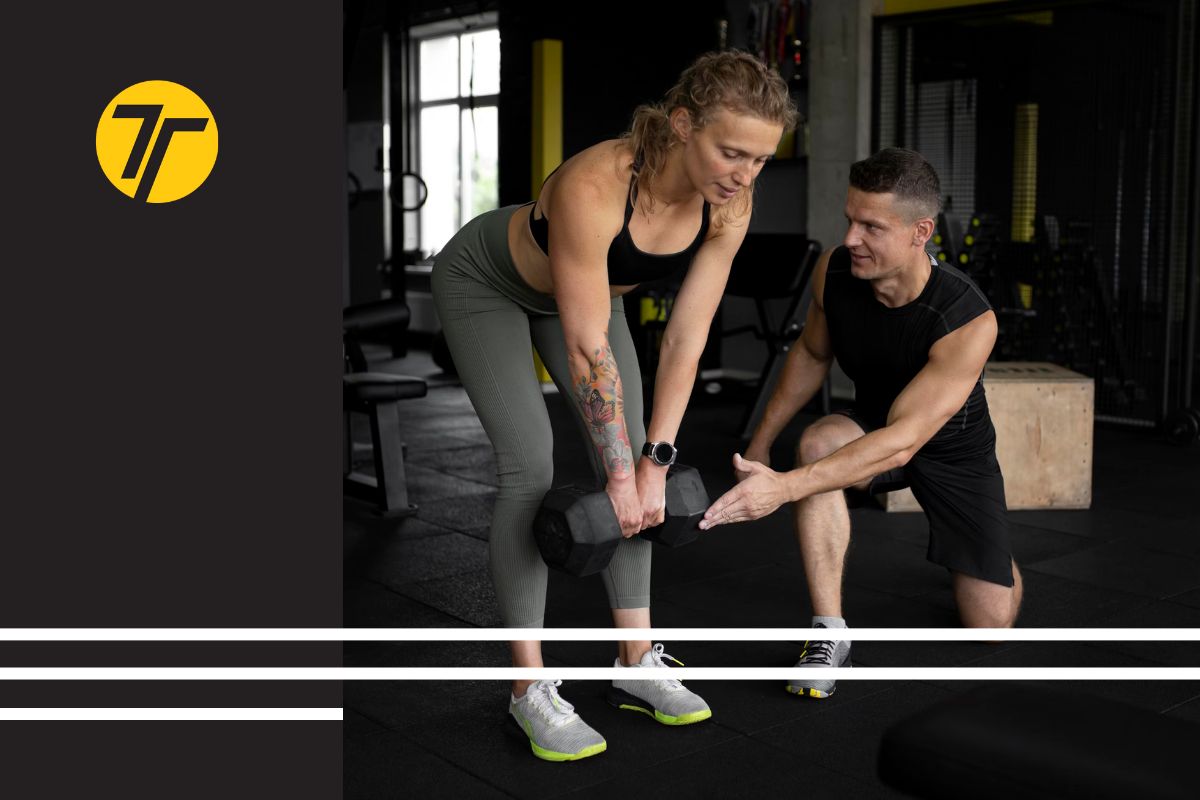
In-person training remains the gold standard for relationship building and real-time correction. But the days of paper workout cards are over.
Even if you are standing right next to your client, you should be running the session through your app. That’s because data is the differentiator. By tracking performance digitally during the session, you aren’t just counting reps; you’re building a searchable history of their progress.
This digital backbone also opens the door to Small Group Training. You can maximize your hourly yield by training four people at once, using the app to manage their individual programs simultaneously.
#2: The Hybrid Personal Training Model
This is the sweet spot for modern fitness professionals because it solves the “frequency” problem. Some clients might not afford, or don’t have time for 3-4 hours of live training a week, and 1 hour isn’t enough to get results.
Hybrid bridges the gap. You might see a client face-to-face once a week to work on complex lifts, tactile cues, or heavy compounds. Then, for the rest of the week, they execute the plan you built via your app.
You can still help them stay consistent and be present by monitoring their cardio stats from their wearable and adjusting loads based on their feedback.
📝 Free Resource: Embracing the Hybrid Model as a Gym or Fitness Studio
#3: Online-Only or Digital Coaching
If you want to remove the geographic ceiling on your income, this is the play. But let’s be clear: “Online” does not mean passive, and it definitely doesn’t mean you stop coaching form.
You can still utilize videos or video calls where clients upload their sets, and the coach provides detailed breakdowns, drawing on the screen or sending voice notes to correct posture and depth.
You can go High Touch (1:1), offering this deep technical feedback and daily accountability. Or, you can go 1:Many, selling standardized programs to hundreds of people.
In either case, you use features like two-way messaging and Smart Meal Planners to deliver a complete ecosystem of support that a generic PDF simply can’t match.
📝 Read More: 5 Reasons to Add Video Workouts to Your Personal Training Services
#4: The Subscription & Membership Model
This is the financial engine that will stabilize your business. We need to move away from transactional “packs of 10” that force you to resell your services constantly.
Think like a media company. Clients pay a recurring monthly fee for access to your coaching. But what justifies that recurring cost?
- Community: Access to private groups where clients compete and support each other.
- Engagement: Monthly Challenges and leaderboards to keep motivation high.
- Resources: Exclusive content, video libraries on mobility, recipe guides, or mindset seminars.
- Programming: Your evolving, customizable, and/or goal-based workout plans.
This shifts the dynamic from “buying an hour of your time” to “subscribing to a result and a community.”
📝 Read More: Build Strong Relationships with Clients Through Engagement & Community
#5: Specialized Add-Ons (Niche & Wellness)
Finally, stop giving away your best advice for free. If you have deep expertise, package it.
The market is moving toward holistic wellness. You can create specific add-on tracks for things like corporate wellness, post-natal recovery, or golf performance.
These don’t have to be your whole business; they can be specialized “boosters” that you offer on top of standard training to increase the “share of wallet” from every client.
📝 Read More: 7 Tried and Trusted Ways to Land New Clients
Essential Tools & Tech to Support Personal Trainers in 2026
Let’s get this out of the way: you cannot run a modern, scalable, hybrid-based personal training business without proper coaching software.
Trying to stitch Excel, WhatsApp, Venmo, Google Sheets, and MyFitnessPal into a “system” creates the exact problems you’re trying to escape: inconsistent service, lost data, messy communication, and no room to scale.
A 2026-ready business needs a central platform that pulls everything together. From there, the supporting tools become multipliers, not band-aids. Here is what that ecosystem looks like!
#1: A Central Coaching Hub to Run Your Business
Your coaching platform, like ABC Trainerize, should act like the center of your entire operation. It’s where programming, communication, client onboarding, calendars, and data live in one place. Without this, every upgrade you make later becomes fragmented.
Inside this hub, the platform handles your core essentials:
- Delivering training programs
- Tracking progress
- Storing client profiles
- Managing communication
- Assigning habits and nutrition goals
Then come integrations with wearables, health data tools, and analytics, which enhance the coaching experience. When clients sync a device like an Apple Watch or Garmin, you can see their daily movement, recovery, sleep, and effort levels. This gives you context far beyond the 3 hours a week you see them and helps you coach with precision rather than guesswork.
#2: Automation for Client Management, Payments, and Coaching Operations
Admin work is the silent killer of PT businesses. If your day is fragmented by reminders, check-ins, lost messages, and manual billing, you cannot scale.
Your personal training management software should automate the essentials:
- Payments and subscriptions so revenue is predictable
- Client reminders so they know when to check in or report
- Program delivery and updates so you aren’t rewriting plans from scratch
- Habit and nutrition tracking so clients can log behaviors without messaging you 14 screenshots
You can reinvest the hours you saved into coaching, growth, or creating new offers.
📝 Check Out: How to Automate Your Fitness Business and Work Less
#3: Digital Content Libraries that Work While You’re Offline
To break the time-for-money ceiling, you need assets that deliver value even when you’re not actively coaching.
This is where digital content comes in:
- On-demand workout libraries
- How-to video demonstrations
- Educational content
- Hybrid scheduling (online + in-person)
A strong platform lets you upload content once and deliver it at scale. It also shows you engagement data, who is watching, what they’re using, and where drop-offs happen.
This helps you refine your offer, improve retention, and build new products based on what clients actually respond to.
Pricing & Revenue Strategy: Move Beyond Hourly
Here is the mindset shift you need to make immediately: Become a price maker, not a price taker.
In the old model, the market dictated a session’s worth. If you stay in that lane, you are capped. But when you shift to a modern model, your price tag becomes a value marker. It signals to the client that they aren’t buying 60 minutes of your time; they are investing in a change in their life.
Clients are willing to pay a premium for that transformation, but you have to structure it correctly. Here is how to build a revenue model that supports sustainable growth.
#1: Value-Based and Tiered Pricing
Most trainers start with session packs because they’re simple: you sell a set number of sessions, the client uses them, and then you renew. This works well for short-term training or clients with irregular schedules, but it also means your revenue resets every time a pack runs out.
Subscription tiers work differently. Instead of selling a finite block of sessions, you sell ongoing access to coaching. Create 2-3 levels of service that allow clients to choose how much access and support they need.
- Tier 1 (Basic): Access to the app, standard programming, and community support.
- Tier 2 (Pro): Everything in Tier 1 + one in-person session per month and nutrition tracking.
- Tier 3 (Premium): Everything in Tier 2 + weekly live check-ins, deep habit coaching, and priority support.
This structure allows you to capture different segments of the market without changing your core programming philosophy.
#2: Packaging & Add-Ons to Diversify Revenue
Once you have your core tiers, look for ways to increase the value of every client without adding more workout hours.
This is where Add-Ons come in. You can package specific expertise as separate revenue streams:
- Nutrition Coaching: A monthly add-on for meal planning and macro monitoring.
- Wellness & Recovery: Selling a “Mobility & Sleep” module, for instance
- Corporate Packages: Selling a bulk membership to a local business for their employees.
By packaging these as products, you diversify your income. If a client pauses their training, they might keep their Nutrition subscription, protecting your bottom line.
Income Predictability & Long-Term Vision as You Scale
A scalable business doesn’t need to be built on Day 1, but visibility does. When you can see your income, workload, and capacity three months ahead, everything becomes easier to plan.
Whether you use subscriptions, retainers, or recurring programs, the goal is simple: create enough predictability that you’re not guessing your way through each month.
Looking for a deep dive on the numbers? Check out our Ultimate Pricing Guide for Personal Trainers to calculate your exact rates.
Personal Training Marketing, Branding & Client Experience in 2026
Today, clients already know why they should exercise. They have the baseline knowledge. The challenge isn’t educating them on health; it’s convincing them that you are the specific authority to help them achieve it.
Marketing is about building an ecosystem that communicates value, education, and inspiration. Here are the three pillars of a modern strategy.
Build a Digital Presence as Your Foundation
- Website: Think of this as your digital headquarters. It doesn’t need to be complex, but it must clearly state who you help and include strong testimonials as social proof.
- Social Media: This is where you show your personality and expertise. Use an “Edutainment” approach, educate them on proper form or nutrition while entertaining and inspiring them.
- Community: Building a community (even a simple group chat or Facebook group) turns individual clients into a tribe, increasing retention and making your brand sticky.
📝 Read More: Using Content Marketing to Grow Your Fitness Business
Emphasize Personalized Client Experience
Marketing doesn’t stop after the sale. In fact, the experience is the marketing. In a crowded market, generic plans are a fast track to high churn. You must leverage tech-assisted personalization to stand out.
A way to do so is to use data from their wearables to support them beyond the workout. If they are stressed or sleeping poorly, adjust their program.
Niche Positioning & Unique Value Proposition (UVP)
You cannot compete on price with AI-only plans, large clubs, or mass-market gyms. If you offer generic “weight loss,” you will lose to the cheapest option.
A way to stand out is through niche positioning. Be the expert for a specific problem or person, whether that’s “Strength for Seniors,” “Post-Natal Core Rehab,” or “Performance for Hyrox Athletes.”
Growth & Scaling: Building More Than a Personal Trainer Job
Scaling is all about leverage. But let’s be clear: scaling starts when you have reached income stability and realized that your clients want more of you than your calendar can accommodate.
That is the moment you must step out of the “billing by the hour” trap. To break through that ceiling, you need to use recurring models, hybrid delivery, and automation.
Here is how to expand effectively once you are ready.
#1: Expansion Routes to Earn More in the Same Time
Once you are at capacity, you have several paths to grow revenue without cloning yourself:
- Small Group Coaching: This is the easiest first step. Instead of one hour for one client, you coach four clients in that same hour. You significantly increase your hourly yield, and clients get a lower price point. It’s a win-win.
- Add-On Services: Increase the Lifetime Value (LTV) of your existing clients. Upsell them on nutrition coaching, habit tracking, or recovery programming. You are earning more from the same relationship by solving more of their problems.
- Corporate Wellness: Secure bigger contracts by selling bulk packages to companies. A single corporate contract can equal the revenue of 20 individual clients with a fraction of the admin work.
- Digital Programs: Package your methods and protocols into a standalone course or challenge. This allows you to serve the “Do It Yourself” market who might not afford coaching but wants your expertise.
📝 Read More: What Is Upselling in Personal Training? And How to Do It Right
#2: Plan for Long-Term Retention & Experience
Growth is pointless if you have a “leaky bucket.” Scaling requires a relentless focus on Client Retention and Lifetime Value.
As you grow, the risk is that the client experience becomes fragmented. You must keep the experience unified. Whether a client is doing a 1-on-1 session, a digital check-in, or a nutrition log, it should all happen in one branded ecosystem.
#3: Community Building
One of the most powerful ways to scale retention is by building a community. When clients feel like they are part of a “tribe,” they stick around longer.
Create a space where clients interact with each other, such as digital groups, leaderboards, and team challenges. When you build a culture where “everybody wants in,” the community itself becomes a retention tool.
📝 Free Resource: The Ultimate Guide to Client Retention
Risks & Considerations for PTs in 2026
Technology is evolving fast, and it’s changing how fitness businesses operate. But the biggest risks for trainers aren’t robots or algorithms; they’re strategic blind spots. As the industry shifts toward hybrid and digital-first coaching, these are the challenges to stay aware of.
#1: Tech Saturation and Commoditization
With low-cost apps and AI-generated programs everywhere, basic programming has become easy to copy. What clients can’t get from a template is context, accountability, and personalized support.
How to navigate: Use software and AI for efficiency, but anchor your value in coaching decisions, communication, and the human side of training.
#2: Workload Creep and Burnout Risk
Hybrid coaching expands a trainer’s reach, but it also adds new responsibilities: messaging, check-ins, content creation, admin, scheduling, plus in-person sessions. Without systems, this mix becomes unsustainable.
How to navigate: Set boundaries, automate repetitive tasks, and use your coaching platform to centralize client management.
#3: Quality vs. Scale
As trainers grow digitally, the temptation is to stack more clients into the system. But scaling without structure often leads to watered-down programming and weakened client results.
How to navigate: Use templates, systems, and tech to maintain quality while freeing up time for individualized decisions.
Actionable Next Steps for Personal Trainers Reading This
You have the strategy. Now, here is exactly how to execute it using ABC Trainerize as your operating system:
Audit Your Business Model
Goal: What percentage of your last month’s income was “trading time for dollars”? Shift at least 20% of your revenue to a recurring/hybrid model in the next 90 days.
Evaluate Your Tech Stack
Goal: List the tools you use and consolidate. Move payments, programming, and nutrition into one central hub. Ensure wearables (Apple Watch, Fitbit, Garmin) are synced.
Define Your Niche & “Add-On” Strategy
Goal: Create one “Add-On” service (e.g., a Habit Coaching track or a Nutrition tier) and offer it to your best clients this week as a beta test.
Build a Package Strategy for MRR
Goal: Create a “Hybrid Membership” tier, for example: 1x In-Person Session/month + Full App Programming + Monthly Call. Price it to be your reliable “base” income.
Invest in “High-Touch” Digital Presence
Goal: Create one community touchpoint (group chat, weekly challenge, live Q&A) and commit to running it for the next 8 weeks.
📝 Read More: Top 7 Ways for Personal Trainers to Earn Passive Income
The Future is Hybrid: Human + Tech
The fitness industry in 2026 is built for the trainer who thinks like an entrepreneur. Those who resist change will fall behind, but those who embrace hybrid coaching will grow with it.
Use technology to handle the data, admin, and routine. Use emotional intelligence and behavioral psychology to handle empathy, motivation, and connection. Combine the two, and you stop building a job that drains you and start building a scalable, resilient business that supports your life and your clients.
Ready to build your hybrid future? ABC Trainerize gives you the tools, from nutrition coaching and habits to automated payments and custom-branded apps, to scale without burning out.
Start your free 30-day trial below today!