
You have two options when it comes to how you build a fitness app for your coaching business. You either build one from scratch, which takes months, costs tens of thousands of dollars, and requires an app development team. Or you put your brand on a white-label fitness app builder that already includes every feature you need.
This guide walks you through both, what to look for, what it costs, and how to get your own custom fitness app live without a long wait or a five-figure budget.
Key Takeaways
- A branded fitness app puts your coaching on your clients’ home screens, drives engagement between sessions, and directly impacts retention, lifetime value, and revenue.
- Building a fitness app from scratch starts at $20,000 and climbs fast.
- For most personal trainers, a white-label platform is the faster, more affordable path to a custom fitness app.
- Not all white-label platforms are built for fitness coaching, and the feature set, pricing tier, and support model are what separate the right choice from the wrong one.
- ABC Trainerize offers three tiers for custom branded fitness app (Pro, Studio, and Enterprise), each built for a different stage of business growth, with setup handled for you.
Table of Contents
- Why Your Coaching Business Needs Its Own App
- Building a Fitness App From Scratch
- Building Your Own Fitness App With a White-Label Platform
- What to Look for in a Custom Fitness App
- How to Build Your Own Fitness App with ABC Trainerize
- FAQs
- Build Your Fitness Brand with ABC Trainerize
Why Your Coaching Business Needs Its Own App
For personal trainers ready to grow beyond the hours they have available, the missing piece is rarely programming or client acquisition. It’s having the systems that support it. Here’s what a branded app does for your business at this stage:
#1 Stand out from the competition
62% of trainers report worrying about competition from AI tools and low-cost alternatives. Having your own app in the App Store signals a level of professionalism that a social media profile simply can’t match.
A prospective client who finds your app before they’ve even spoken to you already knows this is a real business.
Read More: Brand Yourself in 2026: 8 Steps to a Strong Personal Trainer Identity
#2 Keep clients engaged between sessions
With 48% of trainers now running hybrid businesses, your app becomes the hub that holds everything together, workouts, nutrition, habits, check-ins, and messaging all in one place.
Clients who stay connected between sessions get better results, stay longer, and refer more. Mobile app engagement alone drives a 2–4% improvement in retention, and in a coaching business, that compounds fast.
#3 Break the time-for-money trap
Getting new clients can cost 5-25x more than keeping existing ones. A branded app lets you sell on-demand programs, group challenges, and memberships to your existing clients. This turns a one-time buyer into a long-term revenue stream without adding hours to your schedule.
#4 Change how clients perceive you
There’s a real difference between a personal trainer sending workouts via WhatsApp and a personal trainer who has their own app. The latter is perceived as an established business that knows what it’s doing.
Clients associate a branded app with trust, credibility, and longevity, and that perception affects how long they stay and how willing they are to pay more.
#5 Build your community on the ground you own
Social media gives you reach but not control. One algorithm change and your access to your own audience shrinks overnight.
Your app is a direct channel to your clients where you set the rules. Send workout reminders, run group challenges, message clients directly, and build a community that lives inside your brand. Nobody can take that away.
https://www.youtube.com/watch?v=5zud4wMja98&list=PLjhMGMvFU9Y_wl5JSQALmqnRCd4L2dJEM&index=1
Build vs. Brand: Two Paths to Your Own Fitness App
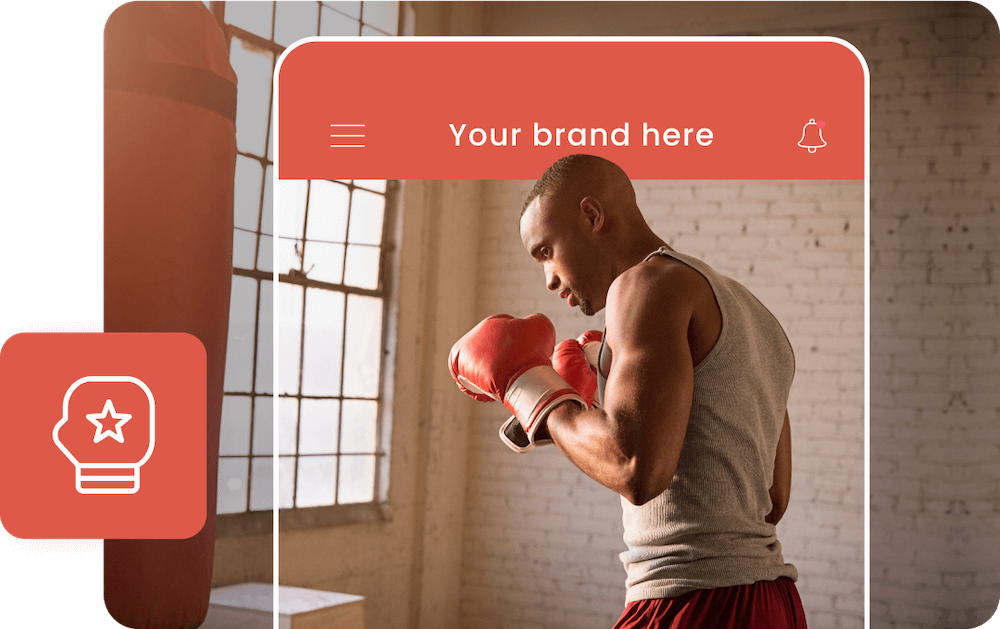
There are two ways to get a professional, branded experience for your clients. One involves building that app from the ground up. The other involves branding one that already exists. Here’s what each actually looks like:
Option 1: Building a Fitness App From Scratch
Building from scratch means hiring a team to construct your app from the ground up. At minimum, you’re looking at:
- A frontend developer to build what users see and interact with
- A backend developer to handle the data, servers, and logic running underneath it
- A UI/UX designer to map out the user experience
Custom development costs range from $20,000 on the very low end to $80,000 or more for a fully featured coaching app.
The timeline runs 6 to 12 months before you have anything live, and that’s assuming the project stays on track, which, with software, it frequently doesn’t. Scope creep, developer turnover, and shifting requirements are the norm, not the exception.
But can you shortcut this with AI?
Partially. Tools like Replit, or no-code builders like Bubble can get a basic prototype off the ground faster and cheaper.
But the moment you need workout programming, nutrition tracking, payment processing, push notifications, and App Store compliance all working together reliably, the complexity compounds fast.
Think of it this way: AI can help you put up four walls. It cannot build the whole house, stock it with equipment, and keep it running across iOS and Android updates, security patches, and bug fixes. You would still need a developer, and you would still inherit every maintenance headaches.
Simply put, for a personal trainer focused on coaching, delivering services, and building new offers, that is simply the wrong use of time.
When building a fitness app from scratch actually makes sense:
- You have proprietary AI or Hardware: If you’ve developed a computer-vision algorithm that corrects squat form in real-time and can’t hand out that code.
- You are building for an investor: If your vision is to become the next Peloton or Centr.
- You have 10,000+ active users: The “per-client” fees of white-label platforms might eventually exceed the cost of hiring your own engineering team.
- You have $100k+ in “disposable” capital: Do not build a custom coaching app with your last dollar.
Option 2: Building Your Own Fitness App with a White-Label Platform
A white-label fitness app builder gives you an app that’s already built, tested, and used by thousands of fitness businesses before yours, plus your branding wrapped around all of it. Your name, logo, brand colors, and client experience in the App Store.
Most white-label app platforms charge anywhere from $300 to $1,000+ per month, depending on the feature set and the size of your client base. That already puts them leagues ahead of custom development on cost.
But not every white-label platform is built for fitness, and within fitness, not every platform is built for coaching. A generic app builder can give you a branded shell. It cannot give you workout programming logic, habit tracking, nutrition coaching, and client check-ins that all work together the way a coaching business actually runs.
The specifics matter because your clients’ experience inside the app is your product. If the platform was not built specifically for coaching, the gaps show up fast.
Read More: Best White Label Coaching Apps 2026
What to Look for in a Custom Fitness App: 8 MUST HAVE Features of a Great Fitness Coaching App
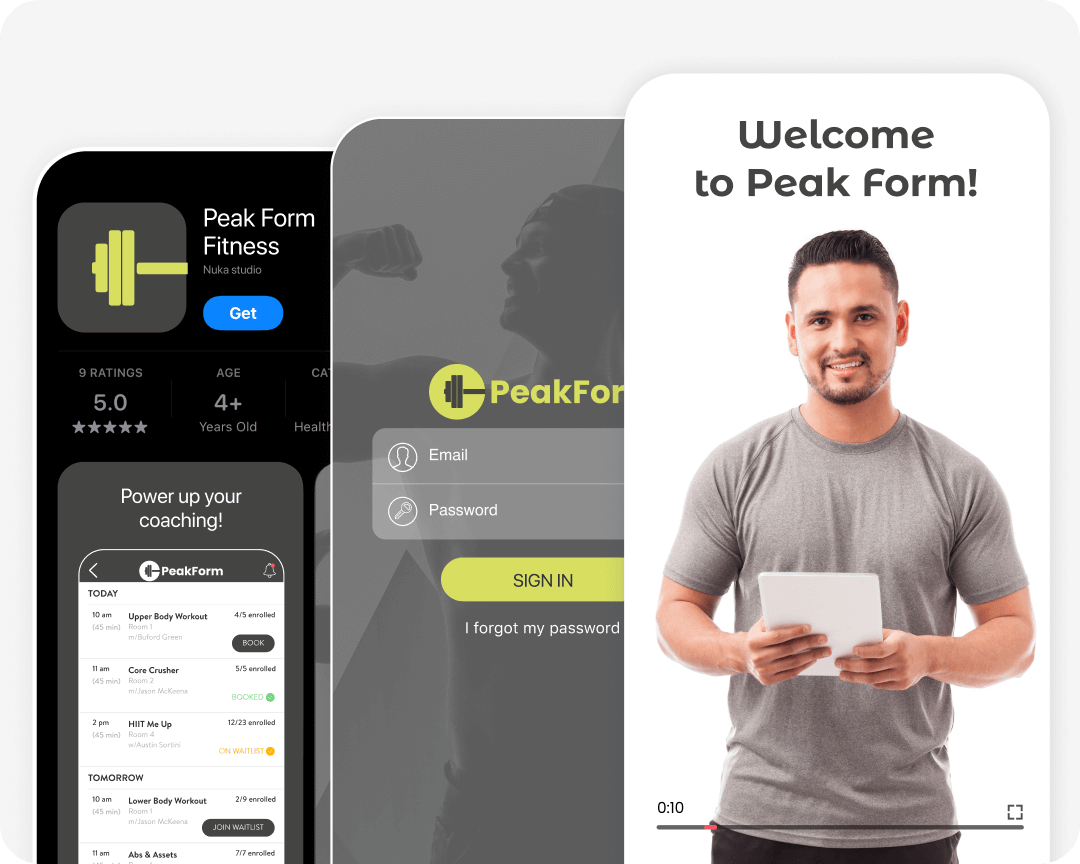
Choosing the right custom fitness app comes down to one question:
“Does this platform actually understand how fitness coaching works, or did a general software company bolt on a workout feature after the fact?”
Here’s what matters when you’re evaluating your options:
#1 Workout and nutrition programming built in from the ground up
Your clients should be able to receive, log, and track workouts and nutrition inside the same app they use to message you and check in, not through a third-party tool, not an add-on you pay extra for. It should all live in one place natively.
Bonus points if it has an AI-powered workout builder or smart meal planning.
#2 In-app messaging and client communication
Email is too slow, and WhatsApp is too personal. Your app needs a messaging layer that keeps every client conversation inside your branded environment, check-in reminders, progress follow-ups, form feedback, and onboarding sequences all in one place.
When a new client signs up, they should be walking into a structured experience from day one, not waiting on a voice note.
#3 Habit and lifestyle coaching tools
Hybrid and lifestyle coaching is no longer a differentiator; it’s what clients expect. The trainers who retain clients longest aren’t just delivering workouts; they’re coaching behavior.
Look for a platform that lets you assign and track habits, lifestyle check-ins, and wellness tasks alongside the physical programming. Think, step goals, hydration, bedtime routines, and nutrition check-ins alongside the physical programming.
#4 Integrated payments and scheduling
Automated billing allows memberships to renew automatically, and failed payments get retried without you sending a single follow-up message. But you also need seamless scheduling so a client can book a session, join a challenge, or purchase a program without leaving the app.
When buying and booking happen in the same place your clients already train, the barrier to saying yes is as low as it gets, and that shows up directly in your conversion and renewal rates.
Check Out: Automated Billing System: 5 Reasons to Switch
#5 Progress tracking and check-in forms
Your app should give you more than workout completion data. Custom check-in forms are non-negotiable. Sleep, energy, recovery, nutrition adherence, all of it should be schedulable automatically so clients get a prompt when it’s time to report in, without you having to chase anyone.
Progress photos, body measurements, and wearable sync should all live in the same client profile.
#6 Custom branding that goes all the way through
Partial branding, where your logo sits inside someone else’s interface, undermines the professional signal you’re trying to send.
Check exactly what each tier of branding includes before committing, because not all white-label coaching apps offer the same depth of customization.
#7 On-demand content delivery
Beyond live and hybrid coaching, your app should let you host and deliver pre-built programs, video libraries, and challenge content to clients who aren’t on a one-on-one plan. This is the feature that makes passive revenue possible, and it’s worth confirming it’s included, not locked behind a higher tier.
#8 No coding required, with setup support included
This one isn’t negotiable, either. If the platform requires technical knowledge to get your app live, it’s the wrong platform for a coaching business. The best options handle the build, the App Store submission, and the ongoing maintenance for you.
How to Build Your Own Fitness App with ABC Trainerize
ABC Trainerize has published over 25,000 custom branded fitness apps for fitness businesses of all sizes.
The setup is handled end-to-end by the ABC Trainerize team. You submit your brand assets, they build the app, manage the App Store submission, and get it live on iOS, Android, and web under your business name.
Your clients open the app and get everything: your workouts, nutrition, habits, check-ins, messaging, payments, and scheduling, all under your brand. Your icon, your colors, your name on their home screen. And every time ABC Trainerize rolls out a new feature or update, it shows up in your app automatically. Nothing extra on your end.
As coach Mike Monti put it after launching his own:
“I invested in the custom branded app version of ABC Trainerize and it has helped me look more professional to potential clients who see that I have my own Mike Monti Fitness app.”
Check Out: 8 Proven Online Fitness Business Models to Learn From in 2026
Three tiers are available depending on where your business is:
| Pro | Studio | Enterprise | |
| Best for | Independent coaches | Growing studios and established coaches | Multi-location gyms and franchises |
| Price | $169 one-time fee | Included in Studio plan | Included in the Enterprise plan |
| Setup | Self-serve | Full-serve | Full-serve |
| Revisions | 0 | 1 round | 3 rounds |
| Apple App Store listing | Shared with ABC Trainerize | Your own | Your own |
| Google Play listing | Your own | Your own | Your own |
| Custom icon + branding | Yes | Yes | Yes |
| Custom in-app theme | Default | Yes | Yes |
Not sure which tier is right for you? The Custom Branded App purchase guide breaks it all down, no guessing, no back and forth.
FAQs
-
Can I create my own fitness app?
Yes. You can build one from scratch, which has a high cost and takes time, or go with a white-label platform that launches a custom branded fitness app under your name. For most trainers, the second option is the best choice.
How much does it cost to build your own fitness app?
Building from scratch can cost from $20,000 to $80,000 or more once you add workout programming, nutrition tracking, messaging, and payments. Through ABC Trainerize, the Pro-level custom branded fitness app runs a one-time fee of $169, plus a $99 annual Apple Developer fee paid directly to Apple.
-
Why should personal trainers build their own fitness app?
A branded app puts your coaching on your clients’ home screens, opens up revenue streams beyond one-on-one sessions, and gives you a direct channel no algorithm can cut off. It also changes how clients perceive your business.
-
What’s the difference between building from scratch vs. using a white-label platform?
Building from scratch gives you full control but also full responsibility, cost, timeline, maintenance, and compliance all land on you. A fitness app builder like ABC Trainerize gives you fitness-specific infrastructure and your branding on top, at a fraction of the cost and timeline.
-
How does a custom branded fitness app help with client retention?
A custom fitness app keeps your workouts, check-ins, habit tracking, and messaging in one place so clients stay connected to your coaching beyond the hour they spend with you. Clients who engage with their coach between sessions stay longer, get better results, and refer more.
-
Is it worth building a fitness app for a small coaching business?
Yes, if you have a stable client base, a clear methodology, and ambitions beyond one-on-one sessions. The Pro-level app is built for independent coaches at exactly that stage, with a low entry cost and a setup process that only requires your brand assets and an existing subscription.
Build Your Fitness Brand with ABC Trainerize
Getting your own fitness app was never really about technology. It’s about giving your coaching business the infrastructure to show up professionally, retain clients longer, and grow beyond the hours you have available.
ABC Trainerize has published over 25,000 custom branded apps for fitness businesses of all sizes, from independent coaches establishing their first branded presence to franchises managing dozens of locations. The platform handles the build, the support, and every update after launch, so your time stays on what actually moves your business forward.
The trainers who build their business on owned digital infrastructure are the ones who stop trading hours for money. Your app is where that starts. Try ABC Trainerize for free.